
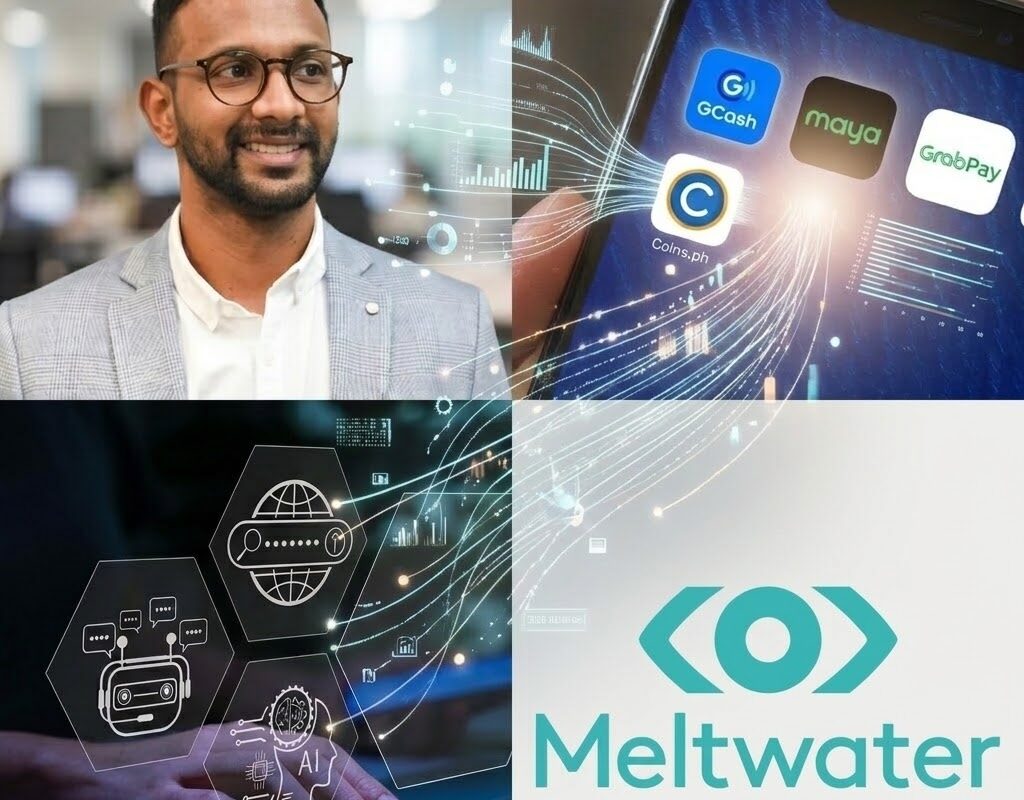
Ask an AI chatbot which e-wallet Filipinos should consider, and the answer may depend on which chatbot you use. That is one of the findings from a month-long Meltwater analysis of how artificial intelligence platforms surface Philippine e-wallet brands.
GCash and Maya had the strongest overall visibility, posting scores of 72 and 71, respectively. But the numbers also show a less obvious difference between the two: Maya was mentioned around 1,800 times during the analysis, compared with about 1,300 mentions for GCash.
These results were discussed with FintechNewsPH in an exclusive interview with Ram Bojeesh, Meltwater’s SEA and India Country Manager, who said the findings point to a growing challenge for banks and fintech companies trying to make themselves visible in AI-generated answers.
Unlike a conventional search engine, an AI chatbot does not simply return a list of websites. It pulls information from different sources and uses that material to formulate an answer.

Ram Bojeesh, Country Manager of Southeast Asia and India
That makes the question of visibility more complicated.
A fintech company may have a strong website and plenty of online content, but that does not necessarily mean it will appear when a consumer asks an AI platform about e-wallets, digital banks or financial products.
One AI platform can see a brand very differently from another
Global Meltwater data found significant differences in how the major AI platforms surfaced e-wallet brands.
Grok gave both GCash and Maya their highest visibility scores. Meta Llama, on the other hand, gave them substantially lower scores.
The sources used by the platforms also varied.
Claude and Google AI Mode relied heavily on Maya’s website when answering e-wallet-related prompts, while ChatGPT and Grok cited GCash’s website more frequently.
Bojeesh said these differences are partly a result of how individual AI models select and process information.
“Every AI model has a different algorithm, with varying ways of selecting where it takes its content from,” he said.
That means there is no single content strategy that guarantees visibility across all AI platforms.
A company that is frequently surfaced by Google AI Mode, for example, may not receive the same treatment from ChatGPT, Grok or Meta Llama.
Meltwater’s monitoring also found that the sources favored by AI platforms can change. In May 2026, Claude leaned more heavily toward data-focused sources such as Statista, while ChatGPT more frequently drew from sources including Wikipedia.
For fintech companies, keeping track of these differences could become just as important as monitoring conventional search rankings.
Smaller e-wallets have a harder time getting into the conversation

The gap becomes more noticeable among smaller players.
GoTyme, CIMB and SeaBank (Maribank) were much less visible in Meltwater’s analysis than GCash and Maya. These brands appeared in Google AI Mode and AI Overviews, but were largely absent from the other AI platforms monitored.
That does not necessarily say anything about the quality of their products or how many Filipinos use them. It does, however, show how difficult it can be for a smaller financial brand to become part of the information that AI models draw on.
It also gives companies clues about where to concentrate their efforts.
If a brand is already appearing in Google’s AI responses, for example, it can look at the topics and questions behind those mentions and develop content that addresses them more directly.
The same applies to third-party sources.
“If Facebook content is regularly being cited, that could signal an opportunity to strengthen their presence and content on that channel,” Bojeesh said.
The content AI cites does not always come from the brand
Another finding could be particularly relevant to fintech communications teams.
Meltwater found that social media accounted for 19.7% of the sources cited in AI responses, with Reddit and Facebook among the leading platforms.
Earned media accounted for another 19%.
FintechNews Philippines ranked fourth overall among the sources cited in the e-wallet analysis.
That matters because much of what an AI platform says about a financial brand may come from somewhere other than the company’s own website.
A fintech can control the information it publishes on its website, but it has much less control over what customers discuss on Reddit, what appears on Facebook or how a media organization describes its products.
“AI is drawing on a much wider information ecosystem to form its responses,” Bojeesh said.
For communications teams, that puts a different emphasis on the work of building a brand online. Media coverage, social conversations and other third-party references can all contribute to the picture an AI model forms.
AI sees e-wallets as more than payment apps
IMAGE CREDIT: Magnific
The analysis also offers a clue about how AI platforms understand the e-wallet category itself.
Among the words that appeared frequently in the responses were “interest,” “savings,” “fees” and “cash.”
That is notable because e-wallets are often associated primarily with payments and money transfers.
The AI responses suggest a broader view. E-wallets are also being discussed in the context of saving money, earning interest and managing cash.
For fintech brands, that raises another question: Is the way a company describes itself online the same as the way AI understands the brand?
A company may emphasize payments in its own marketing, for instance, while information from its website, news coverage and social media discussions may lead an AI model to associate it more strongly with savings or other financial services.
Maya’s strong showing in the analysis illustrates the point. The brand operates across several financial services rather than fitting neatly into a single e-wallet category, yet it remained highly visible in e-wallet-related AI queries.
GEO is becoming a communications issue for fintech
The findings are also changing the conversation around generative engine optimization, or GEO.
For traditional search, companies have spent years optimizing their websites around keywords, links and other factors that can influence search rankings.
AI-generated answers work differently.
The model may draw information from a company’s website, but it can also use news reports, social media posts, online discussions and other third-party material.
That makes GEO partly a communications and reputation exercise.
“If certain media outlets are frequently cited in e-wallet answers, those publications may warrant greater PR focus,” Bojeesh said.
The same thinking can apply to social platforms and online communities. If an AI model repeatedly draws from discussions on a particular platform, fintech companies can examine what people are asking and talking about there.
The objective is not simply to produce more content. It is to make sure that the information available across those channels is accurate, useful and easy for AI systems to understand and connect to the brand.
The question is no longer just whether a fintech brand can be found
The shift matters because consumers are already using AI tools to research products and make decisions.
Instead of opening several search results and comparing websites, a consumer can ask an AI platform a direct question and receive a summarized response.
That response can influence which financial brands the consumer looks at next.
Bojeesh pointed to the growing use of AI as a reason fintech companies should start paying closer attention to how they appear in these answers. He cited estimates that AI could put 20% to 50% of traditional search traffic at risk, while more than 1 billion people globally already use AI each month.
For Philippine banks and fintech companies, the challenge is therefore becoming more specific.
It is not enough to know whether a brand has a strong search presence. Companies also need to understand which AI platforms are mentioning them, what those platforms are saying, and where the information behind those answers is coming from.
For GCash and Maya, the Meltwater findings show that strong brand visibility can extend into AI-generated answers, although not uniformly across platforms.
For smaller players such as GoTyme, CIMB and SeaBank, the results highlight how much room there is to build that presence.
And for the broader fintech industry, the lesson may be a simple one: the digital audience is no longer searching only for links. Increasingly, it is asking AI to make sense of them.