
As communities in parts of Mindanao dealt with the aftermath of a powerful earthquake, PLDT Enterprise, together with PLDT and Smart, deployed Starlink satellite connectivity and emergency communications support to help keep hospitals, local government units and response teams connected.
The telecommunications companies sent field and operations teams to affected areas, including General Santos City and several municipalities in South Cotabato, to assess network facilities and support restoration efforts.
PLDT and Smart said most of their network facilities in the affected areas remained stable and operational. Disruptions were largely linked to commercial power outages that affected some network sites.
Where communications infrastructure was affected, PLDT Enterprise deployed Starlink connectivity to provide an alternative link for emergency operations.
Among the sites supported were the Malungon Sarangani Provincial Hospital and Alabel Sarangani Provincial Hospital, as well as command centers and rescue operation centers involved in coordinating the disaster response.
“During emergencies, connectivity becomes deeply personal. It allows people to reach loved ones, enables responders to coordinate more effectively and helps communities begin the difficult work of rebuilding,” said Menardo “Butch” G. Jimenez Jr., chief operating officer of PLDT.
The deployments were carried out in coordination with the Department of Information and Communications Technology (DICT) and local government units in the affected areas.
Keeping responders connected
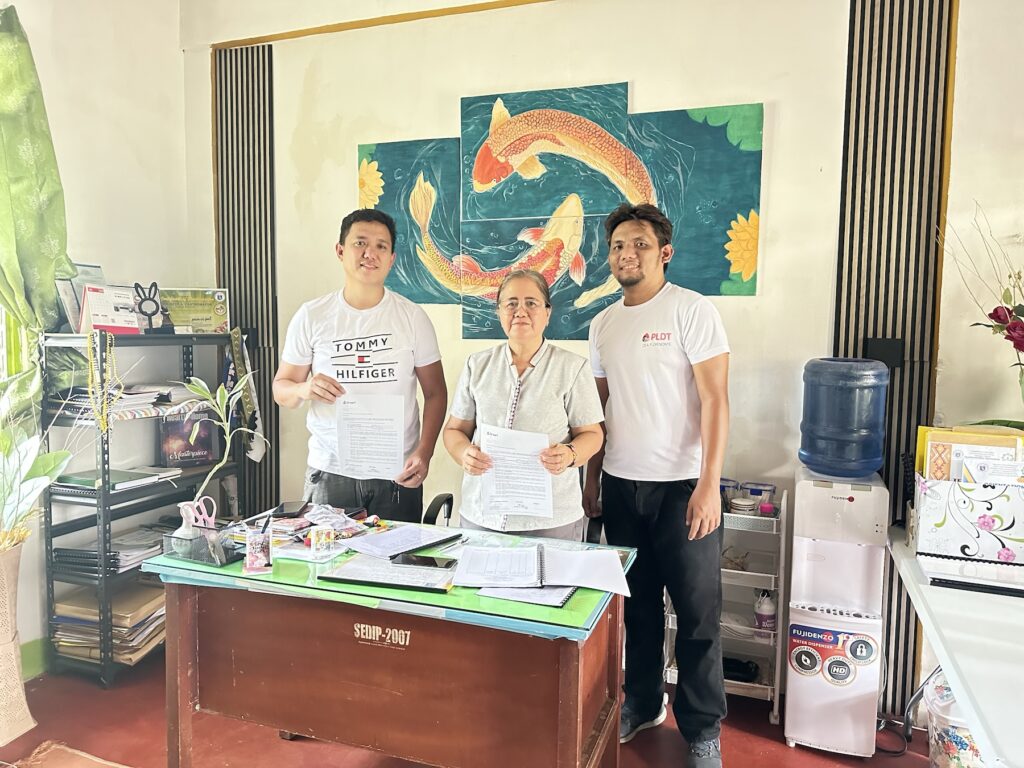
PLDT Enterprise representatives turn over connectivity support documents to local government officials in Mindanao.
For PLDT Enterprise, the Mindanao deployment also highlighted the role of satellite connectivity in disaster situations where conventional communications infrastructure can be affected by power interruptions, physical damage or difficult terrain.
“We strive to be the first responders for the first responders because restoring connectivity at the front line of a disaster can be a powerful force multiplier,” said Blums Pineda, senior vice president and head of the Enterprise Business Group at PLDT Enterprise.
Pineda said response teams were mobilized to assess requirements, restore services and provide connectivity in areas where it was most needed.
“The faster we reconnect communities and response teams, the sooner every call, every update, and every connection can help make a difference,” he said.
Starlink Satellite Broadband was used as part of the connectivity response, giving hospitals, command centers and other emergency operations an additional communications option while affected areas worked through network and power disruptions.
The deployment comes as disaster response agencies and local governments increasingly rely on communications networks not only to coordinate rescue and relief operations, but also to keep communities informed and connected with family members.
For telecommunications providers, maintaining connectivity during such events can therefore be as important as restoring physical infrastructure.
PLDT Enterprise said it will continue working with PLDT, Smart and local partners as affected communities transition from immediate response to recovery and rebuilding.
The company said its broader disaster-response efforts are aimed at providing rapidly deployable connectivity to institutions and communities facing disruptions caused by disasters, power outages and geographic constraints.
For Mindanao communities recovering from the earthquake, the immediate priority remains restoring normal services and supporting recovery operations. But the deployment also underscores a practical reality during disasters: when terrestrial infrastructure is disrupted, having another way to get connected can make a significant difference on the ground.