The Department of Science and Technology’s Technology Application and Promotion Institute (DOST-TAPI) is putting greater emphasis on commercialization, market access, and operational readiness as it looks to help more Filipino technologies move beyond research and become sustainable businesses.
The direction took center stage during the morning sessions of the Lunduyan 2026, held on August 10, 2026, in Pasay City, where government officials, financial institutions, industry leaders, investors, inventors, and technology entrepreneurs discussed what continues to prevent promising Philippine innovations from reaching scale.
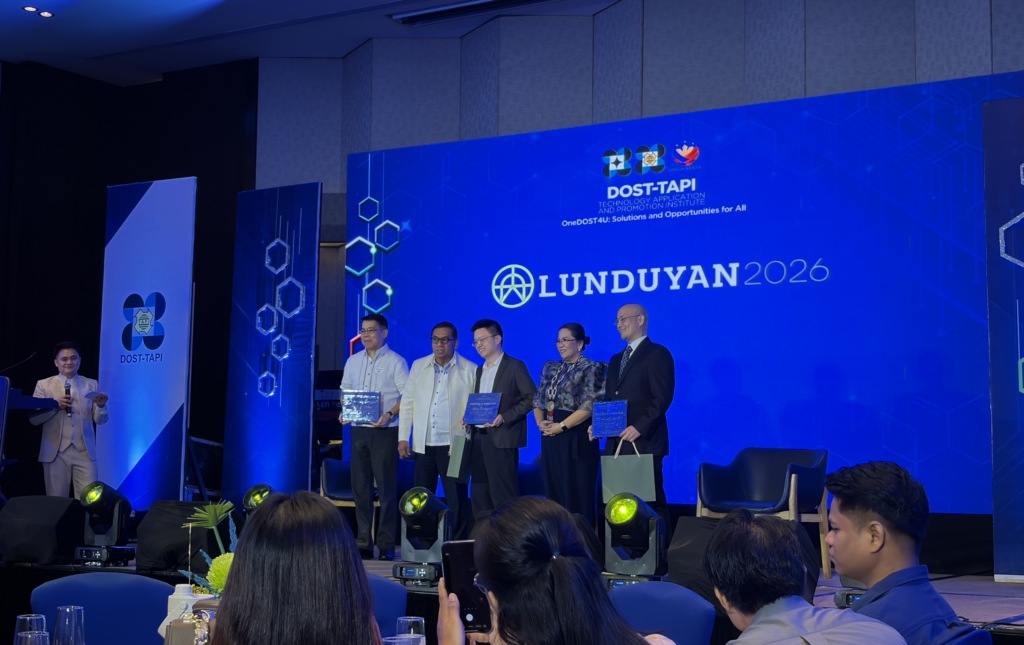
Organized by DOST-TAPI, Lunduyan brought together stakeholders involved in financing, developing, commercializing, and bringing Filipino technologies to market. The event was positioned as a convergence of collaborators, partnerships, and opportunities for local innovators.
But across the morning discussions, one message repeatedly surfaced: having good technology is only the beginning.
Filipino innovation must move beyond the laboratory
In his message of inspiration, DOST Secretary Renato U. Solidum, Jr. pointed to the experience of Manila HealthTek as an example of how government-backed research can progress toward commercial use when innovators are supported through different stages of development.
The company grew from work on accessible diagnostic technology into a broader portfolio of healthcare solutions, supported through DOST programs for technology commercialization, manufacturing, and international market entry. Solidum used the example to underscore the need for institutional support that does not stop after research or prototyping.
DOST-TAPI is also working on an investment portfolio that would organize Filipino technology ventures across sectors such as agriculture, ICT, green technology, and renewable energy.
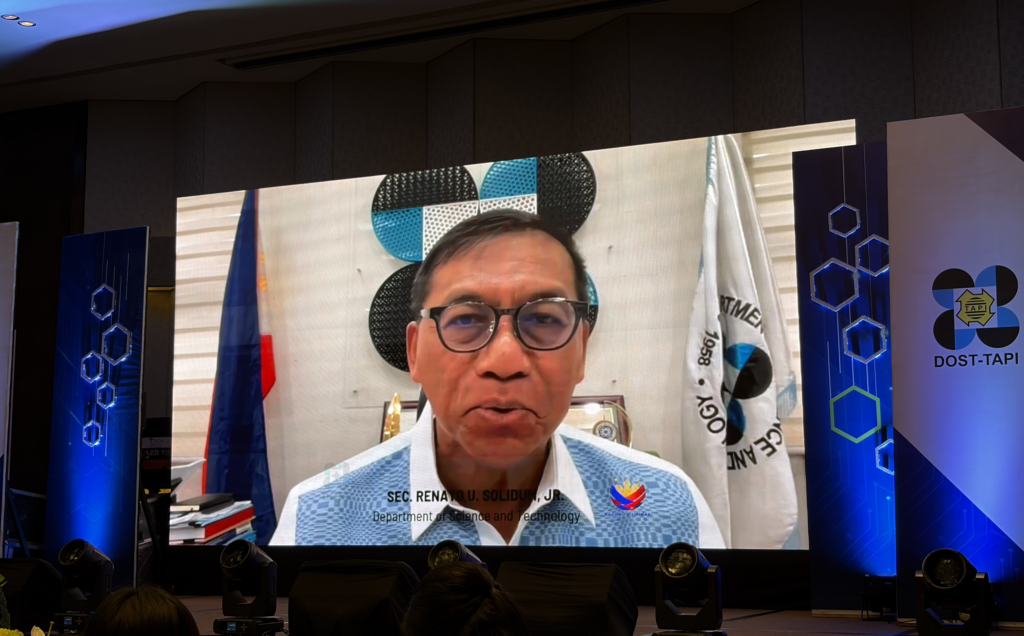
DOST Secretary Renato Solidum, Jr. shares the experience of Manila HealthTek in his inspirational speech
Instead of relying solely on startup pitches, the planned portfolio is intended to provide potential partners with information relevant to investment decisions, including a company’s financial status, funding stage, and capitalization requirements. The approach could help make local ventures easier for investors to evaluate and compare.
LANDBANK: Funding helps, but it cannot fix a weak business
Access to capital remains one of the most visible challenges.
Ronaldo R. Averion, assistant vice president of the Program Management Department at LANDBANK of the Philippines, said innovators need financing as they move from prototype to production, particularly for equipment, facilities, hiring, intellectual property protection, regulatory compliance, and business expansion.

LANDBANK and DOST-TAPI currently work together on the Innovation and Technology Lending Program, or iTECH, which supports Filipino inventors and technology developers seeking to commercialize patented technologies and innovative products.
Averion, however, stressed that capital by itself does not guarantee commercialization.
Innovators must also understand the customers they are trying to serve, identify the problem their technology solves, and build an actual business around that solution. An invention may work inside a laboratory, but its economic value ultimately depends on whether people, companies, farmers, factories, hospitals, or other users are willing to adopt it.
The open forum also exposed another financing problem facing technology companies: collateral.
Representatives from LANDBANK and DOST-TAPI discussed how intellectual property may form part of collateral arrangements, although the difficulty of properly valuing patents remains a challenge. Other assets, including receivables or contracts, may also be considered depending on the financing arrangement.
Philippine startups need their first serious customers
Funding was not the only gap identified during the summit.
Ray Anthony R. Chua III, board member of the Federation of Filipino-Chinese Chambers of Commerce and Industry, Inc., argued that established businesses have an important role to play by becoming customers, mentors, investors, and connectors for younger companies.
For an early-stage startup, securing a major corporate customer can provide something that another accelerator or pitch competition cannot: proof that someone is willing to pay for the technology.
Chua said the Philippine startup ecosystem also continues to face constraints, including limited growth-stage capital, regulatory friction, the concentration of networks and support in Metro Manila, and a shortage of people with experience scaling companies across markets.
He encouraged founders to think internationally much earlier in the startup journey. Building only for the Philippine market could eventually make overseas expansion more difficult if the product was never designed to solve a problem shared by customers outside the country.
Emerging industries will require more than low-cost labor
The commercialization push is happening as the technologies themselves become more complex.
Dr. Danilo C. Lachica, president of the Semiconductor and Electronics Industries in the Philippines Foundation, Inc. (SEIPI), highlighted the growing role of semiconductors in artificial intelligence, connected devices, data centers, advanced communications, electric vehicles, robotics, smart manufacturing, digital healthcare, and clean energy.
But competing in these industries will require the Philippines to strengthen talent development, research and development, infrastructure, supply chain resilience, and sustainability.
Lachica warned that competing primarily on low-cost labor is no longer enough. As advanced manufacturing and emerging technologies reshape industries, the country will increasingly need to compete through technical capability, innovation, quality, and higher-value work.
That concern resurfaced during the panel discussion when participants raised the potential impact of artificial intelligence on jobs.
Speakers argued that businesses and workers will have to learn how to use AI rather than treat it solely as a future threat. As repetitive tasks become easier to automate, maintaining workforce relevance will increasingly depend on education, adaptability, and the ability to perform higher-value work.
Local technology also has to become trade-ready
For startups that successfully find a market at home, the next challenge is expansion.
Kelvin Ka-shing Lit, managing director of Censpot Trading Corporation, discussed how international business networks and startup ecosystems such as Hong Kong could serve as bridges for Philippine ventures seeking customers, investors, and commercialization opportunities outside the country.
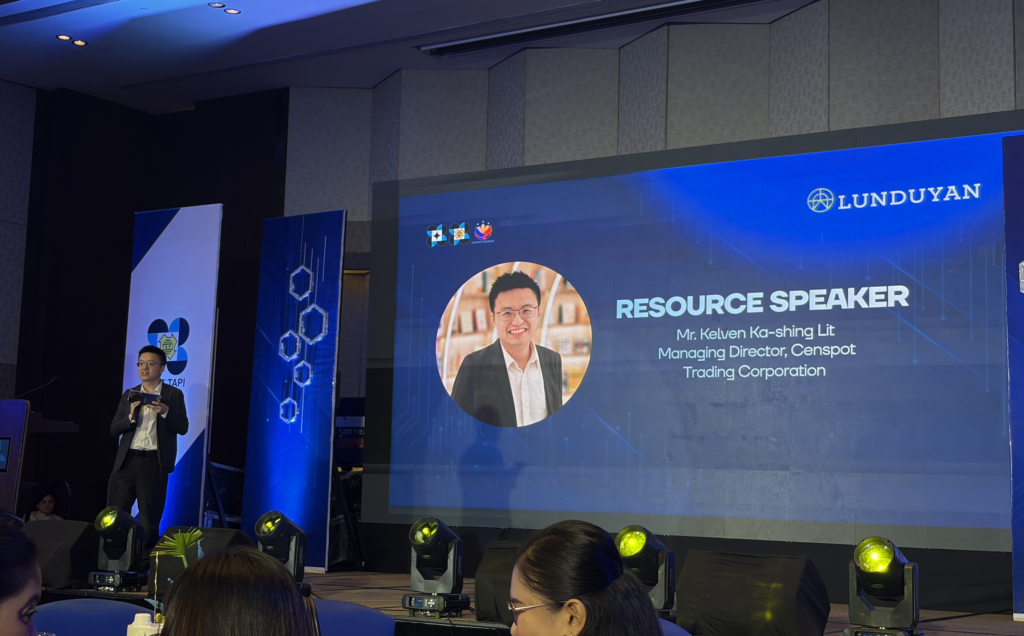
During the open forum, Lit said commercial readiness does not always require a startup to already have hundreds of customers. For a business-to-business company, landing a credible institutional customer and demonstrating that adoption can grow over time may already provide investors with an important signal that the product has moved beyond experimentation.
The implication for founders is significant. International expansion begins well before entering another country. A startup first has to prove that someone needs its technology, that customers will pay for it, and that the business can repeatedly deliver what it sells.
Can the startup survive if demand suddenly jumps 10 times?
Dr. Albert Causo, CEO and co-founder of Hand Plus Robotics, ended the morning program by shifting the conversation away from one of the startup sector’s most common complaints: lack of funding.
Instead, he challenged founders to consider a more difficult operational question: if orders suddenly increased tenfold, what part of the company would break the following morning?
The question cuts into the difference between a startup that can attract attention and one that is genuinely ready to scale.
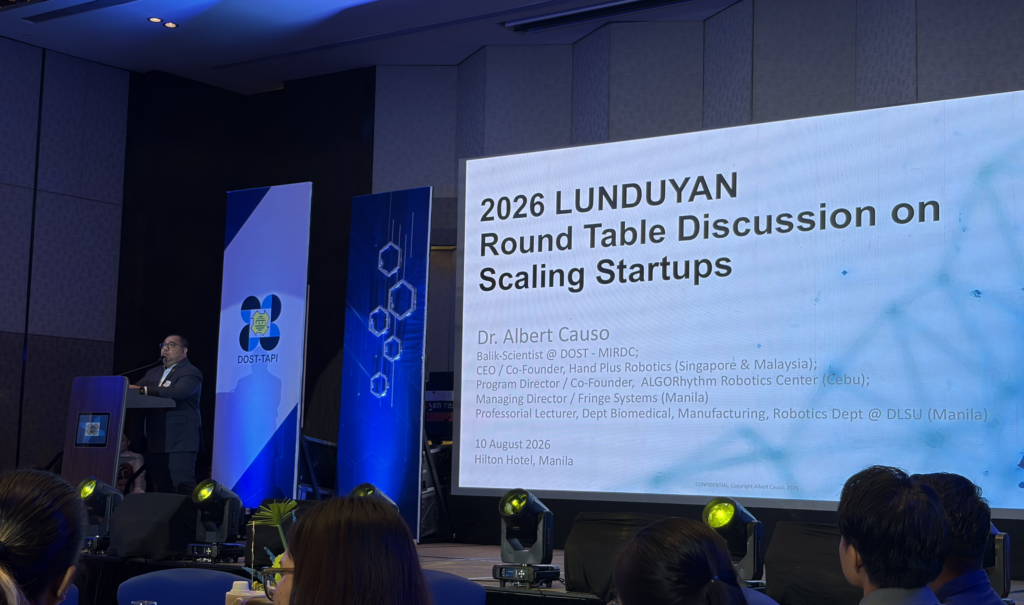
A surge in orders can expose problems in production, staffing, logistics, cash flow, customer support, procurement, or management. If those systems cannot cope with growth, obtaining more investment may simply magnify existing weaknesses rather than solve them.
That became perhaps the clearest takeaway from Lunduyan’s morning discussions.
The Philippine innovation challenge is no longer only about producing more ideas or making more funding available. The harder work is building companies that can win paying customers, withstand rapid growth, attract capital on credible terms, and eventually take Filipino-developed technology beyond the domestic market.
For DOST-TAPI and its partners, helping more innovators cross that gap could determine whether the next generation of Philippine technologies remains inside laboratories and pilot projects or becomes part of a much larger commercial economy.