


As mobile apps become the primary vault for how Filipinos save, spend, and borrow, cybersecurity is shifting from invisible backend infrastructure into a core pillar of the daily customer experience.
Speaking at the recent BusinessWorld Cybersecurity Summit, executives from digital banking giant Maya emphasized that keeping users safe now requires a three-pronged strategy: putting direct control into consumer hands, building operational resilience across enterprises, and modernizing regulatory frameworks to keep pace with evolving threats.
Putting security in the user’s hands

Kristoffer Rada, Head of Corporate Affairs at Maya
Rather than relying solely on passive safeguards, Maya has increasingly integrated fraud prevention into its user interface.
Beyond background biometric checks and automated transaction monitoring, the platform allows users to instantly lock or unlock physical and virtual cards via the app. To curb e-commerce fraud, its credit cards feature dynamic CVVs that rotate periodically, rendering leaked card details useless for prospective scammers.
“For us in Maya, cybersecurity is not some back-office product—it’s really part of the product,” said Kristoffer Rada, Head of Corporate Affairs at Maya. “As more people depend on digital financial services every day, maintaining trust becomes a responsibility shared by financial institutions, regulators, government, and the broader ecosystem.”
Rada stressed that policy frameworks must shift toward outcome-based, risk-neutral standards rather than rigid, tech-specific mandates that risk becoming obsolete as new tech emerges.
With cyber threats cutting across banking, telecommunications, and law enforcement, Maya continues to coordinate closely with regulatory and enforcement bodies, including the Bangko Sentral ng Pilipinas (BSP), the Cybercrime Investigation and Coordinating Center (CICC), the Department of Justice (DOJ), and the Philippine National Police (PNP).
Resilience beyond IT
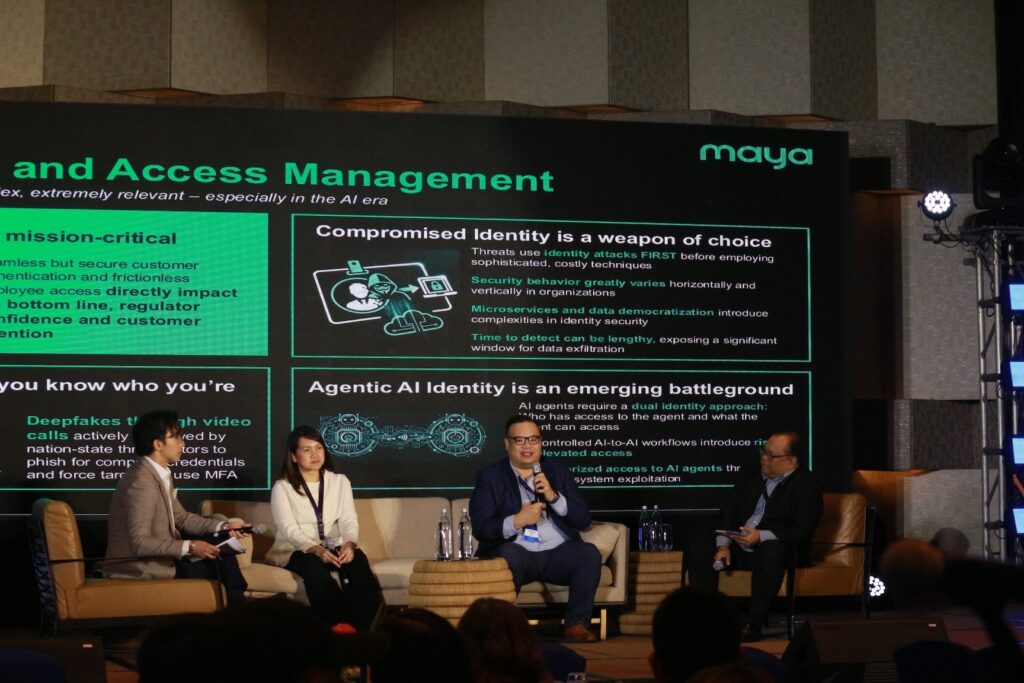
Maya Director of Information Security Jan Martin Encina (second from right) speaking at the BusinessWorld Cybersecurity Summit
Complementing consumer-facing controls is the internal push for enterprise-wide resilience. Jan Martin Encina, Director of Information Security at Maya, noted that cybersecurity can no longer be treated merely as an isolated IT responsibility.
“Cybersecurity is no longer just an IT issue; it is a business imperative, a national security priority, and a fundamental component of public trust,” Encina noted.
Encina pointed out that human targets remain a prime vector for financial cybercrime, as fraudsters increasingly combine technical exploits with social engineering. Building resilience, he argued, demands continuous threat monitoring, stringent identity management, and persistent public education to counter psychological tactics.
As cyber threats grow in sophistication across Southeast Asia, Maya’s multi-layered approach highlights a broader industry shift: digital security is no longer just about preventing breaches, but about actively engineering trust into every swipe, tap, and transfer.