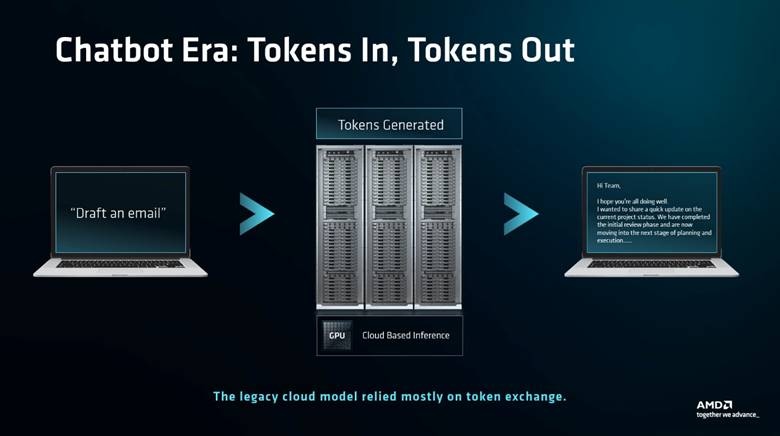
For the first wave of generative AI, the interaction model was simple: tokens in, tokens out. A user entered a prompt, a model processed it, and the response appeared on screen. Most of the visible work happened during inference, often on a cloud GPU.
That model is now changing.
AI agents can read files, execute code, use client-side applications, call tools and complete multi-step tasks. In this new era, inference remains important, but generating tokens is only the first step.
The new model is: Tokens in. Actions out.
From answering questions to completing tasks
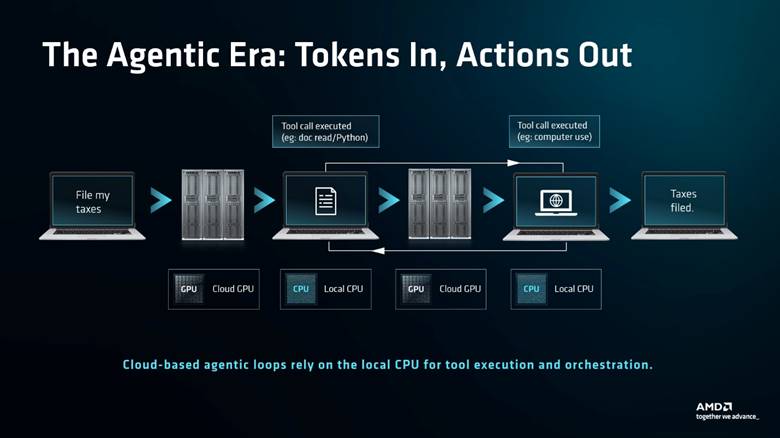
Consider the difference between asking an AI assistant how to file your taxes and asking an agent to help file them. The first task is largely a language problem. The second may require the agent to open documents, extract data, perform calculations, interact with software and validate the result.
This creates a continuous loop. The model decides what to do next, the agent calls a tool, the client CPU executes the action, and the result is sent back to the model.
Many of these actions take place on the user’s computer. Reading local files, running Python, compiling code, searching a project directory and controlling applications all depend heavily on the client system.
As a result, agent performance is no longer defined only by how quickly a model generates tokens. It also depends on how quickly the computer can turn those tokens into useful work.
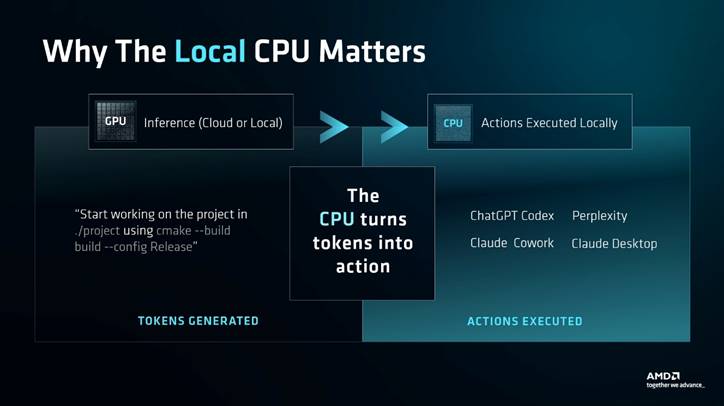
The local CPU turns tokens into action
Inference determines the next step. The CPU helps execute it. When an agent launches a process, parses a file, runs a command or coordinates several workers, the CPU handles much of the execution and scheduling. Even when AI inference runs on a GPU or NPU, the CPU keeps the wider workflow moving.
This becomes more important as agents take on larger tasks. A chatbot might generate one response, but an agent may perform dozens of operations before completing a request. More advanced systems can also launch multiple subagents in parallel, each reading files, running commands and processing results simultaneously.
In these workloads, CPU performance can directly affect tool execution, compilation, local data processing, application responsiveness and total task completion time. A fast model cannot deliver its full value if every action is waiting for the client.
Built for agentic workloads
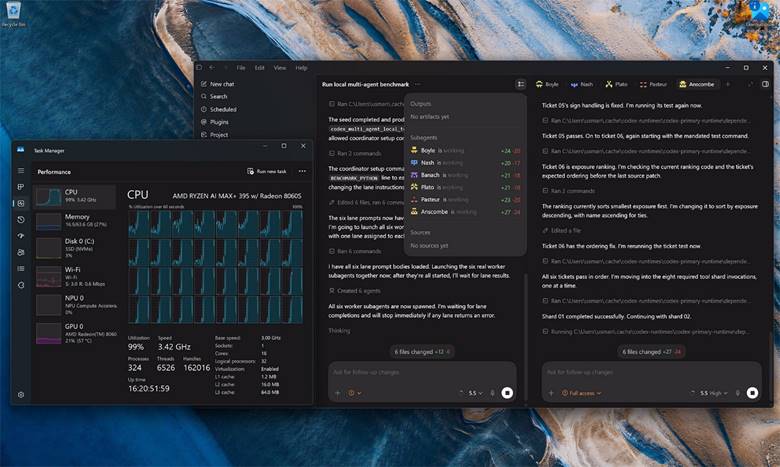
As models become faster and more token-efficient, local execution can represent a larger share of the overall AI workload.
AMD has used a tool-heavy Codex developer workflow to illustrate this shift. The testing involved six concurrent ChatGPT 5.5 High agents, with each agent performing multiple tasks across AST and static analysis, compile and import smoke tests, unit-style execution, JSON and CSV serialization, SQLite queries, compression and hashing, package and manifest operations, and other mixed local-tool workloads using a Python-based testing harness.
According to AMD’s testing, an ASUS ProArt system powered by an AMD Ryzen™ AI Max+ processor delivered up to 6x the CPU throughput of a four-year-old laptop in the multi-agent developer workflow.
The comparison is presented by AMD as evidence that CPU performance can become increasingly important as AI agents perform more work across local files, applications and developer tools.
For readers evaluating the claim, however, the 6x result should be viewed in the context of AMD’s specific test setup rather than as a universal performance comparison. The published test description identifies the workload as a six-agent Codex workflow and describes a Python-based harness, but the performance figure depends on the systems, configurations and workload used in the testing.
The broader point is less about a single benchmark number and more about how agentic workloads change the balance between processors.
The takeaway is straightforward
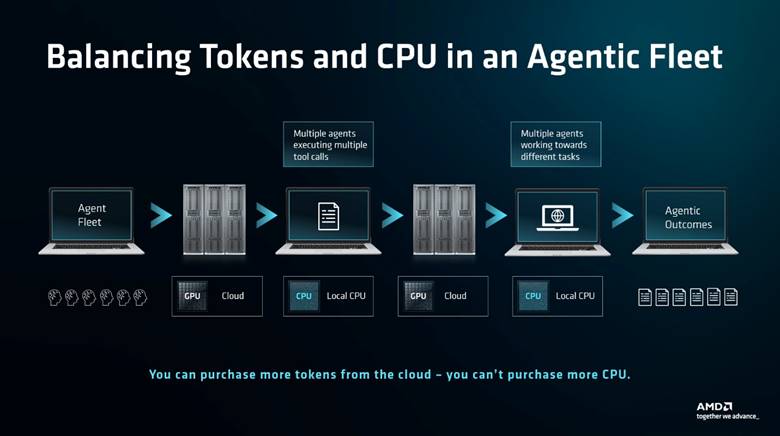
As AI moves from generating responses to operating applications and completing tasks on a device, client hardware becomes an active part of the intelligence loop.
Cloud GPUs may run the largest models. Local GPUs and NPUs can accelerate private and responsive inference, but the CPU provides the execution environment agents need to act.
AMD has similarly argued that agentic AI changes the traditional CPU-GPU equation because agents require additional orchestration, data processing and tool execution around model inference. In data-center environments, the company says CPUs increasingly handle tasks such as orchestration, API and application calls, security checks, memory and data movement.
Whether running on a client PC or in the data center, CPUs provide an important part of the execution environment that transforms model outputs into real-world actions. AMD Ryzen AI and AMD EPYC occupy different parts of that broader computing continuum.
Ultimately, the meaningful measure of an AI agent is not simply how quickly it generates tokens, but how quickly it completes the task.
Network conditions and cloud inference speed will always influence the experience. But once an agent begins reading files, running code, using applications and coordinating tools, local execution becomes a critical part of total time to completion.
In the agentic era, the question is no longer simply how fast AI can generate an answer. It is how quickly the entire system can turn that intelligence into useful work.
—
DISCLAIMER: This is a contributed article. The performance claims and testing results cited in this article are based on testing conducted or reported by AMD and have not been independently verified by FintechNewsPH. The views expressed are those of the author/company and do not necessarily reflect those of FintechNewsPH.