

Reaching a record-high 75 out of 100 in 2026, the Philippines’ Credit Perception Index shows that Filipinos are becoming more familiar and comfortable with credit, even as inflation and rising living costs continue to weigh on their financial outlook.
This latest TransUnion study — its fourth annual edition in the Philippines — found that the overall score increased to its highest level since tracking began in 2023.
Stronger favorability, product trust, and product knowledge among Filipino consumers drove the improvement.
Conducted from May 6 to 26, 2026, the survey gathered insights from 1,000 respondents to examine how Filipinos perceive, use, and plan to engage with credit and financial products.
Credit confidence rises despite economic pressures
IMAGE CREDIT: TransUnion
The record CPI score comes against a backdrop of softer financial confidence.
Only 64% of Filipinos expected their financial situation to improve over the next three months, down three percentage points from 2025. For the next 12 months, 73% expected their finances to improve, also down three points.
Inflation, rising living costs, and energy prices remained the biggest concerns affecting consumers’ expectations.
Despite this cautious outlook, Filipinos continued taking steps to strengthen their financial position. Saving remained the most common planned action, cited by 86% of respondents.
Financial education also gained importance, with 73% planning to access educational materials, up five percentage points. Meanwhile, 70% planned to explore new digital products and fintech services, while 66% intended to use a broader range of financial products.
More Filipinos are using financial products
The rise in the Philippines Credit Perception Index coincides with continued growth in financial product ownership.
eWallets remained the most widely held financial product among Filipinos, with 80% reporting ownership, up four percentage points from 2025.
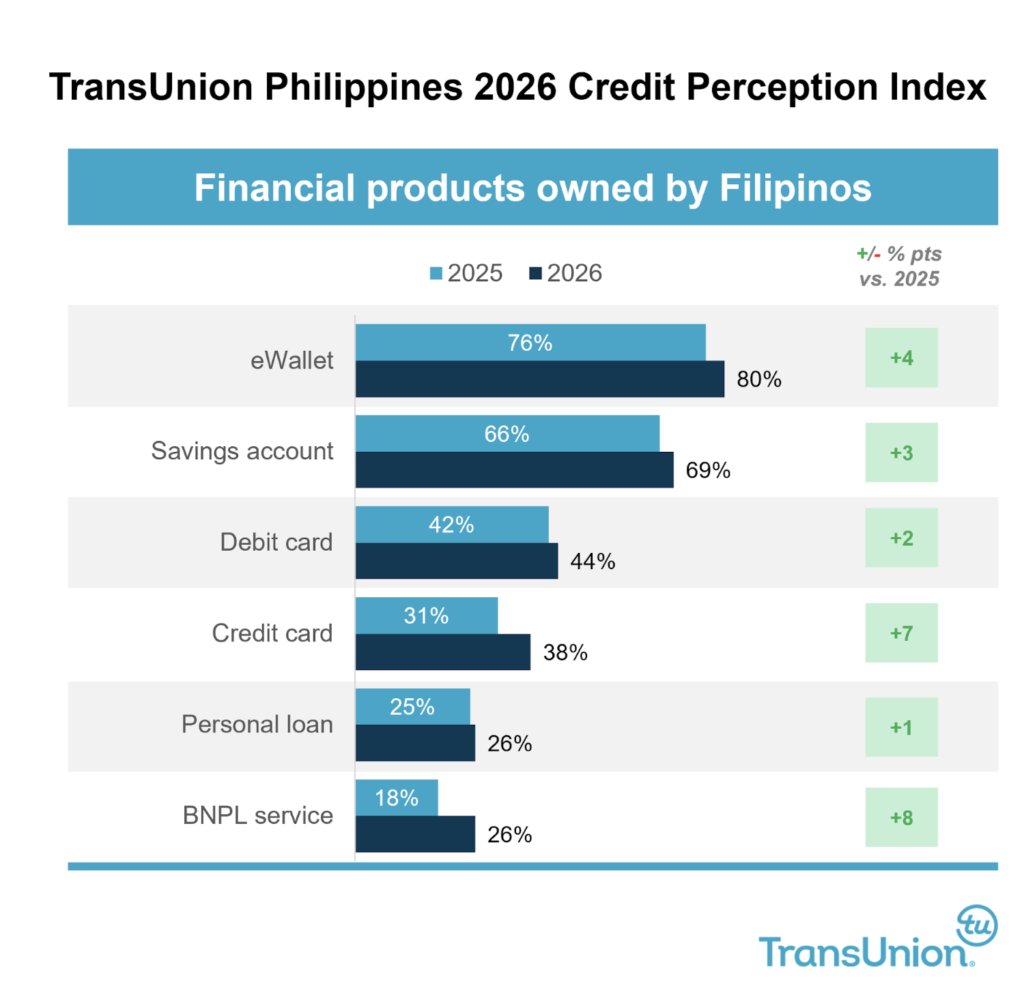
BNPL services recorded the strongest growth in adoption, increasing eight percentage points to 26%. Credit card ownership also rose significantly, reaching 38%, up seven points from the previous year.
Personal loan adoption increased slightly to 26%.
The numbers indicate that Filipinos are not simply becoming more aware of financial products. They are also increasingly incorporating different forms of credit and digital finance into their financial lives.
Digital banks gain momentum
Digital banks emerged as one of the strongest areas of growth in the latest study.
Future borrowing intent increased by 11 percentage points for digital banks, the biggest increase among the financial institutions measured by TransUnion. Traditional banks followed with an eight-point increase, while credit cards gained six points.
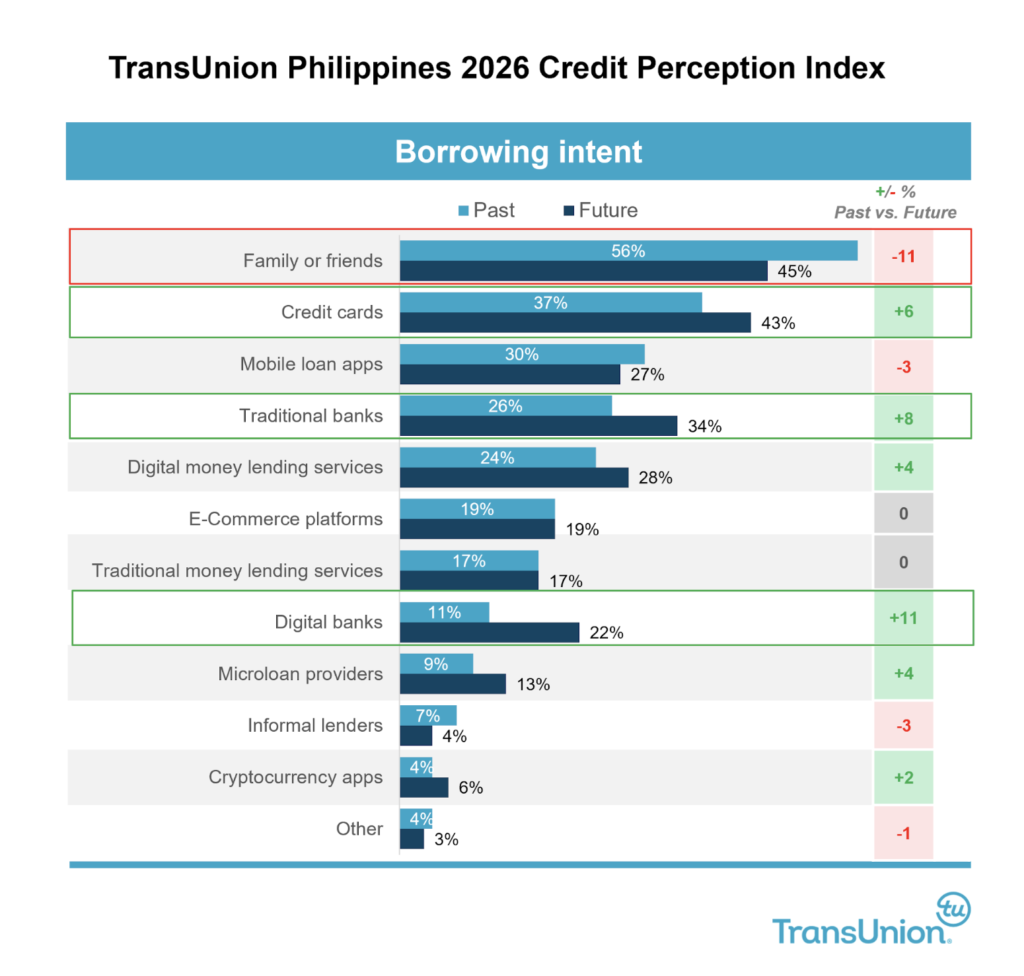
At the same time, borrowing from family and friends became less preferred. Intent to borrow from this informal source declined 11 percentage points to 45%, its lowest level since the CPI began in 2023.
More than half of Filipinos, or 52%, said they already use a digital bank.
Consumer perceptions of digital banks also improved substantially. Knowledge of digital banks increased 15 percentage points to 80%, while favorability climbed 14 points to 79%.
Perceived safety rose 11 points to 84%. Although traditional banks remained ahead at 88%, digital banks recorded stronger gains across the measured perception factors.
Why Filipinos use credit
Credit continues to serve practical financial needs rather than being viewed solely as a tool for discretionary spending.
Emergency expenses were the most common reason Filipinos used credit products, cited by 59% of respondents. Personal expenses followed at 50%, while 45% said they used credit for family expenses.
The study also found that 43% of consumers intended to borrow or use credit for purchases in the near future, an increase of five percentage points from 2025.
This continued increase suggests that credit is becoming a more accepted part of household financial planning, even as consumers remain conscious of economic pressures.
Trust depends on clearer information
Despite growing confidence in credit, information remains a major barrier to wider adoption.
One in four Filipinos said they have difficulty finding information about credit and financial products. Among those who reported difficulties, 60% were uncertain about which sources to trust, while 44% found available information too complex or confusing.
The findings highlight an important challenge for banks, fintech companies, and other financial institutions. Making products available is only part of financial inclusion. Consumers also need to understand how products work, what they cost, and what risks they carry.
Transparency was identified as the strongest driver of trust, cited by 56% of respondents. Fair or low interest rates followed at 53%, while strong security and fraud protection ranked third at 52%.
The next stage of financial inclusion
The latest Philippines Credit Perception Index points to a financial market where consumers are becoming more knowledgeable and increasingly willing to engage with formal financial services.
TransUnion Philippines President and CEO Peter Faulhaber said the improvement in credit confidence despite economic challenges indicates a maturing credit market and creates opportunities to expand access responsibly.

For financial institutions, the challenge will be maintaining that trust as more Filipinos move toward digital banks, formal borrowing, and new financial products.
Greater access will need to be matched by responsible lending, transparent pricing, stronger fraud protection, and financial education.
As Filipino consumers become more open to credit, the next measure of progress may not simply be how many people borrow, but whether they have the information and protection needed to borrow responsibly.