Metrobank is giving customers more control over their digital money as new app safeguards aim to slow down scammers, verify recipients and protect funds from unauthorized transfers.
The Ty-led bank is adding another layer of friction to digital banking as scams increasingly target customers through phishing, account takeovers and other forms of social engineering.

Metropolitan Bank & Trust Co. has introduced four security features to its mobile app, including a 24-hour transaction freeze after critical account changes and a new Money Lock feature that allows customers to set aside funds that cannot be transferred until they are deliberately unlocked.
The move comes as banks face growing pressure to protect customers from fraud that does not necessarily involve hacking the bank’s systems, but instead tricks customers into surrendering access to their accounts.
According to the Bangko Sentral ng Pilipinas (BSP), social engineering attacks, including phishing, account takeovers and identity theft, accounted for 76% of reported cyber fraud losses in 2025.
Metrobank puts a 24-hour pause on critical changes
One of Metrobank’s new measures is a Cooling-Off Period, which automatically disables transactions through the app for 24 hours after certain critical security changes are made. These include changes to a customer’s password or registered device.
The idea is straightforward: if a fraudster manages to take control of an account and immediately changes its security settings, they cannot instantly proceed with transactions.
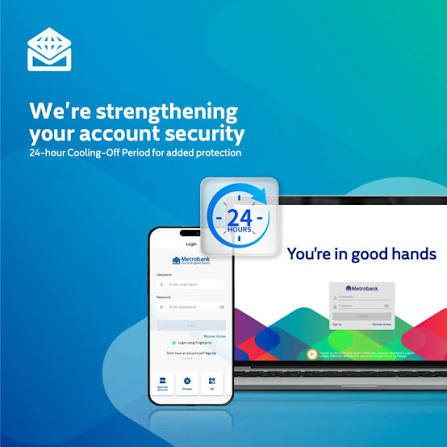
The 24-hour window gives the legitimate account holder time to notice something is wrong and report the incident before money can be moved. This approach effectively adds a delay between gaining account access and being able to use that access to transfer funds. For customers, that extra time could become an important line of defense against account takeover scams.
Money Lock keeps funds out of reach
Metrobank is also introducing Money Lock, which lets customers lock part or all of their available balance so it cannot be transferred or used for transactions. Customers can unlock the funds themselves when they need to use them.
This creates a separation between money that is immediately available for everyday spending and money that a customer wants to keep protected. For example, customers could leave only the amount needed for upcoming bills or purchases unlocked while keeping the rest of their savings locked.
Metrobank cautions customers to keep enough funds unlocked for scheduled payments and other transactions. The feature is particularly relevant in an environment where gaining access to a banking app can potentially give scammers access to a customer’s available balance.
Even if a fraudster manages to gain access to the customer’s card or account, money placed under Money Lock remains protected until the customer unlocks it.
Metrobank checks where transactions are coming from

The bank is also adding geolocation checks to its security controls. The feature compares transactions against the customer’s registered device and its location, allowing unusual activity to be flagged in the background.
The additional layer is designed to help Metrobank identify transactions that may not fit a customer’s normal activity. It also reflects a broader shift in banking security from simply asking whether a user has successfully logged in to assessing whether the transaction itself makes sense.
Customers get another chance to check recipients
Another safeguard, Payee Verification, focuses on the person or account receiving the money. Before a transfer to another Metrobank account is completed, the app displays a masked version of the recipient’s registered name.

This gives customers another opportunity to spot a wrong or suspicious recipient before sending the funds. The feature addresses a common risk in digital transfers: customers may be tricked into sending money to an account controlled by a scammer or accidentally transfer funds to the wrong recipient.
By putting recipient information directly into the transfer flow, Metrobank gives users an additional checkpoint before the transaction goes through.
Why slowing down transactions can matter
Digital banking is designed to make money move quickly. But that same speed can work against customers when a transaction is fraudulent. Once a scammer gains access to an account, every second can matter. A fast transfer can give victims little time to realize that their account has been compromised. Metrobank’s new safeguards take the opposite approach by deliberately slowing down certain activities.
The 24-hour Cooling-Off Period introduces a delay after high-risk account changes, while Money Lock allows customers to proactively restrict access to part of their balance. Together, the features are designed around a simple principle: not every transaction needs to happen instantly.
Security is becoming part of the banking experience
Metrobank’s move also shows how digital banking security is evolving from something that happens mostly behind the scenes into something customers can actively control. Features such as Money Lock allow users to make security decisions based on how they manage their money. Someone who keeps most of their savings untouched, for example, can lock those funds while leaving only their spending money available.
This could become increasingly relevant as more Filipinos shift their savings, bills and everyday transactions to mobile banking apps. At the same time, banks are operating under stronger regulatory expectations around fraud and scams, including measures related to the Anti-Financial Account Scamming Act and BSP Circular No. 1213.
The human factor remains the biggest target
The new features do not eliminate the need for customers to protect their credentials.
Phishing and social engineering attacks work by manipulating people into giving scammers the information they need, rather than simply breaking through a bank’s technical defenses. That means customers still need to be cautious about links, messages, calls and requests for passwords, one-time passwords and other sensitive information. What Metrobank’s latest tools add is another layer after those defenses.
If a scammer does manage to get through, the bank’s strategy is to create additional barriers that could prevent immediate movement of funds. The latest security upgrades are now available to customers who update to the latest version of the Metrobank App. As Philippine banking becomes increasingly digital, the competition among financial institutions is no longer only about who can make transactions faster. It is also about who can make digital money safer without making banking unnecessarily difficult.
Metrobank’s latest features suggest that the next generation of banking security may involve a little more friction, but with the goal of giving customers something equally valuable: time to stop a scam before the money leaves the account.