Every few months, headlines about a “digital peso” resurface in the Philippines, often creating the impression that the Bangko Sentral ng Pilipinas (BSP) is preparing to launch a new digital currency for everyday consumers.
That is not what the central bank is building.
The BSP’s current digital currency initiative is focused on a wholesale central bank digital currency (CBDC) — designed for financial institutions and large-value transactions rather than consumers paying for coffee, shopping online or sending money to friends.
That distinction matters because a retail CBDC and a wholesale CBDC solve very different problems.
And the Philippines has already demonstrated that it can move most of its payments into the digital world without either one becoming a consumer product.
Retail vs. wholesale: What’s the difference?
A retail CBDC is essentially central bank money designed for the public to hold and use for everyday payments.
Think of it as a digital version of a banknote that could sit in a digital wallet and be used to pay merchants, transfer money or settle transactions.
A wholesale CBDC, on the other hand, is intended for use by banks and other financial institutions.
Consumers would not hold it, and it would not appear as another payment option on their smartphones.
Instead, it could be used behind the scenes to make financial transactions between institutions faster and more efficient.
That is where the BSP’s Project Agila comes in.
Project Agila isn’t a digital peso for consumers
IMAGE CREDIT: BSP
Project Agila is the BSP’s wholesale CBDC proof-of-concept, designed to explore how central bank money could improve interbank settlement and wholesale financial transactions, including transactions involving tokenized assets.
The project is therefore aimed at the financial system’s infrastructure rather than the consumer payments experience.
In other words, Project Agila isn’t a new e-wallet, a replacement for cash or a digital peso that Filipinos can download to their phones.
That distinction is important because the Philippines already has a relatively mature retail digital payments infrastructure.
The Philippines digitized payments without a CBDC
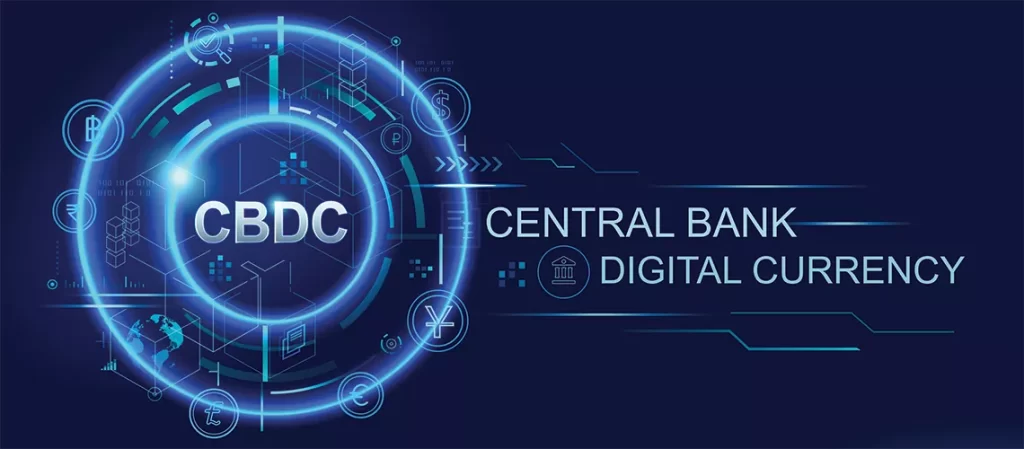
IMAGE CREDIT: BSP
In an analysis published by Forbes, payments expert Zennon Kapron argued that the Philippines took a different path from countries that placed central bank digital currencies or super apps at the center of their digital payments strategies.
Instead, the country built shared, interoperable payment infrastructure and allowed private companies to compete on top of it.
The results are difficult to ignore.
Digital payments accounted for 52.8% of retail payment transaction volume in 2023, allowing the BSP to hit its 50% target a year ahead of schedule. The share increased to 57.4% of transaction volume in 2024, with digital payments accounting for 59% of transaction value.
The growth continued as the country’s two main retail payment rails — InstaPay and PESONet — handled increasingly large volumes.
According to data cited by Kapron, InstaPay and PESONet collectively processed ₱24.745 trillion across 4.773 billion transactions in 2025, with the combined transaction count more than tripling from the previous year.
InstaPay alone processed about 4.656 billion transactions, representing a 231% increase year on year.
Those numbers point to something more fundamental than the arrival of a new form of money: Filipinos are already using digital payment infrastructure at enormous scale.
The rails did the heavy lifting
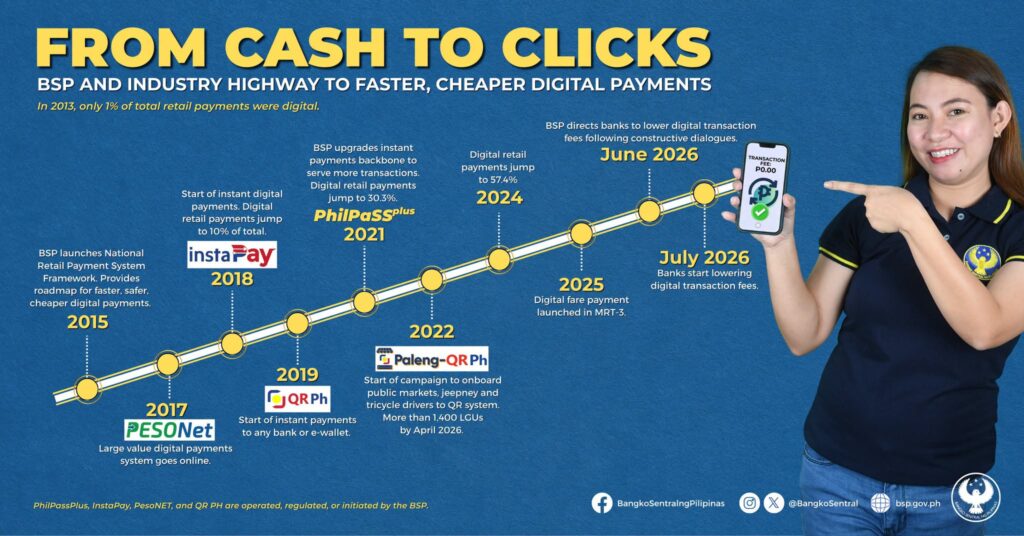
IMAGE CREDIT: BSP
The engine behind much of that growth is the BSP’s National Retail Payment System, which provides the infrastructure for interoperable digital payments.
InstaPay handles near-real-time, low-value fund transfers, while PESONet provides electronic fund transfers that are processed through batch clearing.
Then came QR Ph, the national QR code standard that made it easier for customers using different banks and e-wallets to pay participating merchants.
That interoperability is critical.
A consumer does not need to use the same financial app as a merchant simply because that merchant accepts QR Ph. A wallet user can pay a participating merchant using another bank or e-wallet, while funds can move between participating financial institutions through shared payment rails.
This is fundamentally different from a closed ecosystem in which customers and merchants have to remain inside one platform.
Kapron’s analysis makes this the central lesson of the Philippine experience: the state built the plumbing, then allowed private companies to compete over the customer experience.
So why does the Philippines need another retail currency?
That is the question at the heart of the digital peso debate.
The usual argument for a retail CBDC is straightforward: create a faster, cheaper and more accessible way for people to move money digitally.
But many of those problems are already being addressed by the country’s existing payment rails.
InstaPay allows consumers and businesses to transfer money digitally, while QR Ph provides a standardized payment interface across participating banks and wallets.
The BSP and Philippine Payments Management Inc. (PPMI) have also continued adding new services to the country’s digital payments infrastructure.
For consumers, another form of digital money would therefore have to offer a meaningful advantage over systems they already use.
Kapron contrasts this with China’s experience with the e-CNY. Despite years of development, the central bank digital currency has remained relatively small compared with the country’s established private payment platforms.
The lesson is not necessarily that CBDCs cannot work.
It is that issuing a new form of digital money does not automatically create demand when consumers already have convenient payment tools.
The super-app route isn’t the Philippine model either
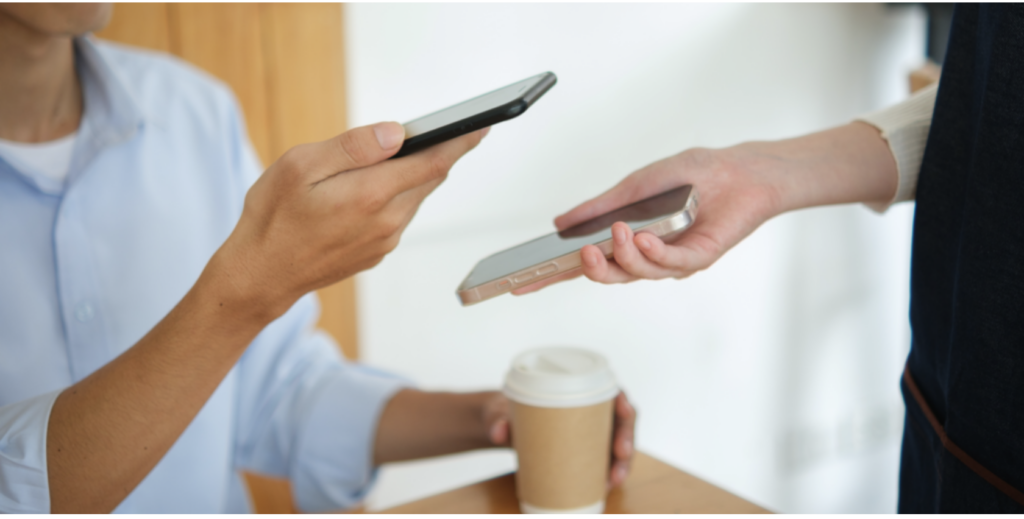
IMAGE CREDIT: Visa
There is another important distinction.
The Philippines did not digitize payments by creating one dominant platform.
Instead, companies such as GCash and Maya have competed for users, merchants and deposits while relying on interoperable payment infrastructure underneath.
That means competition takes place largely at the customer-experience layer — through products, pricing, features, lending, savings and other financial services — while the underlying payment rails remain shared.
It is a structure that allows consumers to use different financial providers without completely losing interoperability.
That may be one reason the Philippine payments ecosystem has been able to expand without requiring a single “super app” to control the customer relationship.
The infrastructure is now moving beyond the Philippines
The same principle is beginning to extend across borders.
The Philippines has been participating in regional efforts to connect instant-payment and QR payment systems, including work involving QR Ph and Singapore’s PayNow, as well as the BIS-backed Project Nexus, which aims to link domestic instant-payment systems across countries.
The objective is familiar: standardize the connections, make the systems interoperable and allow financial institutions to build services around them.
For the Philippines, that has particular significance because cross-border payments and remittances are a major part of the financial system.
The country’s digital payments strategy is therefore no longer just about replacing cash at local stores. It is increasingly about making money move more efficiently between banks, wallets, merchants and countries.
Where the real tokenization story is happening
This does not mean tokenization is irrelevant.
It simply means the most interesting developments may be happening behind the consumer interface rather than inside a retail digital peso.
Project Agila is exploring wholesale CBDC applications, including the use of distributed ledger technology for financial settlement.
At the same time, banks and financial institutions are exploring stablecoins, tokenized assets and other forms of digital value.
That is where the distinction between retail and wholesale CBDCs becomes particularly important.
Consumers may never see the underlying technology.
But banks could eventually use it to settle transactions involving tokenized securities or other digital assets more efficiently.
The financial system can therefore become increasingly digital and programmable without consumers necessarily holding a CBDC.
The BSP’s retail CBDC decision reflects that reality
BSP Governor Eli Remolona has previously made clear that the central bank does not intend to pursue a retail digital peso under its current direction.
One concern is the potential for a retail CBDC to pull deposits away from commercial banks, particularly during periods of financial stress, potentially increasing the risk of bank runs.
The other is more fundamental: what problem would a retail CBDC solve that existing payment infrastructure does not already address?
For now, the BSP appears to have concluded that the case is not strong enough.
That leaves Project Agila focused on the wholesale side, while everyday digital payments continue to run through the country’s existing retail payment infrastructure.
The bigger lesson isn’t about CBDCs
IMAGE CREDIT: Visa
The Philippine experience offers a different answer to a question that has occupied central banks and financial technology companies for years.
The future of payments does not necessarily require a sovereign digital token.
Nor does it require a single platform to own the customer.
It can begin with something far less glamorous: shared infrastructure.
Build interoperable rails. Establish common standards. Make account-to-account payments work. Give merchants a way to accept payments from different providers. Then let private companies compete on top of that infrastructure.
That is largely what happened in the Philippines.
Digital payments crossed the majority threshold in 2023, and the country continued to expand digital payment usage without launching a retail CBDC or handing the market to a single super app.
The bottom line
The Philippines is not currently building a retail digital peso for consumers.
Project Agila is about wholesale CBDC and the financial institutions that sit behind everyday payments.
For ordinary Filipinos, the more immediate digital payments story remains the continued expansion of InstaPay, PESONet, QR Ph, e-wallets, bank apps and other interoperable payment services.
The irony is that the Philippines may be getting closer to a fully digital financial system without needing a digital peso at all.
As Kapron’s analysis suggests, the country’s biggest payments innovation may not be a new form of money. It may be the decision to make the infrastructure underneath the money work for everyone.