

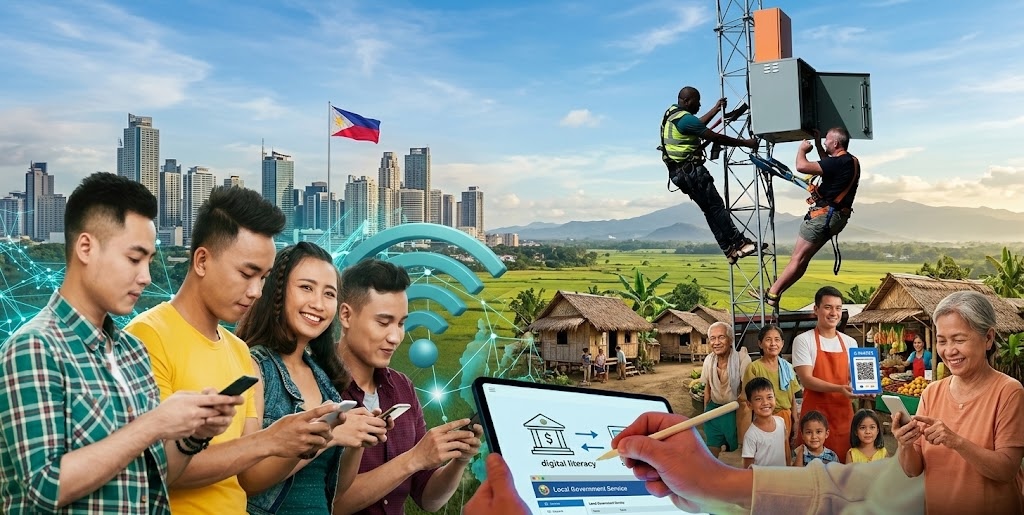
The Philippines is becoming increasingly digital.
Digital payments are now a regular part of everyday transactions, banks and financial institutions continue to expand their digital services, and businesses are investing heavily in technology. The country’s IT and business-process industries have also grown into major contributors to the economy.
But beneath the headline numbers is a more complicated reality: digital adoption is growing, but access, skills and infrastructure remain uneven.
That gap could become one of the biggest challenges the Philippines faces as more essential services — from banking and payments to government transactions, education and commerce — move online.
More Filipinos are online—but not everyone is digitally equipped
The numbers suggest that the Philippines has made significant progress.

According to DataReportal’s Digital 2026: The Philippines report, the country had 98 million internet users at the end of 2025, equivalent to 83.8% of the population. Yet around 19 million Filipinos were still offline.
That distinction matters.
Having access to the internet does not necessarily mean having the skills, confidence or knowledge to use digital services safely and effectively.
A Philippine Institute for Development Studies (PIDS) study found that only about two in five Filipinos had at least one of six basic ICT skills measured under the UN Sustainable Development Goals. The Philippines also lagged several ASEAN countries in many of these skills.
The problem, therefore, is no longer simply about getting people online.
It is about making sure they know what to do once they get there.
That becomes particularly important as financial services move increasingly into digital channels.
The Bangko Sentral ng Pilipinas reported that digital payments accounted for 57.4% of total monthly retail payment volume and 59% by value in 2024.
For consumers who are comfortable with mobile banking, e-wallets and online payments, the shift can make everyday transactions faster and more convenient.
For those who are not digitally confident, however, the same shift can create another barrier.
The digital divide is more than an internet problem
Connectivity remains a fundamental part of the equation.
The Philippines is an archipelago of more than 7,000 islands, and delivering reliable, affordable internet to every community is a considerably different challenge from connecting major urban centers.
The government itself has acknowledged that rural and geographically isolated and disadvantaged areas continue to face connectivity problems. In February 2026, President Ferdinand Marcos Jr. called for greater cooperation to address broadband gaps, citing issues including delayed permits, right-of-way restrictions, fiber cuts and power interruptions.
The government has also been pursuing measures intended to close that gap.
The National Digital Connectivity Plan, approved in January 2026, aims to expand broadband infrastructure, improve affordability and extend connectivity to geographically isolated and disadvantaged areas. Its 2028 targets include universal internet access for public schools, barangay halls and health centers.
The Konektadong Pinoy Act’s implementing rules and regulations were also signed in 2025, with the government saying the measure is intended to accelerate connectivity, reduce costs and expand internet access to underserved communities.
Meanwhile, the Free Wi-Fi for All program is being expanded beyond schools to barangay halls and health centers.
These initiatives point to an important reality: the digital divide is not being ignored. But closing it will take more than launching programs.
Digital literacy may be the bigger challenge
Even when connectivity is available, the ability to use digital services effectively cannot be taken for granted.
This is particularly significant in financial services.

The rise of digital banking, e-wallets, online lending and digital payments has created new opportunities for Filipinos to participate in the formal financial system. At the same time, it has also created new risks.
Scams, phishing, identity theft and other forms of online fraud increasingly rely on social engineering rather than sophisticated hacking. A user does not necessarily need to be technically uninformed to fall victim. Sometimes, knowing how to question a suspicious message, verify a link or protect personal information can make the difference.
This is where digital literacy and financial literacy increasingly overlap.
A person may know how to download an app and send money through it, but that does not necessarily mean they understand the risks associated with sharing an OTP, clicking an unfamiliar link or responding to an unsolicited investment offer.
For fintech companies and financial institutions, this creates a challenge that goes beyond simply building better apps.
The next stage of digital adoption will require building digital confidence and trust alongside technology.
The government has a role—but so does the private sector
It is tempting to reduce the Philippines’ digital adoption problem to government failure.
That would be too simplistic.
The government has a critical responsibility to provide infrastructure, establish clear rules, protect consumers and ensure that public investments actually reach the communities they are intended to serve.
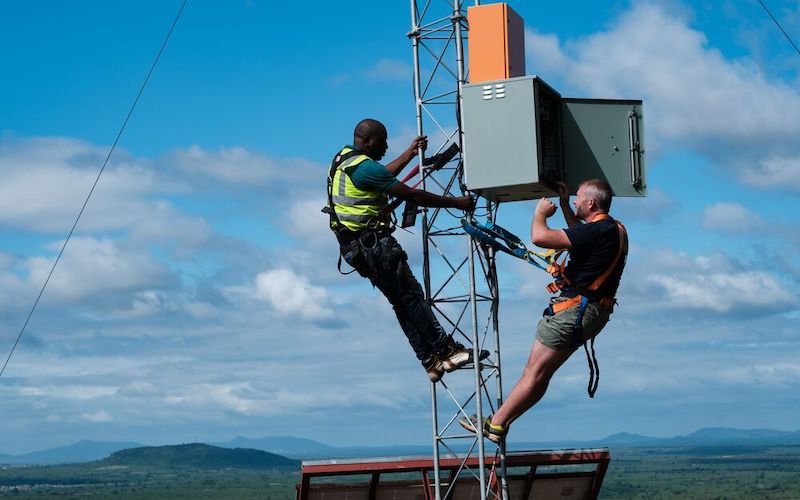
IMAGE CREDIT: Freepik
But digital inclusion is not something government can deliver alone.
Banks, fintech companies, telecommunications providers, technology firms, schools and businesses all have a role to play.
Financial institutions, for instance, can design digital products that are easier to understand and safer for first-time users. Telecommunications companies can continue expanding coverage and improving reliability. Schools can strengthen digital skills at an earlier age. Businesses can help employees and customers navigate digital services instead of assuming that everyone is already comfortable using them.
And government agencies need to make sure that digital transformation does not simply mean putting an existing process online.
A badly designed online service is still a bad service.
The Philippines has already crossed the digital tipping point
The good news is that the Philippines does not have to start from scratch.
The good news is that the Philippines does not have to start from scratch.
The country has already demonstrated that Filipinos are willing to embrace digital services when those services are accessible, useful and easy to understand.
The rapid adoption of digital payments is one example.
The fact that more than half of retail payment volume is now digital shows that the appetite is there.
The challenge now is ensuring that the benefits of that transformation are not concentrated among people who already have reliable connectivity, modern devices and strong digital skills.
The Philippines does not necessarily need another grand digital vision.
It needs to make the existing digital transformation work for more people.
That means better connectivity in remote communities, more affordable internet, stronger digital and financial literacy, better consumer protection and more accessible digital services.
There is also a need for greater accountability in how public digital infrastructure and programs are implemented. But that conversation should be grounded in evidence and measurable outcomes—not simply broad accusations about corruption or political failure.
The Philippines can still get there
For all the challenges surrounding digital adoption, there is little reason to suggest that the Philippines should slow down its digital transformation.
If anything, the country needs to push forward—but with greater focus on the people who are expected to use the technology.
Financial institutions have already made digital payments part of everyday life. More merchants now accept e-wallets, QR payments, bank transfers and other cashless options, while consumers are becoming increasingly comfortable with using their phones for transactions.
Digital payments may not yet have completely displaced cash, but the direction is clear. As access improves and users become more familiar with these services, digital transactions are likely to become an even more ordinary part of daily life.
The same can be said about connectivity.
The number of Filipinos going online continues to grow, while government agencies, schools, financial institutions and technology companies are investing in programs designed to improve digital and financial literacy. More communities are also being connected, gradually bringing more Filipinos into the digital economy.
The opportunity is there.
What the Philippines needs now is to make sure that its digital ambitions translate into something people can actually use.
That means putting connectivity ahead of grand announcements, digital literacy ahead of simply putting services online, and accessibility ahead of technology for technology’s sake. It means investing in infrastructure that reaches underserved communities and creating digital services that work for ordinary Filipinos — not just those who already have fast internet, modern devices and the confidence to navigate the online world.
The country does not need to prove that it can build something big and technologically impressive just to demonstrate that it is ready for the digital economy.
It needs to prove that its people are ready — and, more importantly, that they have been given the tools to participate.
That responsibility falls heavily on government, but it does not end there. Businesses, banks, fintech companies, telecommunications providers, schools and other institutions all have a role in making digital adoption more inclusive and sustainable.
There is, in other words, reason for optimism.
The Philippines has already shown that Filipinos are willing to embrace digital technology when it is affordable, accessible and genuinely useful. The challenge is to ensure that the next wave of digital growth does not leave the same communities behind.
Full digital adoption is within reach. But getting there is less about building a more futuristic Philippines and more about building a more connected, capable and inclusive one.
The technology is already here. The real work is making sure everyone can use it.