

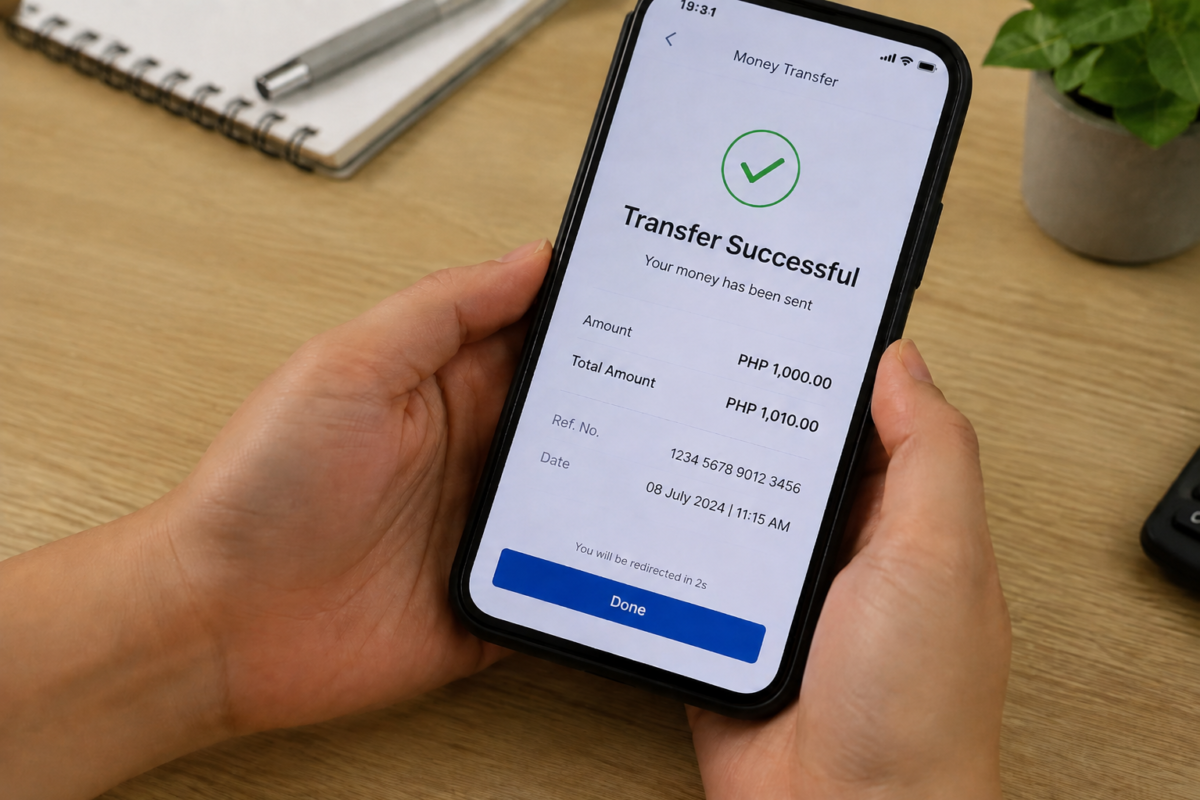
A ₱10 transfer fee does not look expensive on its own. Repeat it often enough, however, and moving money between your own accounts can quietly become another monthly bill.
A customer making 20 transfers a month through an app charging ₱10 each spends ₱200 monthly, or ₱2,400 a year, just to move money. At the old ₱15 rate still familiar to many e-wallet users, the same habit would cost ₱300 a month.
That cost is becoming harder to ignore now that many of the Philippines’ largest banks have made InstaPay and PESONet transfers free.

The Bangko Sentral ng Pilipinas’ latest published transfer-fee disclosure, covering reported charges as of July 31, shows free InstaPay and PESONet transfers for individual customers at BPI, BDO, Metrobank, PNB, RCBC, Security Bank, UnionBank, LANDBANK and several other institutions.
Some e-wallets and financial institutions, however, still charge.
GCash currently charges ₱10 per InstaPay transfer to another bank or e-wallet, down from ₱15 beginning July 4, according to its official fee schedule. The BSP’s July disclosure also lists Maya Philippines and Maya Bank at ₱10 for individual InstaPay transfers.
So the question is no longer simply whether InstaPay costs money. Increasingly, it is where the money starts and which route a customer chooses.
₱10 at a time can still add up
There is no publicly available BSP figure showing how much the average Filipino pays each month specifically in electronic transfer fees. But the cost of frequent transfers is easy to illustrate.
| Transfers per month | At ₱10 each | At ₱15 each |
|---|---|---|
| 5 | ₱50 | ₱75 |
| 10 | ₱100 | ₱150 |
| 20 | ₱200 | ₱300 |
| 30 | ₱300 | ₱450 |
For someone sending allowances, dividing household expenses, moving salary between accounts, paying online sellers or transferring money into savings accounts, these are not necessarily unusual transaction counts.
The burden is also proportionally larger on small transfers. A ₱10 charge on a ₱500 transfer is effectively 2% of the amount being moved. On ₱1,000, it is 1%. The same flat fee becomes less significant as the transfer amount increases.
This is part of what the BSP’s new pricing framework is trying to address.
Under Circular No. 1238, which took effect in July, financial institutions are expected to price interbank transfers in line with the actual cost of processing them. BSP Deputy Governor Mamerto Tangonan said the regulator is reviewing whether the difference between transfers within the same institution and transfers to another institution reflects costs directly associated with switching the transaction between providers.
The BSP has not automatically declared every remaining fee excessive. Institutions were asked to submit their pricing and cost information, which the regulator has been validating for compliance.
Bank-to-wallet can now be cheaper than wallet-to-bank
The changing fee structure has also created an important distinction for consumers.
Sending money from a major bank to an e-wallet can now cost nothing. BPI, for example, permanently removed InstaPay and PESONet fees for retail customers beginning July 1, including transfers to other banks and e-wallets. BDO similarly lists InstaPay and PESONet transfers to other local banks and wallets as free through its digital channels.
Reverse the direction and the economics can change.
Sending money from GCash to a bank account costs ₱10 through InstaPay. This means a customer moving ₱5,000 from BPI to GCash may pay nothing, while moving the same ₱5,000 back from GCash to BPI costs ₱10.
Even funding a wallet can have different prices depending on how the transaction is initiated.
GCash’s fee schedule, for example, lists a ₱15 online cash-in charge through BPI, while sending money from the BPI app directly to GCash through InstaPay is free. The source and destination may effectively be the same, but the route taken changes the cost.
That makes understanding the transaction channel increasingly important for users trying to avoid unnecessary charges.
InstaPay and PESONet now serve different cost calculations
InstaPay remains the obvious option when money needs to arrive immediately. Transfers are credited in real time and are generally capped at ₱50,000 per transaction.
PESONet is better suited for larger transfers that do not need instant settlement. Processing follows clearing schedules rather than immediate crediting, while participating banks typically allow substantially higher transfer limits.
The old trade-off was often speed versus cost. A customer could pay for InstaPay or wait for a cheaper PESONet transaction.
That distinction is weakening as more banks make both services free.
BPI, BDO and Metrobank now offer zero-fee transfers through both rails for retail customers.
Digital banks have also experimented with hybrid models. GoTyme Bank currently gives customers 20 free InstaPay transfers per month, then charges ₱9 for succeeding transfers, while PESONet remains free.
This means customers increasingly have options to structure routine transfers around free allowances or zero-fee banking channels instead of automatically accepting every transaction charge.
Free transfers are becoming a competitive feature
The biggest change may be what consumers now expect from their bank.
Transfer fees were once treated as an unavoidable cost of digital banking. With some of the country’s largest institutions eliminating them altogether, a ₱10 or ₱15 fee now stands out much more clearly.
The BSP’s policy is accelerating that comparison.
It is also changing the economics for banks themselves. Lower fees can encourage customers to transact more frequently, keep more money inside digital accounts and rely less on cash. The BSP has explicitly linked interoperability and lower transaction costs with bringing more Filipinos into digital finance.
For consumers, however, the calculation is much simpler.
A few pesos per transaction may seem small. Multiplied across dozens of transfers every month and hundreds over a year, the cost becomes meaningful.
And now that sending money for free is increasingly possible, paying to move your own money is becoming less of a default and more of a choice worth questioning.