
GSIS Balik Ginhawa has already returned more than ₱19 billion in previously collected loan payments to over 700,000 government workers and pensioners.
But borrowers should not mistake the refund for debt forgiveness. Under the program, GSIS gives qualified borrowers their eligible amortizations back in cash while treating the covered months as a non-collection period, meaning the underlying loan obligation remains.
The Government Service Insurance System said in its latest Balik Ginhawa update that the refunds covered nearly 1.3 million loan contracts as of August 31. Of the ₱19 billion released, ₱8.9 billion came from the original program while ₱10.1 billion was distributed through Balik Ginhawa 2.
How can GSIS refund a payment that was already made?
Normally, a borrower pays a monthly amortization and that payment is applied to the loan.
Balik Ginhawa changes the timing.
Under Balik Ginhawa 2, qualified members can receive refunds covering eligible amortizations paid from December 2025 through May 2026, equivalent to as much as six months of payments. The money is credited directly to the member’s registered GSIS bank account.
Those refunded months are then treated as a non-collection period.
That means GSIS does not classify those months as missed payments or arrears simply because the member received the money back. The borrower’s loan remains active, but repayment of the corresponding obligation is effectively moved further into the loan’s payment schedule.
The original Balik Ginhawa program made the mechanism clearer: GSIS continued regular loan deductions, refunded three months of amortizations in a lump sum and extended the loan term by three months without additional interest or penalties.
A ₱60,000 refund does not mean ₱60,000 of debt disappeared
Consider a government employee paying ₱10,000 a month on an eligible GSIS loan.
If six qualifying monthly payments are refunded, the member could receive ₱60,000 back into their bank account.
That creates ₱60,000 of immediate cash that can be used for groceries, tuition, bills or other expenses.
But it does not mean GSIS permanently reduced the loan by ₱60,000.
The relief comes from changing when GSIS collects those payments, rather than cancelling the amount owed.
GSIS itself illustrated the benefit using a borrower paying ₱20,000 monthly. Six months of relief could provide as much as ₱120,000 in immediate spending power.
It is closer to a payment holiday than loan forgiveness
Loan forgiveness means some or all of the borrower’s debt is permanently cancelled.
That is not what Balik Ginhawa does.
A conventional payment holiday or loan moratorium usually allows borrowers to temporarily stop making payments. The unpaid installments are then dealt with later according to the lender’s rules.
Balik Ginhawa reaches a similar result through a different route.
Instead of simply stopping deductions for several months, GSIS collects eligible amortizations and then refunds them, giving the member a larger amount of cash at once.
GSIS described the original program as a “modified” loan moratorium precisely because of this refund mechanism.
It is also different from restructuring or refinancing
Loan restructuring normally involves changing the terms of an existing debt because the borrower is struggling to repay it.
The lender might extend the term, reduce the monthly installment, modify the interest arrangement or consolidate obligations.
Balik Ginhawa does not require members to take out a replacement loan to receive the relief.
It is also different from refinancing, where a borrower obtains a new loan to pay off an existing one.
GSIS specifically says the program provides members with liquidity without requiring them to borrow additional money.
That distinction can matter for a household already carrying debt. A member receives usable cash without adding another separate loan contract solely to obtain that money.
Who can still apply for Balik Ginhawa 2?
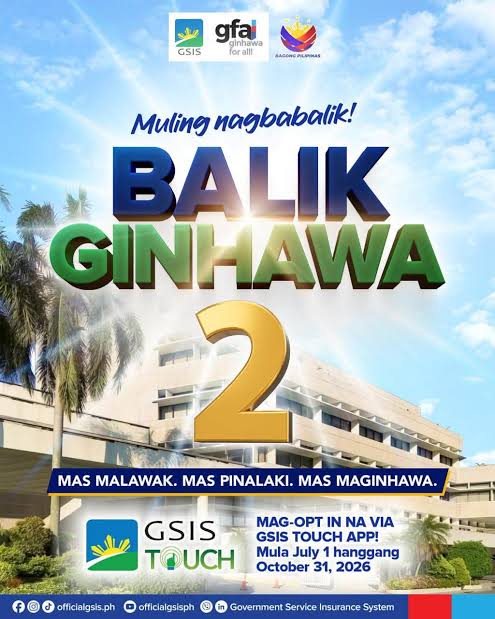
Applications for Balik Ginhawa 2 remain open until October 31.
The program covers qualified GSIS members and pensioners with active loan accounts, including housing loans, provided the account is not classified as Due and Demandable and the member has a registered GSIS bank account.
Eligible refunds are based on payments corresponding to December 2025 through May 2026.
Fully paid loans, Due and Demandable accounts and several other categories are excluded.
Applications are voluntary and are submitted through the GSIS Touch app.
The benefit is liquidity, not debt cancellation
That is ultimately the easiest way to understand Balik Ginhawa.
GSIS is temporarily converting some money that had already gone toward loan payments back into cash the member can use today.
The trade-off is that the borrower still has an outstanding obligation to GSIS.
For households facing immediate expenses, however, that distinction may be precisely the point of the program: provide breathing room without requiring workers to take on another emergency loan.