
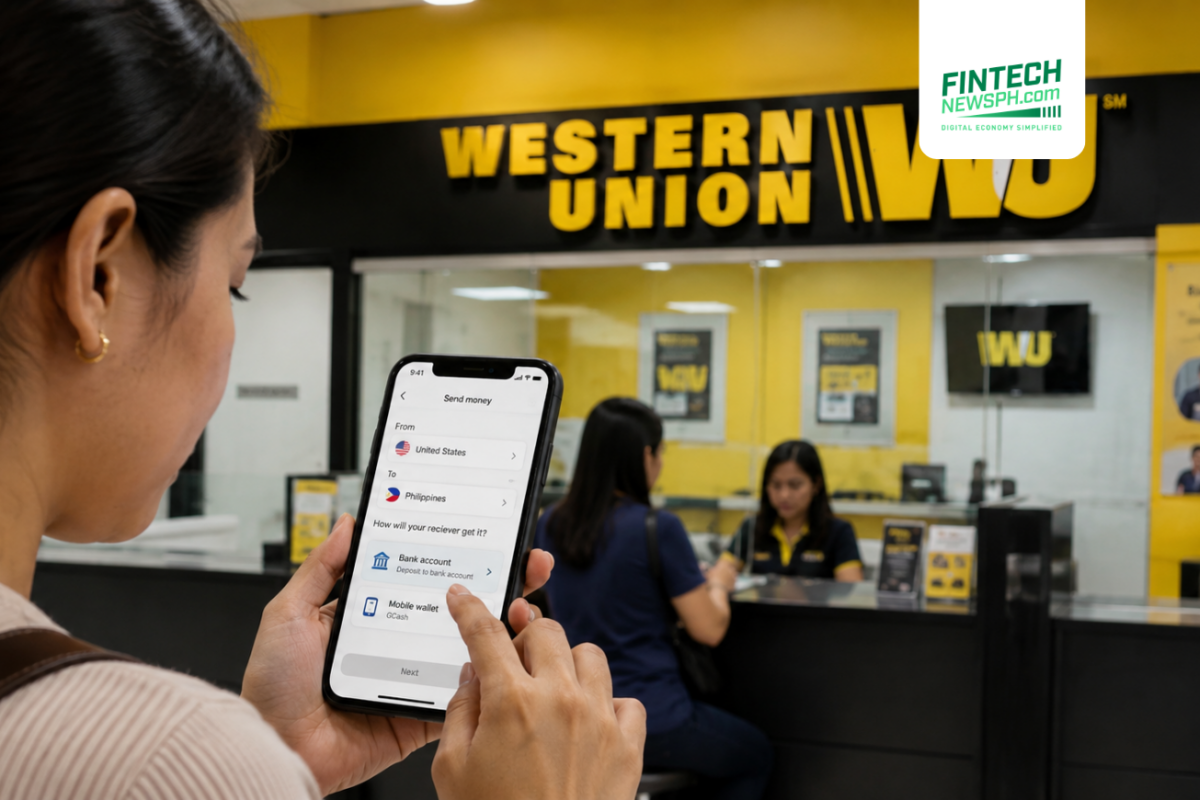
Western Union has introduced a new Philippine digital pricing structure that makes bank and mobile wallet transfers significantly cheaper than cash payouts, giving Filipino senders a stronger financial incentive to move cross-border remittances into digital channels.
Effective August 6, Western Union lowered the transfer fees applied to bank and wallet payouts made through its Philippine website and mobile app. For transfers of up to ₱10,000, customers now pay ₱75 when sending to a bank account or wallet, compared with ₱300 for a cash payout.
For amounts between ₱10,001 and ₱20,000, the respective fees are ₱100 and ₱400. A ₱20,001 to ₱30,000 transfer costs ₱125 through bank or wallet delivery compared with ₱400 in cash.
The gap remains for larger transactions, although it gradually narrows. A transfer between ₱100,001 and ₱200,000 carries a ₱650 bank or wallet fee compared with ₱1,000 for cash. Above ₱300,000, the fees rise to ₱1,150 and ₱1,200, respectively.
Western Union also says a customer’s first digital transfer remains free of a transfer fee under the updated pricing structure.
Price is becoming an incentive to leave cash behind
The difference creates a straightforward incentive for senders whose recipients already have access to a supported bank account or mobile wallet.
Cash pickup has traditionally been one of the defining features of international remittances. It remains important for recipients who are unbanked, prefer physical cash or live in markets where access to digital financial services remains limited.
But direct account and wallet transfers can remove the need for recipients to travel to a remittance branch, queue for a payout and then deposit or spend the cash separately.
Western Union’s pricing structure effectively puts a lower price on that digital route.
The shift also comes as Filipinos increasingly use electronic channels for their everyday financial transactions. The Bangko Sentral ng Pilipinas’ latest e-payments measurement found that digital channels represented 57.4% of retail payment transactions by volume in 2024, up from 52.8% a year earlier. Payments made by individuals were even more digitalized, with 72.2% completed through electronic channels.
While domestic retail payments and international money transfers are different markets, greater familiarity with mobile wallets, online banking and instant transfers removes some of the friction that previously made cash the default option.
The transfer fee is not the whole cost
A lower advertised fee, however, does not necessarily mean a particular remittance service will always deliver the lowest overall cost.
Western Union itself tells customers to compare both transfer fees and exchange rates, noting that the company also earns revenue when currencies are exchanged.
Its terms explain that consumer exchange rates can include a margin over wholesale market rates, with Western Union retaining the difference between the rate it receives and the rate offered to the customer.
For consumers, that makes the final amount received more useful than looking at the transfer fee alone.
A provider advertising a smaller transaction fee could still produce a less favorable result if its exchange rate leaves the recipient with fewer pesos, dollars or other destination currency. Fees can also vary depending on the destination, payment method and payout channel.
Some mobile wallets may impose their own receiver-side charges as well. Western Union notes that additional charges, including cash-out fees, may be applied by a recipient’s wallet provider.
Remittance competition is moving into the digital channel
Western Union’s new pricing illustrates how competition in cross-border transfers is increasingly moving away from the traditional branch-to-branch model.
For customers who still need cash payout, physical remittance networks remain valuable. But for digitally connected senders and recipients, bank and wallet delivery can increasingly compete on both convenience and price.
That changes what consumers need to compare.
Instead of looking only at the fee printed beside a remittance amount, Filipino senders can compare the transfer fee, exchange rate, delivery speed, payout method and ultimately how much money reaches the recipient.
As remittance providers make digital delivery cheaper, the question may no longer be whether consumers can send money without using cash. It is whether the combined savings and convenience are becoming large enough for them to stop choosing cash pickup in the first place.