Having a single salary account keeps things simple, but it also creates a major budgeting blind spot. When all your money sits in one place, it becomes nearly impossible to track where your earnings are actually going—or to stop yourself from spending funds meant for next week’s bills.
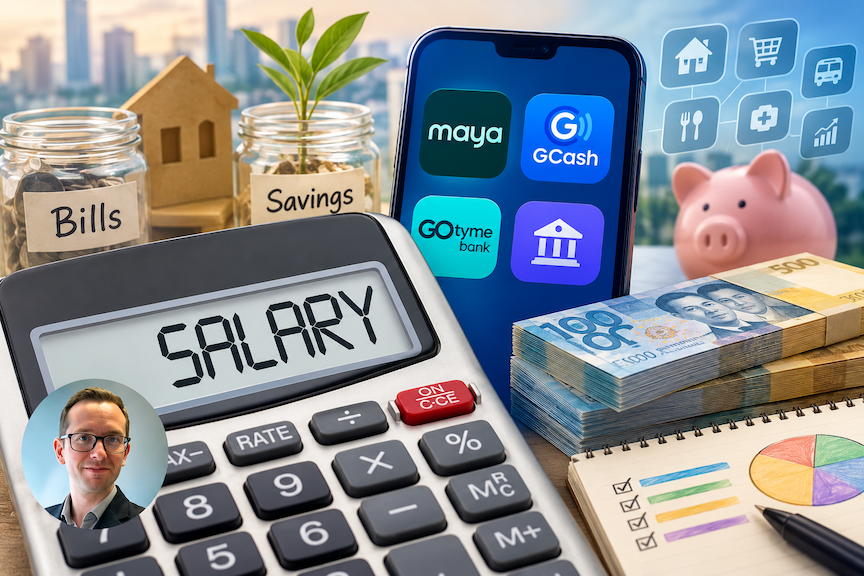
To solve this, Filipino employees are increasingly using platforms like GCash, Maya, and GoTyme Bank to split their income across dedicated accounts. The goal isn’t to collect as many apps as possible, but to build a clean, automated system where every account has one clear job.
Start with take-home pay, not app features

IMAGE CREDIT: Magnific
Before transferring money anywhere, map out your actual monthly take-home pay.
Instead of copying a rigid budgeting rule, divide your income based on your real-world priorities.
For an employee earning ₱30,000 a month, a practical setup might look like:
- ₱12,000 for fixed bills and household obligations
- ₱6,000 for emergency savings and long-term goals
- ₱6,000 for food, transport, and daily essentials
- ₱3,000 for lifestyle and personal spending
- ₱3,000 left in your primary bank as a buffer
Assigning every peso a specific destination before spending starts keeps your money organized and prevents funds from quietly disappearing across multiple apps.
Assign each account a specific role
The most effective way to manage multiple accounts is to treat each one as an isolated lane:
- Bills and fixed expenses: Keep rent, utilities, insurance, and subscription money in a dedicated account. Moving this money right after payday prevents the illusion that you have more spendable cash than you actually do. Seeing ₱10,000 in an e-wallet does not mean you have ₱10,000 available to spend if half is earmarked for electricity—treating fixed costs as spent cash ensures the money is waiting when bills are due.
- Everyday spending: Use a separate e-wallet for daily food, transportation, shopping, and entertainment. If you allocate ₱6,000 a month and spend ₱4,500 in the first two weeks, seeing a ₱1,500 balance instantly creates a clear, natural spending limit without needing to track every receipt manually. Once this balance runs low, it acts as a firm stopping point without risking your bill payments.
- Dedicated savings: Keep emergency savings far away from your primary spending wallet so you aren’t tempted to treat savings as shopping money. If your daily spending account hits ₱2,000, you shouldn’t see your ₱50,000 emergency fund as available cash. The goal is accessibility for genuine emergencies, but inconvenience for impulse purchases. Hybrid platforms like Maya work well here, offering base interest rates of 3% p.a. that can scale up to 15% p.a. through daily app transactions.
- Long-term goals and wealth building: Dedicated sub-accounts or investment hubs — like GCash’s GFunds or GStocks — allow you to grow money for long-term targets without mixing those assets with short-term cash. Once your emergency fund is built, redirecting these allocations toward long-term investments helps your system adapt to your evolving finances.
Automate and protect your cash flow

IMAGE CREDIT: Freepik
To make salary splitting effective, adopt the rule of paying yourself first.
Move money into savings and bill accounts immediately on payday rather than saving whatever happens to be left at the end of the month. Transferring your savings allocation right away draws a clear line between spendable income and money set aside for the future.
Leverage built-in app tools like scheduled transfers, auto-save rules, virtual cards, and spending alerts to keep the process moving automatically. Automation lowers the mental burden of manual budgeting and removes the monthly decision-making process.
At the same time, keep transfer fees in mind — moving small amounts back and forth continuously can slowly eat into your budget. Consolidating your transfers to once or twice a month keeps overhead low.
Additionally, avoid chasing every promotional interest rate across dozens of apps; the added complexity and strict eligibility criteria can lead to losing track of funds. The best system is always the one you can realistically maintain.
Ultimately, two to four well-managed accounts offer the ideal balance for most workers. By giving every peso a clear job from the day you get paid and reviewing your allocations after major life changes, you turn your digital wallets into a reliable system for building financial security.