


Metrobank‘s penalty has drawn attention to the Philippine Stock Exchange (PSE) and its enforcement of the amended minimum public ownership (MPO rule.
The listed bank was recently penalized for violating the exchange’s public float requirement, highlighting the importance of complying with listing regulations designed to promote market liquidity and investor participation.

While the sanction does not affect Metrobank’s banking operations, it serves as a reminder that publicly listed companies are expected to maintain the required level of shares held by public investors.
The case also underscores the role of the PSE and the Securities and Exchange Commission (SEC) in ensuring transparency and maintaining orderly capital markets.
Understanding the minimum public ownership rule
The minimum public ownership rule requires listed companies to maintain a prescribed percentage of their outstanding shares in the hands of public investors. The requirement is intended to encourage active trading, improve market liquidity, and ensure that investors have sufficient access to listed securities.
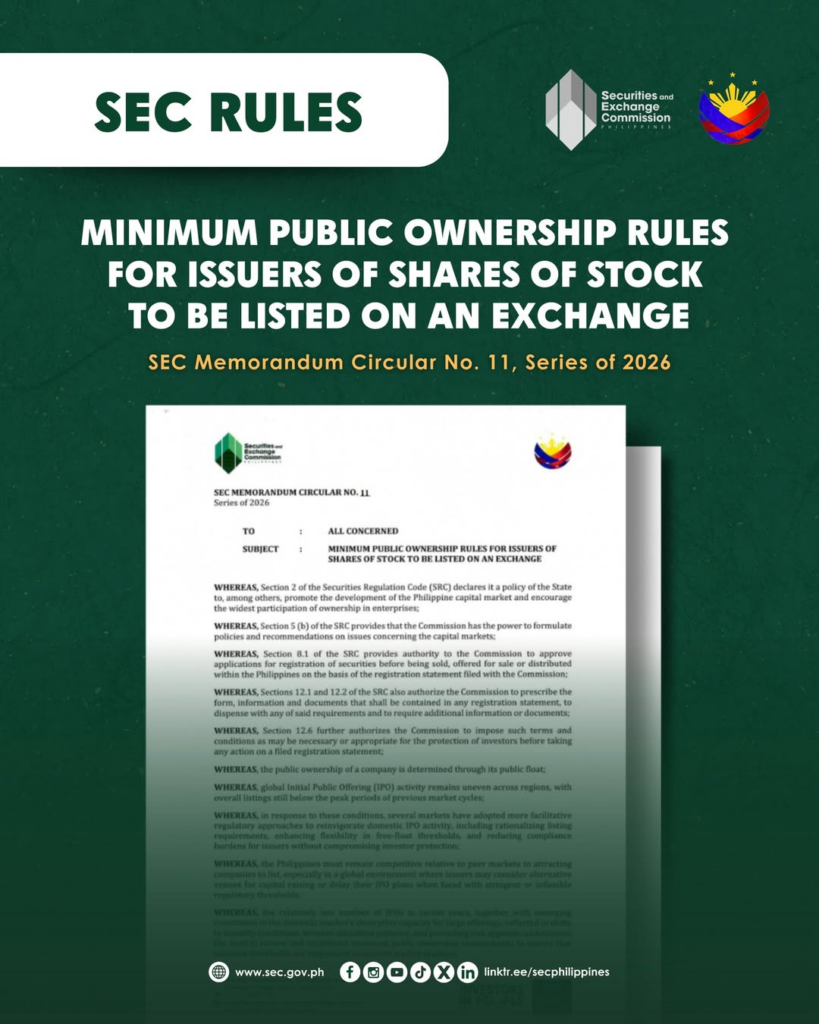
Companies that fail to meet the required public float may face regulatory actions, including penalties, reportorial requirements, trading suspension, or other enforcement measures, depending on the nature and duration of the non-compliance. The PSE has also proposed revisions to align its rules with the SEC’s updated framework on minimum public ownership.
Read the full Memorandum Circular here: https://www.sec.gov.ph/mc-2026/sec-mc-no-11-series-of-2026/
Why the Metrobank penalty matters
The Metrobank penalty highlights that compliance with exchange rules extends beyond financial performance.
Listed companies are also expected to comply with governance, disclosure, and ownership requirements that support investor confidence and market integrity.
Public float requirements are particularly important because they help ensure that shares remain sufficiently available for trading. A healthy public float contributes to better price discovery, improved liquidity, and a more efficient securities market. When public ownership falls below the required threshold, regulators may require companies to submit compliance plans and periodic reports detailing how they intend to restore compliance.
For investors, consistent enforcement of listing rules reinforces confidence that all publicly listed companies are held to the same regulatory standards, regardless of size or industry.
Stronger rules support capital market development
The Metrobank penalty also comes as regulators continue to refine the country’s public ownership framework. Recent SEC rules introduced a more flexible, tiered minimum public ownership structure for future IPOs while maintaining continuing compliance obligations for listed companies. These reforms aim to balance capital market competitiveness with investor protection.
As the Philippine capital market continues to evolve, regulatory compliance remains an essential component of maintaining a fair, transparent, and orderly exchange. For listed companies, meeting public ownership requirements is not simply a regulatory obligation but also a factor in supporting market confidence and long-term investor participation.
Strengthening confidence in the Philippine stock market
The Metrobank penalty serves as a reminder that compliance with minimum public ownership rules remains an important responsibility for publicly listed companies.
While the sanction is regulatory in nature, it reflects the PSE’s continued efforts to uphold market integrity and ensure that companies comply with established listing standards.
As regulators enhance the country’s capital market framework, consistent enforcement of public float requirements can help strengthen investor confidence, improve market liquidity, and support the long-term development of the Philippine stock market.