

Saving money used to mean opening an account at a traditional bank, visiting a branch, and keeping a passbook or ATM card within reach. Today, Filipinos can open and manage savings accounts almost entirely through their smartphones.
Digital banks have made saving more accessible by allowing customers to open accounts, transfer money, monitor balances, and manage their funds through an app. The Bangko Sentral ng Pilipinas (BSP) recognizes digital banks as a distinct category of banks, with their financial products and services processed end-to-end through digital platforms or electronic channels.
As of March 2026, the Philippines had six BSP-authorized digital banks.
For someone opening a digital savings account for the first time, however, the question should not simply be, “Which bank offers the highest interest rate?”
The better question is: “Which account will help me save consistently while keeping my money accessible and secure?”
What is a digital bank savings account?
A digital bank savings account works much like a regular savings account, except most banking activities happen through an app or other electronic channels.

You can typically deposit money, transfer funds, check your balance, pay bills, and monitor transactions without going to a physical branch.
This makes digital savings particularly useful for people who want to separate their savings from their everyday spending account. Instead of keeping all your money in one place, you can designate a digital account for a specific goal such as an emergency fund, travel fund, tuition, or a future purchase.
The convenience also makes it easier to monitor your progress. Rather than waiting for a monthly statement, you can check your balance whenever you want.
Why are digital banks popular among Filipino savers?
One major attraction is the potential to earn a higher interest rate than what consumers may find in conventional savings accounts.
Digital banks compete for deposits by offering interest rates, promotional rewards, goal-based savings features, and other incentives. But rates can change, and some attractive offers may only apply for a limited period or require customers to meet certain conditions.
That means a higher advertised rate should be treated as one factor, not the entire basis for choosing an account.
A beginner should also consider how easy it is to deposit and withdraw money, whether there are transfer fees, what minimum balance requirements apply, and how reliable the app is.
Start by giving your savings a purpose
Before opening another account, decide what you are saving for.
If you simply transfer random amounts whenever you have extra money, saving can easily become inconsistent. Giving your account a purpose creates a clearer reason to keep contributing.
For example, you might divide your goals into:
- Emergency fund: Money reserved for unexpected expenses
- Short-term goals: Travel, gadgets, tuition, or annual bills
- Long-term savings: Money you do not expect to use soon
- Sinking funds: Regular expenses such as insurance, school fees, or holiday spending
The amount matters, but consistency matters too. Someone who regularly saves ₱500 or ₱1,000 a month is building a stronger habit than someone who waits for a large amount of money before saving.
Look beyond the advertised interest rate
Interest rates are one of the easiest features to compare, but they can also be misleading if viewed on their own.
Check whether the advertised rate is the base rate or a promotional rate. Some higher rates may require customers to meet spending, deposit, transaction, or balance conditions.

It is also worth checking how often interest is credited and whether the rate applies to your entire balance or only up to a specified amount.
For example, an account advertising a high promotional rate may sound more attractive than another offering a lower rate. But if the promotional rate requires conditions you are unlikely to meet, the second account may ultimately be more practical.
The best interest rate is not necessarily the best savings account for you.
Check if your money is PDIC-insured
Security should be a major consideration when choosing where to keep your savings.
Deposits in insured banks are covered by the Philippine Deposit Insurance Corporation (PDIC), subject to the applicable rules and limits. Since March 15, 2025, the maximum deposit insurance coverage has been ₱1 million per depositor, per bank.
This does not mean every financial app or digital wallet automatically receives the same deposit insurance treatment as a bank deposit. Consumers should first determine whether they are actually opening a bank deposit account.
If you are unsure, verify the institution through the BSP’s financial institution verifier and check the product’s terms before depositing significant amounts.
Understand the difference between a digital bank and an e-wallet
This is an important distinction for beginners.
An e-wallet is primarily designed for digital payments, transfers, purchases, and other transactions. A digital bank, on the other hand, is a bank that provides deposit and other banking services through digital channels.
They may look similar because both can be accessed through a smartphone, but they are not automatically the same type of financial product.
Before putting your emergency fund into an app, check whether the money is held as a bank deposit or as an e-money balance. The BSP itself separates deposits and e-money as different categories of financial products and services.
Don’t put all your savings into one account just because of a high rate
A high interest rate can be tempting, but savers should also think about accessibility.
Your emergency fund, for example, should ideally be somewhere you can access when you actually need it. Meanwhile, money intended for a longer-term goal can potentially be kept in an account designed to encourage you to leave it untouched.
You can also spread savings across accounts based on purpose rather than simply chasing the highest rate.
For example:
Everyday account: Bills and regular spending
Digital savings account: Emergency fund
Goal-based account: Travel, education, or major purchases
The goal is to make your money easier to manage, not to collect as many bank apps as possible.
Protect your digital savings account
Because your savings are accessible through your phone, digital security is just as important as the interest rate.
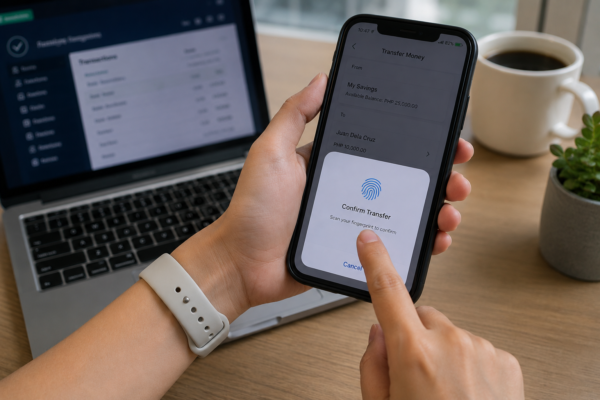
Use a strong, unique password and enable available security features such as biometric authentication or multi-factor authentication. Never share your password, PIN, one-time password, or other authentication credentials with anyone.
The BSP advises consumers to verify links and sources before clicking, protect passwords and financial information, and immediately report suspicious transactions to their bank or e-money issuer.
Also be cautious about messages claiming that your account will be suspended or that you need to provide an OTP to receive a reward. A legitimate bank should not require you to hand over confidential authentication credentials through an unsolicited message.
A simple way to start saving digitally
For beginners, there is no need to make the process complicated.
Start with one account that you understand. Compare its interest rate, fees, requirements, withdrawal options, transfer charges, security features, and deposit insurance coverage.
Then automate your savings if the bank allows it. You could schedule a transfer immediately after receiving your salary instead of waiting until the end of the month to see what is left.
Even a simple rule such as saving 10% of every paycheck can help establish a routine. If that amount is too high at first, start smaller and increase it as your income grows.
The important part is to make saving a regular expense rather than something you only do when you have extra money.
Digital savings should make saving easier, not spending easier
Digital banks give Filipino consumers more choices, but more choices also mean more responsibility.
A high interest rate can help your money grow, but it will not compensate for constantly withdrawing your savings. An attractive app will not matter if the account’s fees do not fit your habits. And a convenient account is not necessarily the right place for every peso you own.
For beginners, the smartest approach is to start with your financial goal, compare the account’s complete terms, and build a savings habit before chasing the highest rate.
Digital banking can make saving easier. The real advantage comes when you use that convenience to consistently keep more money aside for the future.