
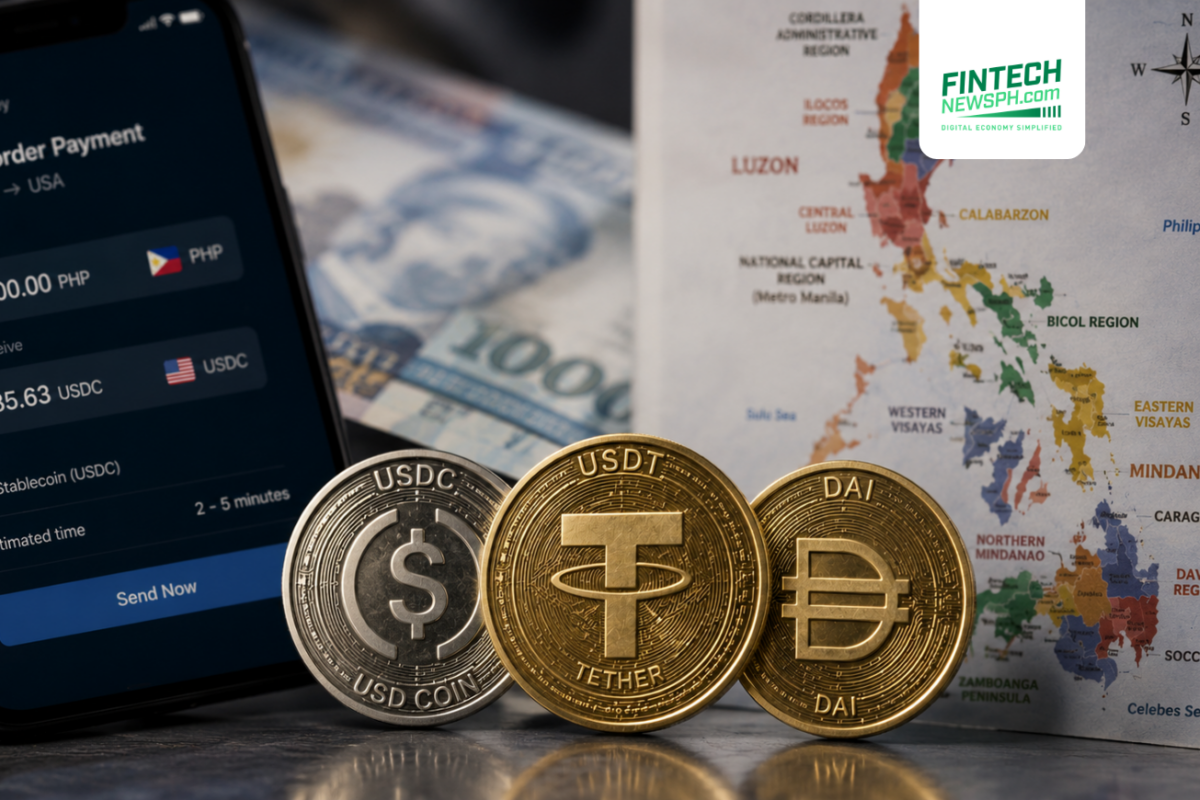
Stablecoins are no longer discussed solely as a crypto trading tool.
As banks, payment companies, fintechs, and remittance players explore faster ways to move money across borders, stablecoins are increasingly being viewed as part of the next payments conversation.
The value proposition is straightforward: a digital asset designed to maintain a stable value, often linked to a fiat currency such as the US dollar, that can move across blockchain networks more quickly than some traditional payment rails.
For the Philippines, the question is not theoretical.
The country has a large remittance market, a growing digital payments base, and an active crypto user community. These conditions make stablecoins increasingly attractive for cross-border transfers, merchant settlement, treasury management, and fintech infrastructure.
But mainstream use also brings harder questions. Are users protected? Are platforms licensed? Can regulators monitor risks? And can stablecoins be used for payments without creating new problems around fraud, money laundering, consumer confusion, or financial stability?
A TransFi article on BSP crypto regulations said stablecoin users in the Philippines should deal with registered platforms, complete KYC checks, and follow anti-money laundering and counter-terrorism financing rules. It also noted that users do not need a special license to hold stablecoins such as USDT or USDC, but platforms offering virtual asset services must comply with BSP requirements.
Why stablecoins are attracting payment players
Stablecoins are different from more volatile crypto assets because they are designed to track the value of another asset, usually a fiat currency. This makes them more useful for payments than tokens whose prices can move sharply within a day.
The strongest use case is cross-border payments.
Traditional international transfers can involve several intermediaries, different operating hours, foreign exchange steps, and settlement delays. For remittance providers and payment companies, stablecoins offer a possible way to move value faster across markets, especially when paired with licensed on-ramps and off-ramps that convert between fiat and digital assets.
The International Monetary Fund has said digital money could improve cross-border payments by making them faster, cheaper, more transparent, and more accessible. The IMF has also noted that overseas payments can be slow, expensive, and opaque because they often depend on correspondent banking relationships and several intermediaries.
Institutional interest is also rising.
In June 2026, Reuters reported that a consortium including Visa, Mastercard, Coinbase, and other companies had launched Open USD, a dollar-pegged stablecoin initiative aimed at broader business adoption.
Momentum behind stablecoins has accelerated over the past year as global financial institutions, payment networks, and technology firms increasingly explore blockchain-based settlement for commercial payments.
Rather than replacing banks, many initiatives are focused on reducing the cost and complexity of moving money across borders while remaining within existing regulatory frameworks.
This does not mean stablecoins have already replaced traditional rails. Stablecoins remain far more established in crypto trading than in everyday consumer payments. But the direction is changing: stablecoins are increasingly being tested as payment infrastructure, not only as crypto market instruments.
What this could mean for the Philippines
In the Philippines, stablecoins could become relevant in several areas.
The first is remittances. Millions of Filipinos rely on money sent from overseas, and any technology that can reduce cost, improve speed, or extend service availability will attract attention from fintechs and remittance firms. Stablecoins could be used behind the scenes as a settlement layer, even if the sender and receiver still see pesos, dollars, or another fiat currency at the front end.
The second is business payments. Exporters, freelancers, online service providers, and cross-border merchants may benefit from faster settlement, especially when dealing with overseas clients or platforms. Stablecoins could serve as an intermediary settlement layer for receiving value from abroad before converting to pesos through a licensed provider.
The third is fintech infrastructure. Wallets, payment gateways, virtual asset service providers, and banking partners may explore stablecoins as part of cross-border payment products, merchant settlement, or liquidity management.
But adoption will depend heavily on trust. Users will need to know whether the stablecoin is properly backed, whether redemption is reliable, whether the platform is licensed, and what happens if a transaction is sent to the wrong wallet or a provider fails.
This is where regulation becomes central.
BSP and SEC rules shape the local market
The Philippines already regulates virtual asset activity, although stablecoins are neither legal tender nor equivalent to bank deposits.
The Bangko Sentral ng Pilipinas regulates Virtual Asset Service Providers, or VASPs, under its framework for virtual asset activities. BSP Circular No. 1108 sets out guidelines for VASPs, covering activities such as exchange between virtual assets and fiat currency, exchange between one or more forms of virtual assets, transfer of virtual assets, and safekeeping or administration of virtual assets.
As of 31 May 2026, the BSP had an updated list of active and inactive VASPs. The central bank has also warned the public against dealing with unauthorized VASPs, saying these providers facilitate activities such as cryptocurrency exchange, trading, transfers, safekeeping, and payments.
The Securities and Exchange Commission has also moved into the space. In 2025, the SEC issued rules for Crypto-Asset Service Providers, or CASPs, covering entities offering crypto-asset services and certain related marketing activities in the Philippines. The rules are intended to strengthen consumer protection, market integrity, and regulatory oversight.
For stablecoin users, the practical takeaway is clear: the platform matters. A stablecoin may be designed to hold its value, but the user still faces risks if the exchange, wallet, broker, or payment provider is not authorized, transparent, or properly supervised.
This is especially important because stablecoin transactions can be difficult to reverse. Unlike card payments or some bank transfers, blockchain-based transfers may not have the same dispute process or consumer recourse once funds are sent.
Readiness is about more than technology
The Philippines has many of the ingredients needed for broader stablecoin adoption: remittance demand, a digitally active population, fintech experimentation, and regulatory experience with VASPs.
But readiness is not only about whether the technology works. It is about whether the system around it is strong enough.
For banks, the challenge is deciding whether stablecoins should be treated as a threat, a settlement tool, or an infrastructure layer that can be integrated with regulated financial services. Banks may also need to consider operational risks, liquidity risks, custody arrangements, and compliance obligations if they work with virtual asset providers.
For remittance companies, the opportunity is speed and reach. But they must still satisfy KYC, AML/CFT, sanctions screening, reporting, and customer protection requirements. A faster rail does not remove the need for responsible compliance.
For fintechs, stablecoins can support cross-border products, but only if the user experience is simple and safe. Most consumers do not want to manage wallet addresses, blockchain transaction fees (“gas fees”), private keys, or chain selection. They want money to arrive correctly, quickly, and at a clear cost.
For regulators, the challenge is balancing innovation with financial safety. Global regulators have repeatedly pointed to risks around stablecoin reserve quality, redemption rights, governance, cross-border supervision, and potential runs if users lose confidence.
In 2025, the Financial Stability Board said that jurisdictions had made progress in regulating crypto-asset activities and global stablecoin arrangements, but implementation gaps and inconsistencies remained.
The mainstream test for stablecoins
IMAGE CREDIT: Freepik
Stablecoins may become more visible in Philippine fintech, but their biggest impact may happen behind the scenes.
A consumer sending money home may not care whether a stablecoin was used in the settlement process. A freelancer may only care that funds from an overseas client arrive faster. A merchant may only care that a cross-border payment clears with lower friction. In that sense, stablecoins could succeed not by becoming a household term, but by becoming part of the infrastructure that makes digital payments faster and more connected.
Still, mainstream adoption requires safeguards. Users need clear disclosures, licensed platforms, reliable conversion to pesos, stronger fraud controls, and a better understanding of what stablecoins are and what they are not.
Stablecoins are steadily moving closer to mainstream finance. The Philippines appears well positioned to explore their use in remittances and cross-border payments, but readiness will depend on whether banks, fintechs, remittance providers, and regulators can build trust around the technology.
The question is no longer whether stablecoins are part of the fintech conversation. The question is whether the Philippines can turn them into a useful payment tool without weakening consumer protection, compliance, and financial stability.
—
Disclaimer: This article is for news and informational purposes only and should not be construed as financial or investment advice, nor as an endorsement of any cryptocurrency, crypto-asset, or platform. Crypto-assets are highly speculative and involve significant risks. Readers should conduct their own research and verify the regulatory status of crypto service providers with the Bangko Sentral ng Pilipinas (BSP) and the Securities and Exchange Commission (SEC) before making any investment or transaction.