

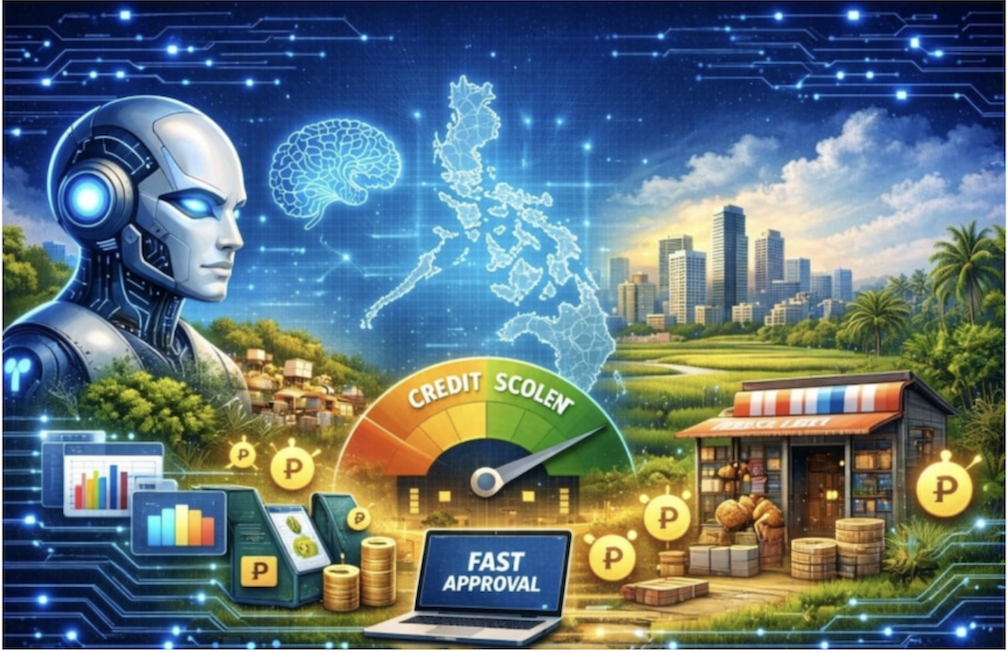
For many Filipinos, the challenge of accessing credit is not always about their ability or willingness to repay.
More often, it stems from a lack of formal records that traditional lenders typically rely on, such as extensive credit histories, collateral, payslips, or bank statements.
This gap is creating opportunities for AI-powered lending models that use alternative data to assess borrowers more dynamically.

IMAGE CREDIT: Magnific
In the Philippines, digital lenders such as Tala are demonstrating how real-time data, transaction patterns, and machine learning can help expand credit access for consumers and micro-entrepreneurs who may otherwise remain outside formal lending channels.
Why traditional credit scoring leaves gaps
Traditional credit scoring systems work well for borrowers who already have established financial footprints. However, many Filipinos continue to operate partly or entirely within cash-based, informal, or mobile-first environments, meaning their economic activity may not always be reflected in conventional credit records.
Based on the latest data from the central bank, this challenge is particularly evident among micro, small, and medium enterprises (MSMEs), where business owners often combine household and business finances.
A sari-sari store owner, online seller, delivery rider, or small service provider may have steady income streams, repeat customers, and a record of responsible repayments but still lack the documentation typically required by banks.

According to the Bangko Sentral ng Pilipinas’ (BSP) 2025 Financial Inclusion Survey, formal access to borrowing is improving, but significant gaps remain.
Formal borrowing surpassed informal lending, with 16% of Filipino adults obtaining loans from formal financial institutions compared to 10% who borrowed from informal sources.
However, adult account ownership declined to 50% from 56% in 2021, indicating that access to formal financial services remains uneven despite improvements in household-level account ownership.
How alternative data changes the credit picture
Alternative data refers to non-traditional information that can help lenders better understand a borrower’s financial behavior. These may include transaction histories, digital payment activity, repayment records, business platform data, mobile-enabled usage patterns, and other consent-based indicators of financial activity.
The value of alternative data does not lie in a single signal. Rather, its strength comes from combining multiple data points to create a more comprehensive picture of a borrower’s financial capacity, consistency, and habits.
When paired with machine learning, these insights can help lenders identify patterns more efficiently than traditional manual underwriting processes. This may support faster credit decisions, more personalized loan offers, and credit limits that more accurately reflect a borrower’s financial activity.
Tala’s approach to AI-powered lending
Tala Philippines recently highlighted the growing role of real-time data, machine learning, and embedded finance in MSME lending during Money20/20 Asia in Bangkok, Thailand. At the event, Tala Philippines General Manager Moritz Gastl shared that alternative data and modern financial infrastructure are now reshaping how lenders assess risk and serve small business owners.
Tala said that approximately one-quarter of its 4.5 million customers in the Philippines use their loans for business-related purposes. The company also reported that nine out of 10 of these borrowers experienced an improved business outlook after receiving financing through the platform.

IMAGE CREDIT: Tala
According to Tala, its underwriting models are trained using billions of data points collected over more than a decade of operations across multiple markets. The company said these insights help strengthen risk assessment and support more personalized credit offerings.
Tala is not alone in exploring AI-driven credit assessment.
Other fintech lenders and digital financial service providers in the Philippines like BillEase are increasingly examining alternative data models as they seek to serve consumers and MSMEs with limited traditional credit histories.
Why MSMEs are central to the shift
The rise of AI-powered lending is particularly relevant for MSMEs, many of which require working capital in smaller, faster, and more flexible amounts.
Traditional loan applications can be time-consuming and documentation-heavy for entrepreneurs who need immediate funding for inventory, supplies, logistics, or seasonal demand.

Digital lending platforms can help address this gap by enabling borrowers to apply through mobile-first channels and receive decisions more quickly.
For businesses operating on thin margins, faster access to capital can mean the difference between restocking inventory on time and missing a sales opportunity.
This does not mean AI-powered lending will replace traditional banks. Instead, it has the potential to complement the formal financial system by creating additional pathways for borrowers who may not yet be fully visible to conventional credit providers.
Embedded finance could expand the model further
Tala has also identified embedded finance as a key part of its broader strategy. Embedded finance allows financial services, including credit products, to be integrated directly into digital platforms and ecosystems where users already conduct transactions.
For MSMEs, embedded lending could eventually make financing available within the platforms they use for selling products, accepting payments, managing logistics, or running daily business operations. This could reduce friction in the borrowing process because lending decisions may be informed by real-time business activity within those ecosystems.
For lenders and platform partners, the appeal lies in access to richer contextual data. Rather than relying solely on static documentation, they can evaluate business performance as it occurs, subject to appropriate consent, privacy safeguards, and regulatory compliance.
The need for responsible AI and data use
CREDIT IMAGE: Magnific (AI-generated)
The growth of AI-powered lending also brings important responsibilities.
As lenders rely on more data to make decisions, they must ensure that borrowers understand what information is being collected, how it is being used, and how their privacy is protected.
There is also a need to address potential bias and prevent new forms of exclusion. AI systems trained on incomplete or skewed data can still produce unfair outcomes, even when supported by advanced technology.
For alternative credit scoring to genuinely support financial inclusion, it must be transparent, secure, and accountable. Strong consumer protection measures, sound data governance practices, and responsible lending standards will remain as important as speed and automation.
What it means for credit access in the Philippines
AI-powered lending is changing how creditworthiness is assessed in the Philippines. Rather than relying solely on formal financial records, lenders are increasingly incorporating digital behavior, transaction activity, and real-time business performance into their evaluation processes.
For underserved Filipinos and small businesses, this could create access to credit that is faster, more flexible, and more aligned with how they earn, spend, and transact. For fintech lenders, it presents an opportunity to serve market segments that traditional credit systems have historically struggled to reach.
The next phase of digital lending will not be defined by artificial intelligence alone. Its long-term success will depend on how effectively fintech firms use alternative data while maintaining transparency, protecting consumers, and building trust among borrowers, regulators, and partners across the broader financial ecosystem.