
Security Bank and Pays0 are bringing banking and payment services closer together, allowing businesses to collect customer payments, send funds, and reconcile transactions through a fintech platform backed by traditional banking infrastructure.
The companies announced their partnership on August 7, combining Pays0’s payment platform with Security Bank’s banking services as more Philippine businesses move collections, payroll, and supplier payments online.
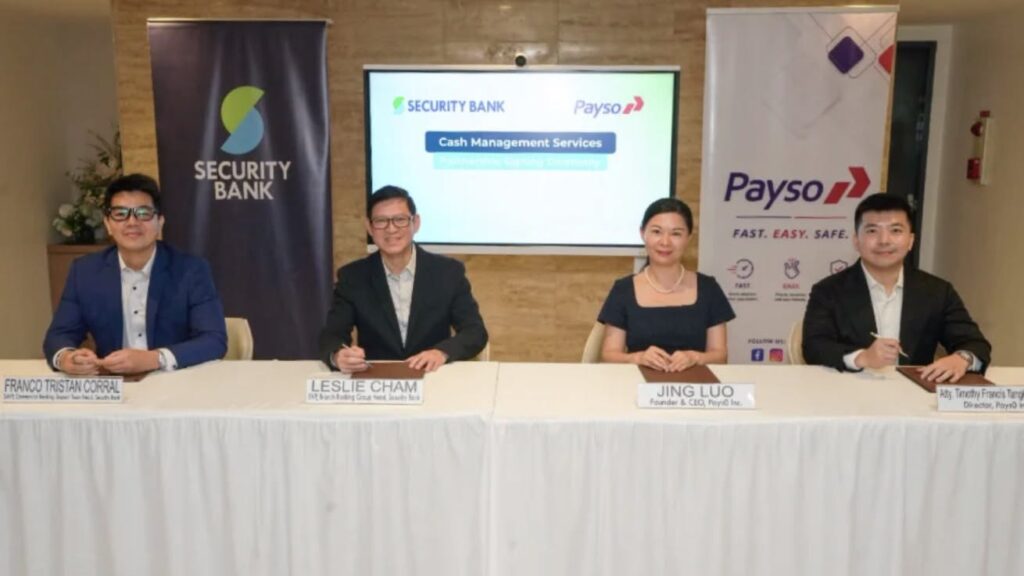
Security Bank described Pays0 as a licensed electronic money issuer (EMI) and payment solutions provider. The arrangement gives Pays0 additional banking support while opening opportunities for Security Bank to extend transaction banking, cash management, foreign exchange, and other financial services through the partnership.
The development reflects a growing shift in financial services: businesses no longer need to interact directly with a bank’s own platform every time they use banking infrastructure.
Banking moves behind the merchant interface
Traditionally, businesses might use separate systems for accepting customer payments, managing a bank account, sending salaries, and paying suppliers.
The Security Bank-Pays0 partnership aims to bring more of these processes together under one seamless umbrella.
Businesses using Pays0 can accept online payments, move funds, and reconcile transactions while the underlying banking relationship supports the movement and management of money. Security Bank said the setup can reduce manual work and help companies manage cash flow more efficiently.
For merchants, that means the fintech platform can remain the interface they interact with, while banking services operate increasingly in the background.
This model is commonly associated with embedded finance, where financial capabilities are integrated directly into platforms businesses already use instead of requiring them to move between separate banking products.
Collections, payroll, and suppliers converge
IMAGE CREDIT: Security Bank
The partnership targets practical, day-to-day business transactions.
Security Bank specifically cited an online merchant collecting customer payments, a company processing payroll, and a business paying suppliers as examples of how the integrated setup can be used.
These functions are particularly relevant to micro-, small-, and medium-sized enterprises (MSMEs), where business owners often handle multiple financial processes themselves.
Bringing collections and payouts onto fewer platforms could make it easier to monitor incoming and outgoing funds while reducing the amount of manual reconciliation needed between payment records and bank transactions.
Security Bank Executive Vice President Leslie Y. Cham noted that the partnership is intended to simplify how businesses collect, send, and manage payments as digital transactions become a larger part of their operations.
Banks find a new role behind fintech platforms
The partnership also shows how competition between banks and fintech companies does not always mean one has to replace the other.
Fintech platforms can own the merchant-facing experience while banks provide regulated infrastructure, cash management, foreign exchange, settlement, and other financial capabilities behind it.
Security Bank said the Pays0 collaboration builds on its role as a banking partner for fintech companies and businesses seeking modern payment solutions.
For Philippine MSMEs, that could mean accessing more financial services without having to assemble every banking and payment function separately.
As embedded finance develops, the bank may become less visible at the point where a business collects or sends money. Its infrastructure, however, could become even more deeply integrated into the platforms merchants use every day.