


Philippine digital banks have proven they can attract customers. The harder question in 2026 is whether they can turn millions of accounts and rapidly growing deposits into sustainable profits.
The sector ended 2025 with ₱138.5 billion in deposits spread across 33.9 million accounts. Digital banks counted 22.4 million depositors, up 81 percent from a year earlier, while their loan portfolio reached ₱71.5 billion by January 2026.
Those numbers point to strong adoption, but scale alone has not guaranteed profitability. As of September 2025, only Maya Bank and Overseas Filipino Bank had been publicly identified as profitable among the six original digital bank license holders.
A third player joined that group in May 2026 when Tonik announced that both the company and its regulated bank subsidiary had recorded positive results for the first quarter.
Growth is still expensive
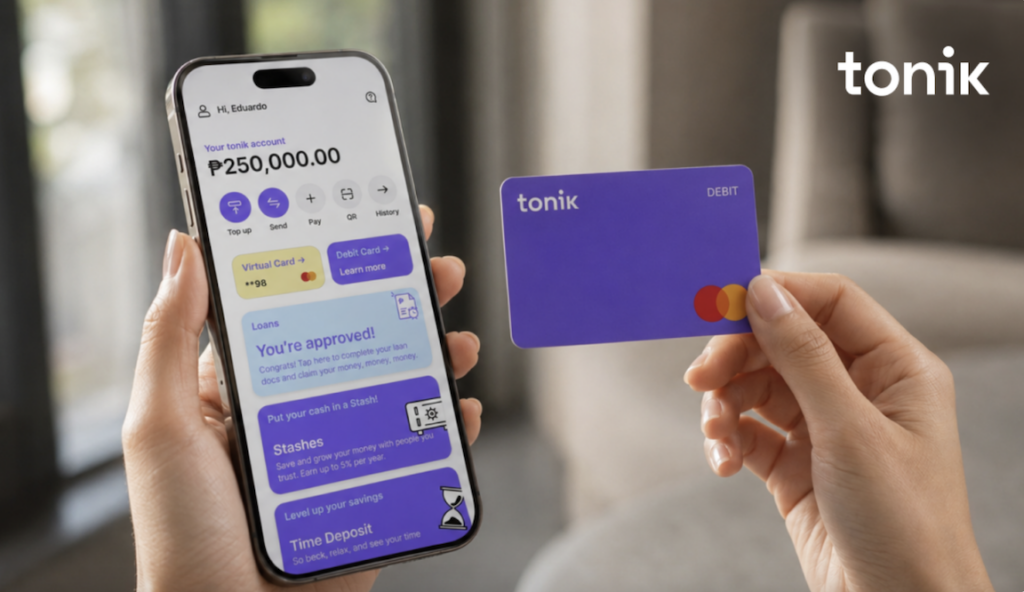
IMAGE CREDIT: Tonik
Digital banks do not operate traditional branch networks, but they are not automatically inexpensive businesses to build. They must invest heavily in technology, cybersecurity, regulatory compliance, customer support, product development, and marketing before revenue catches up.
High savings rates also add to costs. These offers are useful for attracting deposits, but banks still need to lend or invest those funds at returns high enough to cover interest payments, operating expenses, credit losses, and capital requirements.
This is where the industry’s profitability challenge becomes clearer. The digital banking sector’s loan book is growing rapidly, but its nonperforming loan ((NPL) ratio stood at 6.16 percent in January 2026, compared with 3.31 percent for the broader Philippine banking system.
Digital banks often serve borrowers with limited credit histories. This creates an opportunity to expand financial inclusion, but it can also expose banks to higher underwriting and fraud risks if credit models and identity verification controls do not improve alongside growth.
Tonik attributed its first-quarter profitability to a credit-led model, reporting that 99 percent of its annualized revenue run rate came from lending.
Other digital banks are also expanding beyond deposits into personal loans, credit lines, payroll services, merchant financing, and investment products because savings accounts alone generate limited revenue.
Will high savings rates remain attractive?

IMAGE CREDIT: Freepik
Digital banks are unlikely to abandon attractive rates entirely because deposits remain central to customer acquisition and loan funding. However, the most generous offers may become more conditional over the next two years.
Some banks already reserve their highest advertised rates for customers who meet spending, payment, or minimum balance requirements. Others are placing greater emphasis on time deposits, which give banks more certainty that funds will remain available for lending.
Recent changes show how quickly these offers can evolve. Tonik reduced several time-deposit rates effective June 5, 2026, with its 12-month rate falling from 6.5 percent to 5.5 percent.
UnionDigital listed regular savings rates of 3 percent to 3.25 percent, while UNO adjusted its savings rate to as much as 3.5 percent in July.
Rates may therefore remain higher than those offered by many traditional savings accounts, but customers should expect more tiered structures, missions, balance caps, and limited promotional periods.
The headline rate will not necessarily apply to a customer’s entire balance.
Why 2026 could still be the turning point

IMAGE CREDIT: Magnific
The industry is entering a phase in which growth must be matched by stronger lending economics.
Better data, more mature credit models, and access to customers through payroll, retail, e-wallet, and merchant ecosystems could lower acquisition costs while improving underwriting.
Competition could also intensify. The Bangko Sentral ng Pilipinas (BSP) reopened applications after raising the maximum number of digital bank licenses to 10, and it was reviewing three new applications as of March 2026.
New entrants may put pressure on margins through aggressive deposit offers, but they could also push existing players to improve service, pricing, and product offerings.
For customers, the next two years will likely bring fewer digital banks focused solely on savings and more platforms combining deposits, credit, payments, investments, and business services.
Profitability will depend on whether those products can generate recurring revenue without leading to unsustainable loan losses.
Digital banks have already won attention and deposits. Their next challenge is proving that rapid customer adoption can translate into a durable banking business rather than a prolonged competition driven by promotional rates.