

Philippine banks expect lending conditions to remain largely steady in the third quarter, while more businesses are seen turning to banks for financing, according to the latest survey by the Bangko Sentral ng Pilipinas (BSP).
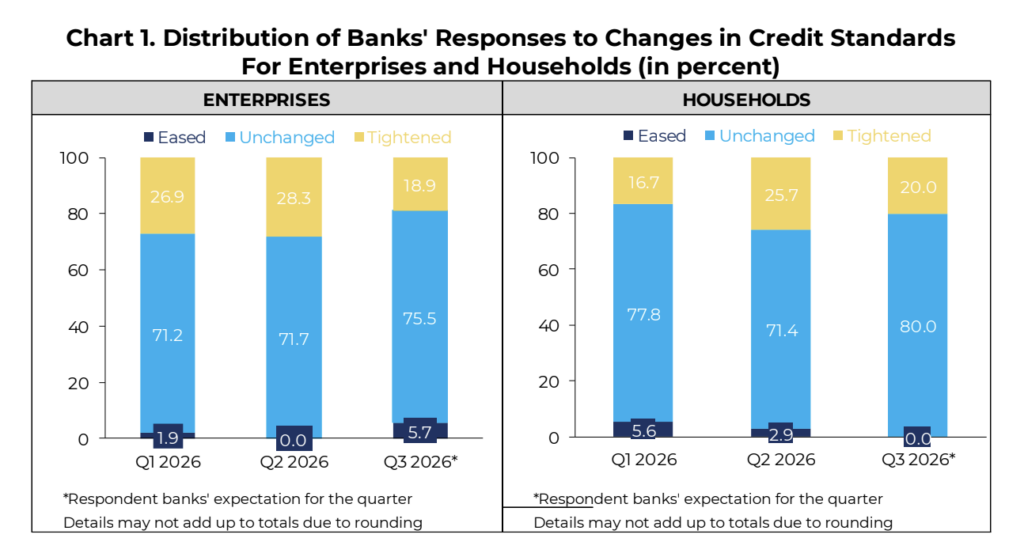
The BSP’s Senior Bank Loan Officers’ Survey (SLOS) showed that 75.5% of respondent banks expect their lending standards for enterprises to remain unchanged in the third quarter. That is higher than the 71.7% recorded in the second quarter.
The outlook is similar for household loans, with 80% of banks expecting no change in their credit standards, up from 71.4% in Q2.
The results suggest that banks are keeping their approach to lending relatively steady despite continued uncertainty in the economic and geopolitical environment.
At the same time, fewer banks are expecting to tighten their lending standards.
For enterprise loans, only 5.7% of banks surveyed expect to tighten credit standards in Q3, a significant drop from 28.3% in the previous quarter. No banks expect to tighten their standards for household loans, compared with 25.7% in Q2.
A small number of banks, meanwhile, expect to ease their standards for enterprise loans.
Businesses are expected to seek more financing
The more notable shift in the survey is on the demand side.
Nearly one-third, or 30.2%, of banks expect demand for enterprise loans to increase in Q3. That is up from 17% in Q2.
At the same time, the share of banks expecting enterprise loan demand to remain unchanged fell to 64.2% from 73.6%. Only 5.7% expect demand to decline.
Banks cited higher inventory financing requirements and increased accounts receivable financing needs among their customers as some of the reasons for the expected rise in borrowing.
An improved economic outlook among businesses is also expected to contribute to stronger demand for credit.
The numbers point to companies becoming more willing to use bank financing for day-to-day operations and working capital as business conditions improve.
Household borrowing also expected to pick up
Banks also see stronger demand for household loans in the third quarter.
The survey pointed to household consumption, higher housing investment and a lack of alternative funding sources as some of the factors that could drive demand.
More attractive financing terms offered by banks were also cited as a factor behind the expected increase.
The diffusion index for household loan demand rose to 24.5% in Q3, from 7.5% in Q2, indicating a stronger net increase in the number of banks expecting demand to grow.
Enterprise loan demand also posted a stronger outlook, with the diffusion index increasing to 24.5% in Q3 from 1.9% in the previous quarter.
Banks remain cautious on credit risks
IMAGE CREDIT: BSP
Despite the more positive outlook for loan demand, banks are not letting their guard down.
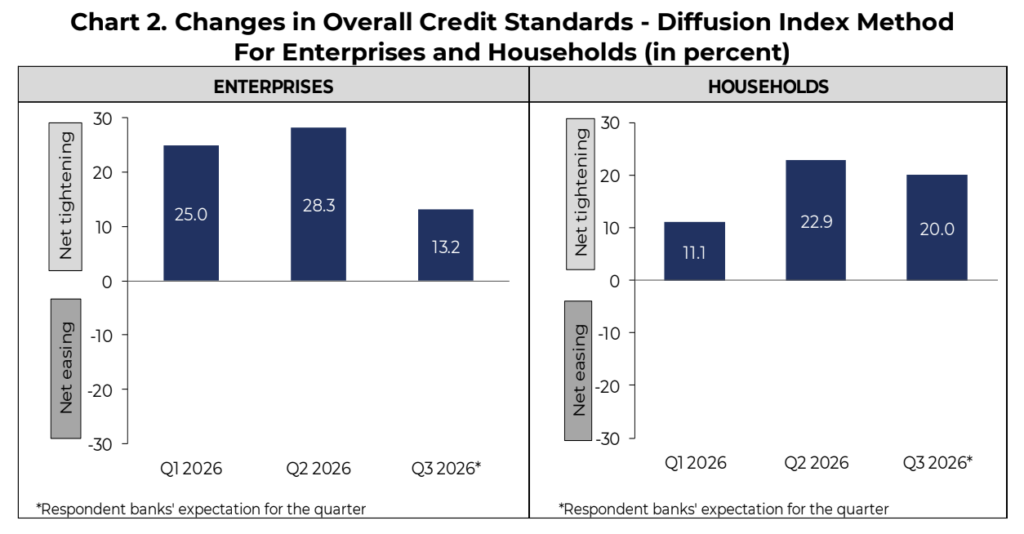
The diffusion index for credit standards remained positive for both enterprise and household loans, indicating that banks still have a net bias toward tighter lending conditions.
Among the factors that could push banks to tighten credit standards are a less favorable or more uncertain economic outlook, lower risk tolerance and a deterioration in borrowers’ financial profiles.
This means that while banks generally do not expect to make major changes to their lending policies in the third quarter, borrowers may still face closer scrutiny when applying for credit.
The latest figures therefore point to a banking sector that is willing to accommodate stronger demand for loans while continuing to manage credit risks.
The BSP survey gathered responses from 56 of the 60 banks covered, representing a 93.3% response rate. Senior loan officers from universal and commercial banks, thrift banks and rural banks participated in the survey, which was conducted from June 3 to July 7, 2026.
The SLOS measures banks’ views on changes in credit standards and loan demand for both businesses and households. It uses a modal approach to determine whether most banks expect standards to tighten, ease or remain unchanged, while the diffusion index measures the difference between banks expecting tighter and easier credit conditions.
For the third quarter, the survey results point to relatively stable lending conditions, but with a clearer expectation that businesses and households will be looking to borrow more.