


As the friction of paying for everyday purchases fades into the background thanks to the growing availability of digital payments, there are still situations that can disrupt an otherwise seamless experience.
Just imagine walking into a convenience store to buy something on your way somewhere. You only have your phone or e-wallet, and as the cashier processes your payment, the transaction fails. You try again, but still nothing.
You soon realize that the problem isn’t your account balance or the payment rail, but rather an unexpected internet shutdown.
For consumers, this brief outage might be a minor inconvenience. For businesses, however, it can lead to longer queues, frustrated customers leaving empty-handed, and ultimately lost sales.
According to Splunk research, this downtime carries hidden costs, including brand damage and lost trust. Around 81% of technology executives reported losing customers due to outages, while nearly 20% of marketing professionals said it took a full quarter for brand health to recover.
However, these risks can be mitigated through innovations such as offline payment capabilities and network failover mechanisms that help merchants continue accepting digital payments even when connectivity is disrupted.

Many businesses unknowingly lose opportunities because customer information, payment systems, booking platforms, marketing tools, and internal operations often run on separate, disconnected technologies.
While each solution may perform its individual function well, the lack of integration can result in slower response times, duplicated work, inconsistent reporting, and fragmented customer experiences — problems that become even more apparent during network disruptions.
As digital payments become increasingly central to commerce, resilience is no longer just about keeping terminals online. It also depends on how well payment infrastructure, business systems, and customer-facing technologies work together when unexpected outages occur.
Richard Noromor, Founder and President of Emerge, said many organizations continue to treat digital tools as standalone solutions instead of viewing them as part of a broader business ecosystem.
“Many businesses keep adding new software to solve individual problems, but the real challenge is making those systems work together. When your payments, customer information, marketing, and operations are connected, you’re in a much better position to keep serving customers even when disruptions occur,” Noromor said.
Keeping payments moving with network failover
To prepare for unexpected disruptions, businesses often rely on network failover to keep digital payment systems running when their primary internet connection becomes unavailable.
In simple terms, network failover serves as an automatic backup mechanism that switches payment traffic to an alternative connection whenever the primary network fails.
Basically, this system is designed to minimize — or even eliminate — the impact of connectivity failures on merchants. The backup connection could be a secondary wired internet service or, more commonly today, a 4G or 5G cellular connection built into or connected to the payment terminal.
When an internet connection drops, manually diagnosing and fixing network issues takes time and can interruptbusiness operations. This is why network failover allows businesses to continue trading seamlessly without additional labor or human intervention.
However, if a store lacks this setup, it can still fall back on a manual solution, such as using a phone’s secure mobile hotspot. While this is not an ideal long-term fix, it can temporarily get a point-of-sale (POS) or card terminal back online until the primary connection is restored.
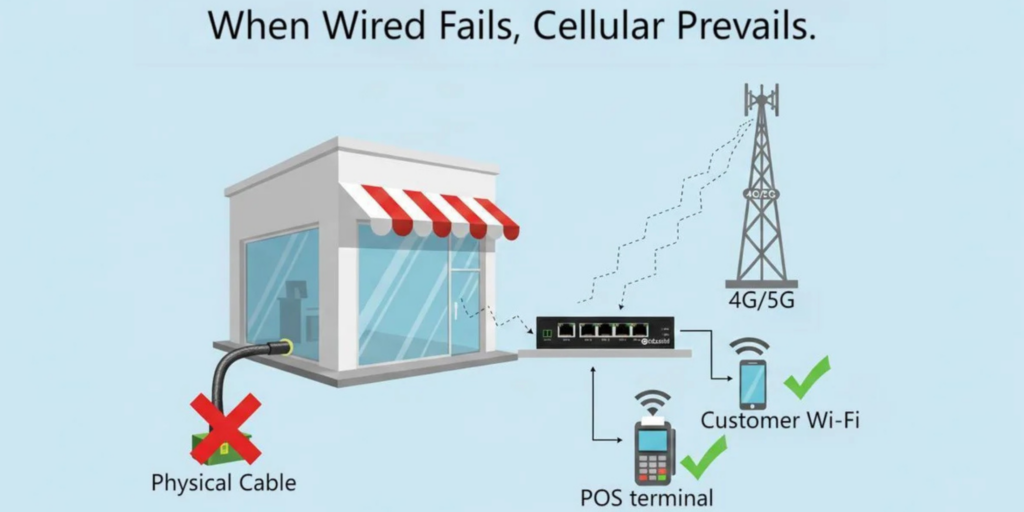
Industry observers note that network failover should no longer be viewed simply as an IT safeguard. For businesses that rely heavily on digital payments, it is increasingly becoming part of customer experience management. Every failed transaction represents a potential lost sale, while every successful backup transaction helps preserve customer confidence and business continuity.
No signal, no problem: Operating in complete offline mode
Although a total internet blackout might sound unlikely, assuming it will never happen is a risk. Complete connectivity disruptions can occur for several reasons.
They may result from typhoons damaging telecommunications infrastructure, poor network coverage at events or venues, or network congestion when too many users are trying to connect at the same time.
To address this worst-case scenario, specialized hardware and software configurations are required. One example is NMI’s payment hardware suite, which supports native offline processing capabilities.
From the customer’s perspective, the payment experience remains largely unchanged. Customers can tap, dip, swipe, or scan a QR code, and the payment terminal immediately responds with a provisional approval.
Behind the scenes, however, the terminal encrypts and securely stores transaction data locally in a PCI-compliant environment. Once the network is restored, the device automatically submits those queued transactions for authorization.
While effective, offline payment modes also come with trade-offs. Since transactions are not authorized in real time, they do not receive the same fraud screening and may therefore be more vulnerable to declines or insufficient funds once they are processed.

IMAGE CREDITS: Magnific
Another concern is the limited storage window for these transactions.
Depending on the processor, device configuration, and hardware, this window can range from 24 to 72 hours. If the device does not reconnect within that period, the stored transactions may expire and become impossible to settle.
For this reason, merchants typically configure offline payment limits based on the value and risk profile of the transactions they accept, balancing business continuity with fraud management.
Offline payments are therefore designed to bridge temporary connectivity gaps rather than permanently replace online authorization. They provide merchants with a practical way to continue serving customers during short-lived disruptions while ensuring transactions are securely processed once connectivity returns.
According to Noromor, resilience extends beyond maintaining internet connectivity. Businesses also need systems that allow customer-facing functions to continue operating even when one component experiences an outage.
“Technology should remove friction, not create it. Our goal is to help businesses simplify operations so their teams can focus on customers and growth instead of constantly switching between disconnected systems,” he said.
Why offline capabilities matter for digital payments
As cashless payments become more deeply embedded in everyday commerce, offline payment capabilities are becoming increasingly important.
They do more than serve as a backup during emergencies. Offline payments also offer several benefits across the broader payment sector.

IMAGE CREDITS: Magnific
First, they can extend financial inclusion to underserved populations.
By reducing reliance on continuous internet connectivity and costly infrastructure, offline digital payments can make digital financial services more accessible to people in areas with limited connectivity and resources.
Second, they transform digital payments from being merely convenient into becoming more resilient.
They help build a stable and reliable payment infrastructure that is less dependent on unpredictable networks, allowing transactions to continue during unforeseen disruptions instead of forcing businesses and consumers back to cash.
Finally, they can provide a cash-like experience.
Offline digital payments can bring some of the convenience and privacy associated with physical cash into the digital payment ecosystem. Depending on how the system is designed, they may offer greater privacy and immediate transaction completion, giving users more control over their data.
The growing adoption of AI, automation, and integrated business platforms also makes payment resilience increasingly important. Modern businesses rely on connected systems that link payments with inventory, customer relationship management (CRM), loyalty programs, bookings, and marketing. A payment interruption can therefore affect far more than a single transaction — it can disrupt multiple business processes at once.
For technology providers, the challenge is no longer limited to enabling digital payments. Increasingly, the focus is shifting toward building connected business systems where payments remain available even when connectivity is compromised. The goal is not digital transformation for its own sake, but creating smoother customer experiences, greater operational efficiency, and sustainable business growth.

IMAGE CREDITS: Emerge
Emerge advocates what it calls the HUGS (Humans Using Growth Systems) methodology, which encourages organizations to align marketing, sales, customer service, and operations around a shared customer journey supported by practical automation and AI where appropriate.
Noromor said organizations should shift the conversation away from simply acquiring more software and instead focus on building connected business systems that improve both operational efficiency and customer experience.
“Digital transformation isn’t about adopting the latest technology for its own sake. It’s about creating systems that work together to deliver better customer experiences, support employees, and help businesses grow sustainably,” he said.
As more economies move toward cashless transactions, resilience is becoming just as important as convenience. Consumers increasingly expect digital payments to work whenever and wherever they need them — even when internet connectivity becomes unreliable.
For payment providers, merchants, and financial institutions, investing in technologies such as network failover and offline payment capabilities is no longer simply about preparing for rare outages. It is increasingly becoming part of building a payments ecosystem that customers can trust under virtually any circumstance.
In that sense, the future of digital payments will be measured not only by how fast transactions can be completed, but also by how reliably they continue to work when unexpected disruptions occur. As businesses become more dependent on digital commerce, resilience is emerging as one of the defining features of the next generation of payment infrastructure.