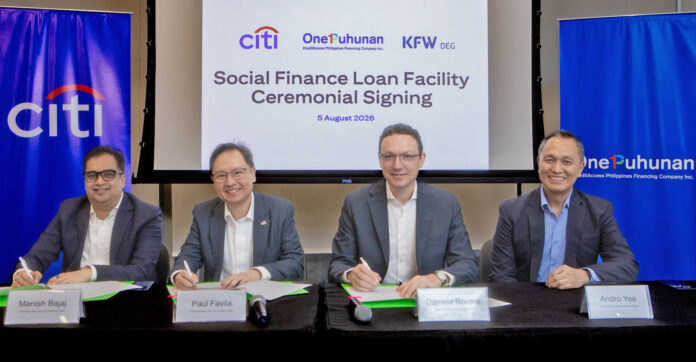
Citi and German development finance institution DEG are providing more than ₱1.5 billion in financing to OnePuhunan to expand lending to Filipino microentrepreneurs, particularly women running small businesses.
Citi is providing more than ₱300 million directly and coordinated the transaction, mobilizing more than ₱1.2 billion from DEG, a member of Germany’s KfW Group. The transaction marks DEG’s first debt financing in the Philippine financial inclusion sector and Citi’s first Social Finance partnership with DEG in the country.
OnePuhunan, formally CreditAccess Philippines Financing Company Inc., said the additional funding would support the expansion of its microfinance portfolio as well as the continued digitalization of its operations and services.
The company focuses on low-income individuals and small businesses that may have limited access to traditional banking services. It is registered as a financing company and regulated by the Securities and Exchange Commission.
As of 2025, OnePuhunan had more than ₱10 billion in gross loans outstanding and served more than 600,000 borrowers through 315 branches across all 16 regions of the Philippines.

OnePuhunan President and CEO Daniele Rovere said the financing would allow the company to reach more borrowers while accelerating the digitalization of its operations and offerings.
For borrowers, however, the transaction raises a broader question: where does a microfinance lender get the billions of pesos that it eventually lends out in much smaller amounts?
How does ₱1.5 billion become thousands of smaller loans?
A financing company does not operate exactly like a traditional bank.
Banks can use customer deposits as one of their major sources of funds for lending. A financing company such as OnePuhunan instead relies on sources that can include shareholder capital, retained earnings and borrowing from banks, investors and development finance institutions.
That is where transactions such as the Citi-DEG facility come in.
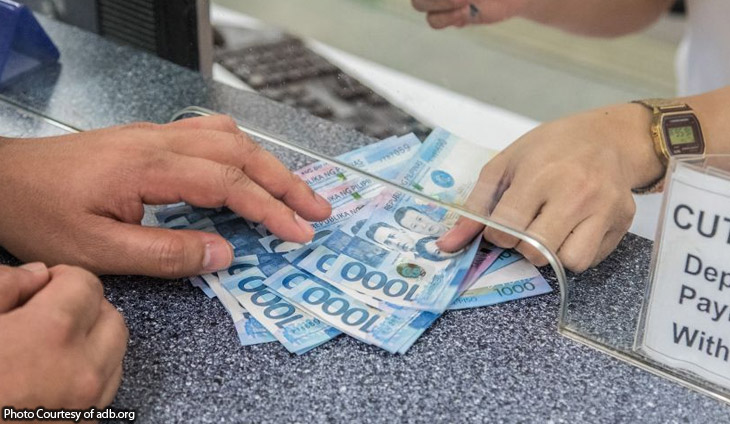
IMAGE CREDIT: ADB.org
Rather than Citi and DEG selecting individual sari-sari stores or microbusiness owners to finance, the institutions provide a much larger loan to OnePuhunan. The microfinance lender can then use that additional funding capacity to extend smaller loans across its borrower base under its own lending and credit processes.
This process is commonly referred to as on-lending.
Development finance institutions frequently use the model because it allows them to reach borrowers that would be difficult to serve individually. Instead of making thousands of small loans themselves, they provide wholesale financing to a financial institution that already has branches, credit systems and relationships with borrowers.
The latest transaction is not the first example of this model involving OnePuhunan this year.
In March, the International Finance Corporation announced an up-to-$60 million three-year senior loan for OnePuhunan. The facility included up to $20 million directly from IFC and up to $40 million in mobilized financing, with the proceeds earmarked for on-lending to women-owned or women-led microenterprises in rural areas.
IFC said at the time that the financing was also intended to help OnePuhunan diversify its funding base and gain access to additional sources of capital as it grows.
Having several institutional funding sources can matter for a rapidly expanding lender. Its ability to issue new loans depends partly on having enough capital and liquidity available to support that portfolio.
For a microentrepreneur, the eventual loan may only be a fraction of the billions being announced at the institutional level. But behind those smaller loans can be a chain of financing that begins with global banks and development institutions providing capital to lenders already operating in local communities.
The Citi-DEG facility effectively adds another source to that chain, giving OnePuhunan additional capacity to finance women-led microbusinesses while continuing its nationwide expansion and digitalization plans.