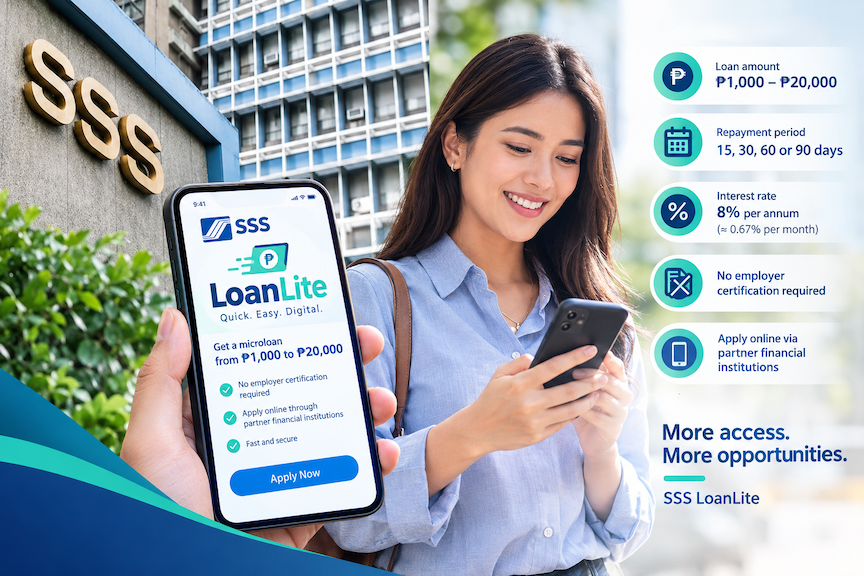
The Social Security System (SSS) has officially rolled out its new SSS LoanLite microloan program, allowing qualified members to borrow between ₱1,000 and ₱20,000 online without securing employer certification.
The facility gives eligible members a fully digital way to access short-term credit through participating financial institutions. UnionDigital Bank is the first partner currently accepting applications through its mobile app, with other participating institutions expected to follow as their systems become ready.
The launch marks a shift from the traditional SSS salary loan process, where employed members generally need their employer to certify the application and handle payroll deductions. Under LoanLite, the application is processed digitally through the participating financial institution, removing that employer certification requirement.
SSS removes employer certification from digital microloans
The SSS LoanLite is designed as a short-term credit facility for members who need relatively small amounts for immediate expenses, including emergencies, medical needs, education, household essentials, and small business needs.
For employed members, one of the biggest changes is the removal of the usual employer certification. Traditional SSS salary loans require an employer to certify that a worker is currently employed, has sufficient take-home pay to cover repayments, and can have the loan collected through payroll deductions.
LoanLite takes a different approach. Qualified members apply directly through the digital platform of a participating financial institution, with eligibility validated through SSS and the partner’s systems.
According to SSS, the process may allow eligible applications to be processed and approved within minutes, although actual approval remains subject to applicable eligibility checks, verification procedures, and system processing.
This means employees no longer need to coordinate with their HR departments simply to obtain employer certification before applying for this particular SSS loan facility.
Members can borrow up to ₱20,000
Under SSS LoanLite, eligible members can apply for between ₱1,000 and ₱20,000, with the maximum amount determined based on the average of their 12 latest Monthly Salary Credits.
Borrowers can choose repayment periods of 15, 30, 60, or 90 days, giving members shorter repayment options depending on their financial capacity.
The interest rate is set at 8% per annum, equivalent to approximately 0.67% per month. Applicable charges and therepayment schedule are fully disclosed to the borrower before the loan is accepted.
SSS said the facility is intended to provide a safer and more affordable alternative to high-cost informal lending, particularly for members who need relatively small amounts of money on short notice.
Who can qualify for SSS LoanLite?
The program is available to qualified employed, self-employed, voluntary, and land-based OFW members, subject to the requirements under SSS Circular No. 2026-005.
For the current LoanLite implementation, members must generally have at least 36 total monthly contributions, including at least six posted contributions within the 12 months immediately preceding the loan application.
Applicants must also have no past-due Short-Term Member Loan or active SSS Micro Loan, and must maintain an account with the participating financial institution enrolled in its online facility. Other requirements covering age, existing loans, benefit claims, and SSS account status also apply.
SSS previously indicated that the program would be open to members with at least 12 posted contributions. However, the current implementation details under Circular No. 2026-005 specify the higher contribution requirement for the LoanLite facility now being rolled out. Members should therefore check their eligibility through the participating institution before applying.
UnionDigital Bank is the first digital lending partner
SSS LoanLite is being delivered through participating financial institutions rather than directly through the My.SSS portal.
UnionDigital Bank is currently the first partner to make the facility available, with qualified members able to apply through its mobile application. SSS said other participating financial institutions will make LoanLite available through their respective digital platforms as their systems become ready.
SSS has identified UnionDigital Bank, RCBC, Land Bank of the Philippines, and UnionBank of the Philippines as participating financial institutions for the program. The SSS LoanLite page also indicates that additional financial institutions may be onboarded in the future.
The move reflects a broader effort to make government financial services more accessible through private-sector digital banking infrastructure. Instead of requiring every loan transaction to pass through an employer or a physical SSS channel, the program connects SSS member records with financial institutions that can handle digital applications, verification, disbursement, and repayment.
Loan proceeds go directly to the borrower’s account
Once approved, loan proceeds are credited directly to the borrower’s account with the participating financial institution.
Repayment is primarily handled through an automatic debit arrangement, with deductions generally taken from the account where the loan proceeds were credited. Members are encouraged to ensure that sufficient funds are available when payments become due.
SSS also allows LoanLite repayments through other channels depending on the participating financial institution. Its official program page lists options such as automatic debit, online bills payment, bank or e-wallet transfers, and over-the-counter payments where available.
SSS offers an alternative to informal lenders
The microloan program is part of SSS’ broader financial inclusion strategy, particularly its effort to give members access to formal credit when they face immediate financial needs.
The Department of Finance previously stated that the program was intended to help protect SSS members from high-cost informal lending. The original framework called for loans of ₱1,000 to ₱20,000, repayment periods of 15 to 90 days, and an 8% annual interest rate.
That objective is particularly relevant in a market where borrowers seeking small amounts may turn to informal lenders because traditional credit products can involve lengthy requirements or mandatory employer involvement.
By placing smaller loans inside a regulated social security and financial institution framework, SSS is providingmembers with a viable formal option before they turn to potentially predatory sources of emergency cash.
Digital convenience comes with borrowing responsibility
While LoanLite speeds up the borrowing process, easier application does not remove the need for borrowers to assess whether they can repay the loan on time.
Because repayment periods can be as short as 15 days, a loan that is convenient to obtain can quickly create a significant near-term payment obligation.
SSS advises members to review the loan disclosure statement carefully before accepting an offer, including applicableinterest, fees, repayment schedules, and other terms and conditions. The agency also warned members to use only the official mobile applications of participating financial institutions and avoid third parties offering fake processing services.
SSS moves more member services into digital finance
LoanLite is another example of how SSS is moving beyond traditional government service channels and using digital financial institutions to deliver core member services.
The program was initially announced as part of SSS’ broader expansion of financial assistance programs, with the agency targeting a LoanLite portfolio of up to ₱40 billion over two years.
The strategy also reflects a wider convergence between government services, banking, and fintech. Instead of building an entirely separate digital lending infrastructure, SSS is leveraging participating financial institutions to provide the customer-facing technology and financial rails while maintaining control over member eligibility and program rules.
For Filipino workers, the practical impact is straightforward: accessing a small SSS loan no longer requires going through an employer first.
Qualified members can apply digitally, receive funds directly through a participating financial institution, and repay over a short period — bringing SSS credit closer to the instant digital financial services Filipinos use for everyday transactions.