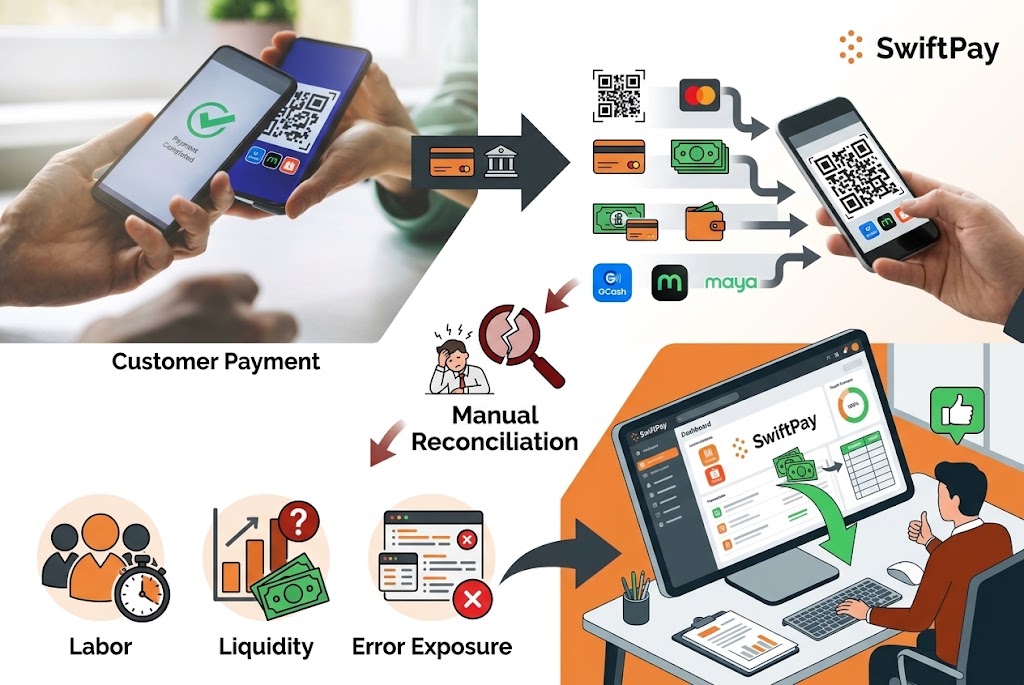
Payment reconciliation in the Philippines is becoming a bigger operational issue for businesses as customers increasingly move across QR codes, e-wallets, cards, and bank transfers, according to enterprise payment provider SwiftPay.
During its September 8 webinar, “Your Payments Went Digital. Your Back Office Is Paying for It,” SwiftPay executives led by Aya Montebon, chief marketing officer, and Genella Malang, REB, senior sales director, said accepting digital payments is only one part of the process. Finance teams still need to identify transactions, match them against internal records and settlement reports, and eventually reflect the money in a company’s accounting or enterprise resource planning (ERP) system.
The issue is becoming more visible as the Philippine payments market grows.
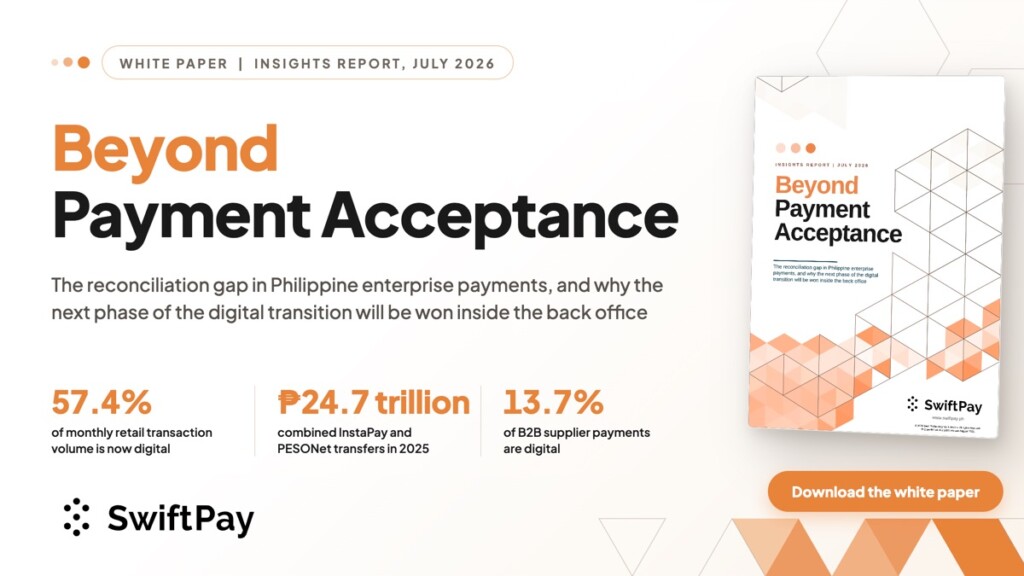
According to the Bangko Sentral ng Pilipinas (BSP) Report on E-Payments Measurement, digital channels accounted for 64.69% of retail payment volume in 2025, up from 57.45% in 2024.
Business-initiated payments, however, remained much less digitized at 18.75% by volume, down from 19.8% a year earlier. Consumer-initiated payments were nearly 75% digital, leaving a gap of more than 56 percentage points between the two.
The shift is also visible in the country’s major electronic fund transfer systems. InstaPay and PESONet processed a combined ₱24.74 trillion in 2025, up 42% from ₱17.42 trillion in 2024, according to the BSP’s 2025 Peso RTGS Payment System Report.
For SwiftPay, higher transaction volumes raise another question: what happens after the customer sees the payment confirmation?
The payment may be complete for the customer, but not for finance
Businesses today can collect through QR Ph, e-wallets, debit and credit cards, online banking, and other payment channels without necessarily replacing older methods such as checks and conventional bank transfers.
Each channel can come with its own transaction confirmation, settlement file, dashboard, or portal. Someone inside the business must then bring those records together and determine which payment corresponds to which transaction.
SwiftPay calls the distance between a payment being confirmed and eventually being recorded and usable inside a company’s financial system the “reconciliation gap.”
A payment, for example, may already have reached a company’s account while a customer’s receivable remains marked as unpaid because the transaction has yet to be matched internally.
That distinction can affect more than accounting. SwiftPay said delayed reconciliation can leave finance teams looking at an incomplete cash position when deciding which payments to release, which receivables to pursue, or how much money is currently available for use.
“Settlement puts money in the bank, but only reconciliation puts it in your system so you can actually use it. Until that match happens, your finance team is essentially operating with one eye closed,” explained Ms. Malang during the webinar.
SwiftPay sees three hidden costs
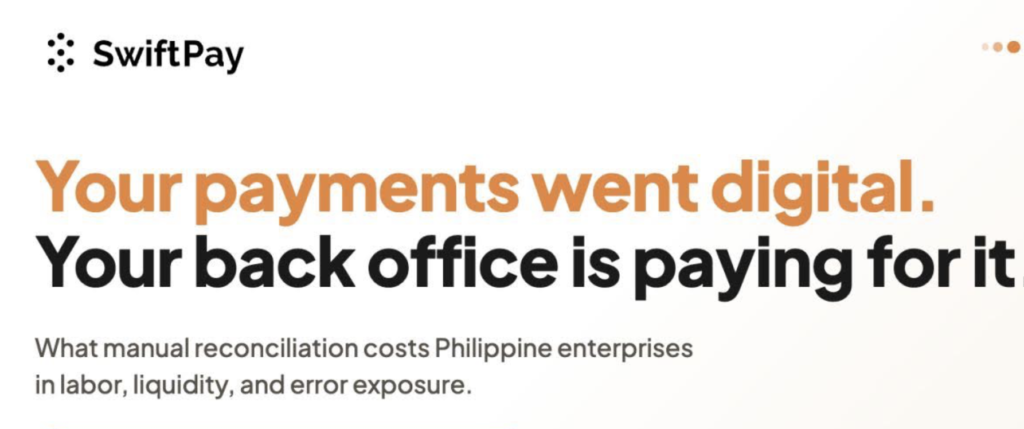
SwiftPay grouped the consequences of manual reconciliation into three areas: labor, liquidity, and error exposure.
The first comes from the people needed to manage it.
In one pattern discussed during the webinar, finance teams may download settlement records from several portals, compare them with bank statements in spreadsheets, and separately investigate transfers with incorrect references, deducted fees or other discrepancies.
Unlike a temporary migration problem, SwiftPay argued that this workload can persist because businesses are unlikely to return to accepting only one payment method.
The second cost is cash visibility.
If payments have been received but remain unmatched, reports on receivables and available cash may not fully reflect the company’s actual position. Customer-facing processes such as confirming enrollment, clearing an account, or issuing a refund can also remain pending even after the payment itself has settled.
The third area is error exposure.
Manual processes can result in payments being applied to the wrong account or transaction discrepancies requiring additional investigation. During an audit, tracing a particular payment can also become difficult when supporting information is spread across spreadsheets, payment portals and historical exports.
SwiftPay said its observations were partly based on qualitative research involving in-depth interviews with finance leaders at mid-market Philippine enterprises.
The company emphasized that the research was not a statistical survey. Instead, it was designed to identify recurring patterns in how reconciliation is handled within businesses.
Five stages from manual matching to automation
SwiftPay also introduced a five-stage framework that businesses can use to assess how mature their reconciliation operations are.
Stage one is largely ad hoc. Transactions are investigated when a customer complains, a discrepancy appears, or an auditor requests information.
At stage two, reconciliation becomes an established process with assigned employees and a weekly or month-end schedule. It is more dependable, but growth can still mean more employees or longer working hours devoted to matching transactions.
Stage three introduces tools such as dashboards, templates, or automated features that handle straightforward matches. Finance employees can then concentrate on exceptions such as partial payments, deducted fees and incorrect reference numbers.
Stage four involves integrating reconciliation directly into an ERP or core financial system. Payments from several channels can be automatically matched while staff primarily manage exceptions.
Stage five, the final stage, is what SwiftPay calls a “straight-through operation,” where a cleared payment can automatically update a ledger or receivable, release an order, or trigger another related process without manual intervention.
SwiftPay acknowledged that few organizations currently operate entirely at Stage 5.
Getting there requires more than purchasing reconciliation software; companies may need to integrate systems, redesign internal processes, and determine which platform will serve as the single source of financial truth.
Automation may not mean immediate cost savings
During the webinar, SwiftPay executives also cautioned that the benefits of automating reconciliation may not arrive at the same time.
It expects error exposure to improve first as transaction records become easier to trace. Better cash visibility can follow as records become more current, while labor savings may take longer because unusual and complicated transactions are often the hardest to automate.
That means the next stage of the Philippines’ digital payments transition may increasingly involve what happens behind the checkout screen.
Customers may now complete a payment within seconds, but for businesses handling thousands or millions of transactions, the process is only truly finished once that payment can move accurately into the financial records that the rest of the company relies on.
SwiftPay is a BSP-regulated Operator of Payment Systems (OPS) that provides payment acceptance, disbursement, and automated reconciliation services. It serves more than 500 businesses and processes more than 30 million transactions monthly.