

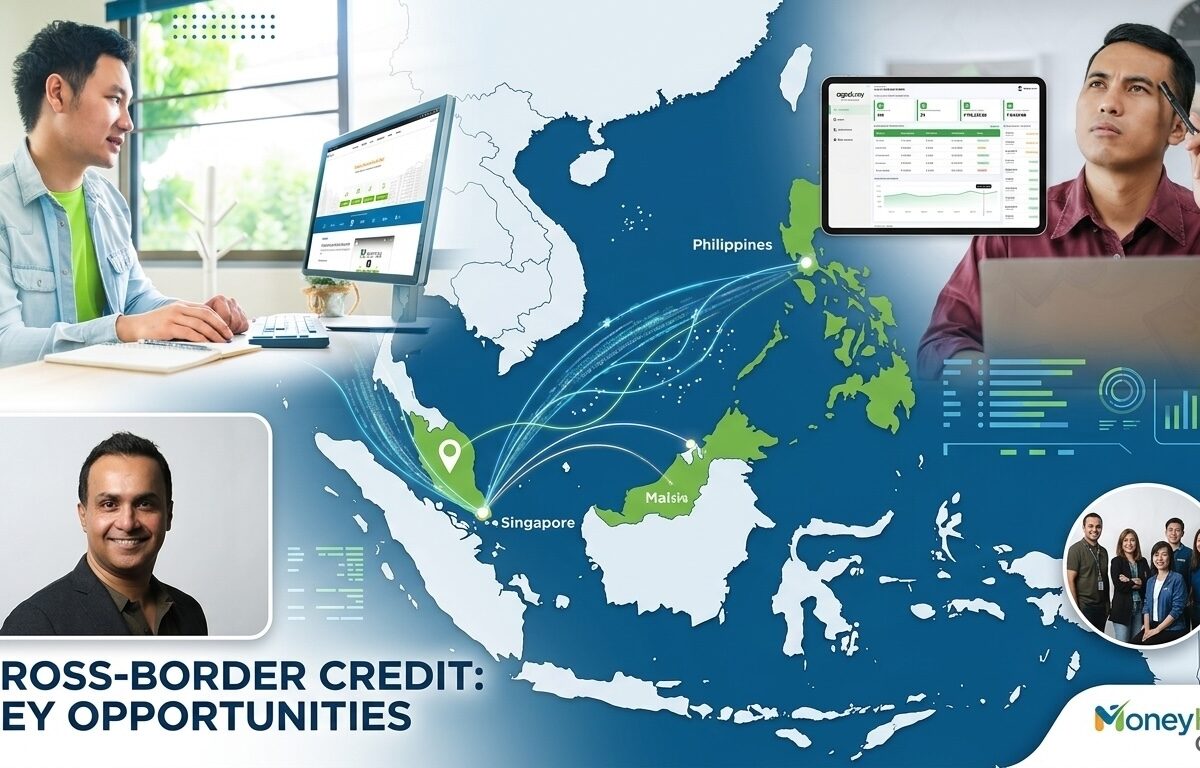
Moving to a new country often means leaving years of hard-earned financial history behind, but Southeast Asia’s credit borders are finally beginning to dissolve, according to Shravan Thakur, Group Chief Commercial Officer of MoneyHero Group, in an exclusive interview with FintechNewsPH.
A consumer can spend a decade building a strong repayment record in one market, only to arrive in another with little to no usable credit history — making it significantly harder to qualify for loans, credit cards, and other essential financial products, or forcing them to accept far less favorable terms.
That status quo, however, is starting to shift as regional credit bureaus explore ways to share verified borrower data across borders.
Credit Bureau Singapore (CBS) and Experian Malaysia are already developing a two-way, consent-based framework for cross-border credit reporting, allowing credit information to flow between the two markets.
As consumers and businesses become increasingly mobile across the region, the initiative raises a critical question for banks and fintech companies: if people can cross borders with their jobs, businesses, and financial obligations, shouldn’t their credit histories move with them?
While current tests remain specific to Singapore and Malaysia, the framework could have far-reaching implications for highly mobile populations across Southeast Asia, including the Philippines.
A credit history that travels

Shravan Thakur, Group Chief Commercial Officer at MoneyHero Group
“Today, years of responsible repayment become invisible the moment you cross a border,” said Shravan Thakur, Group Chief Commercial Officer at MoneyHero Group. “This two-way, consent-based framework changes that—lenders no longer have to treat established borrowers as new-to-credit customers.”
Expatriates are among the most obvious beneficiaries, but Thakur said the potential reach is much broader.
Cross-border workers, overseas Filipino workers (OFWs), students, property buyers, digital entrepreneurs, small businesses and consumers who regularly transact across markets can all have financial activity in one country that is difficult for lenders to see in another.
The problem is not necessarily that these customers lack a financial track record. It is that their history may not be available to a lender operating in their new market.
“Traditional credit assessment was built for a world where people banked, borrowed, and built their lives in one jurisdiction,” Thakur explained. “The data exists; the systems just haven’t been connected. Collaborations like CBS–Experian suggest the industry is finally catching up.”
For banks and digital lenders, access to verified information from another market could provide a fuller picture of a customer’s creditworthiness.
That could influence decisions on loans and credit cards, as well as the interest rates and other terms offered to borrowers. It could also reduce the need to treat customers with established repayment records as high-risk simply because they are new to the local credit system.
For consumers, the benefit could be straightforward: fewer financial barriers simply because they moved.
The Philippines still needs to strengthen its domestic credit system

IMAGE CREDIT: MoneyMax
For the Philippines — where MoneyHero operates through its local financial comparison platform Moneymax — the regional development is particularly relevant.
The country has a large overseas workforce and a highly mobile population. Many Filipinos also maintain financial relationships in more than one country, whether through remittances, employment, property ownership, investments or business activities.
The Bangko Sentral ng Pilipinas (BSP) has made financial inclusion a policy priority through its National Strategy for Financial Inclusion (NSFI) 2022–2028.
But before cross-border credit reporting can become useful at scale, the country needs to continue expanding the number of Filipinos with usable credit records.
Roughly 95% of Filipinos remain credit invisible domestically. For people without sufficient credit information, financial activity may still be taking place, but lenders have limited data with which to assess how they manage borrowing and repayments.
Bringing more consumers into the formal financial system would therefore strengthen the foundation for any future cross-border credit-data framework.
Central bank data also points to greater consumer awareness of formal financial services, with 64% of adult Filipinos reportedly checking whether a financial provider is regulated before transacting.
The next challenge is turning more of that financial activity into reliable, accessible credit information.
More data could mean better financial matches
IMAGE CREDIT: MoneyMax
The potential impact goes beyond loan approvals.
For financial comparison platforms, more complete credit information could help consumers identify products that are better suited to their circumstances.
Today, consumers often have to rely on broad eligibility requirements when comparing loans, credit cards and other financial products. Incomplete information can result in applications for products they are unlikely to qualify for, followed by a rejection.
With a fuller financial profile, comparison platforms could potentially make more relevant recommendations based on a consumer’s actual financial position.
That could help consumers narrow down their choices and reduce unnecessary applications, while giving financial institutions a better basis for assessing potential customers.
The same principle could apply to businesses. SMEs operating across markets can face similar challenges when their financial activities are spread across different jurisdictions.
A lender may see only part of a company’s financial picture, even when the business has an established record elsewhere.
Cross-border credit reporting could help close some of those information gaps, provided the information being shared is accurate and relevant.
Responsible lending still depends on safeguards
Greater access to financial data does not automatically mean better outcomes.
Credit information has to be accurate, updated and handled appropriately. Consumers also need to know when their information is being shared and give meaningful consent for its use.
Thakur said these safeguards will be important as financial institutions and fintech companies explore greater connectivity between markets.
“The real promise isn’t faster approvals but wiser decisions, made with confidence,” he said.
That means cross-border credit reporting should not simply be viewed as a way for lenders to approve more applications. Better information could also help lenders make more informed risk assessments and avoid extending credit on the basis of incomplete information.
Strong governance will be necessary to make that work.
Data accuracy, consumer consent, security and regulatory oversight will remain important as more financial information moves between jurisdictions.
Could Singapore-Malaysia become a model for Asia?
The Singapore-Malaysia initiative is still specific to those two markets, and other countries would need to consider their own regulatory frameworks, credit-reporting systems and data-protection requirements.
But it provides a useful reference point for markets facing the same underlying problem: consumers and businesses are becoming increasingly mobile, while financial information remains largely tied to individual jurisdictions.
For the Philippines, that question is particularly relevant.
Millions of Filipinos work or study overseas, send and receive money across borders, own property abroad or operate businesses with international connections. A credit history that stops at the border does not necessarily reflect the financial reality of those consumers.
As domestic credit reporting continues to develop and regional financial systems become more connected, the industry could move toward a model in which a borrower’s financial history is not automatically reset when they enter a new market.
For banks and fintech companies, that could mean better risk assessment.
For comparison platforms, it could mean more relevant product recommendations. And for consumers, it could mean that years of responsible financial behavior continue to count — even after they cross a border.