
Globe AT HOME fiber subscribers continued to climb in the first half of 2026 as more Filipino households shifted from legacy fixed wireless services to faster and more reliable fiber connections.
Globe said its wired broadband subscriber base grew 32% year-on-year to more than 2 million as of June 2026. The growth helped offset the continued decline in legacy fixed wireless subscribers and strengthened the company’s position in the home broadband market.
Fiber drives Globe AT HOME growth
The shift to fiber is becoming increasingly central to Globe’s broadband business. Globe AT HOME generated ₱12.4 billion in broadband revenues during the first half of 2026, representing a 6% increase from the same period last year.
Fiber accounted for 93% of total Globe AT HOME broadband revenues, highlighting how quickly Filipino households are moving toward wired connectivity. The company attributed the shift to growing demand for faster, more reliable, and future-ready home internet services.
The trend was already visible earlier in the year. In the first quarter, Globe AT HOME broadband revenues reached ₱6.2 billion, also up 6% year-on-year, while total broadband subscribers reached 2.2 million. Fiber similarly accounted for about 93% of home broadband revenues during the period.
GFiber prepaid users reach 1.1 million

A major driver of the growth has been GFiber Prepaid, Globe’s prepaid fiber offering designed for households looking for more flexible home internet without a fixed monthly commitment.
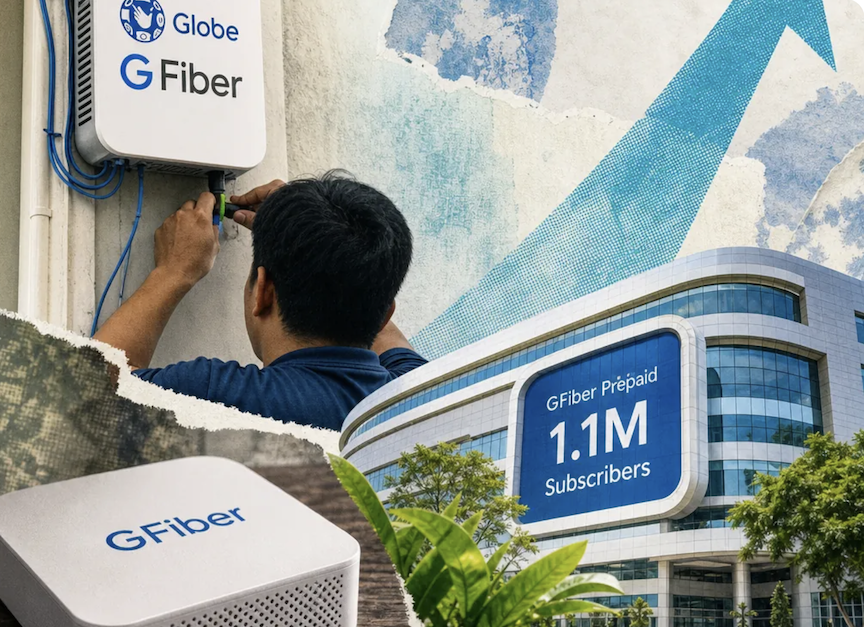
As of the end of June, GFiber Prepaid reached 1.1 million subscribers, up from the one-million milestone recorded in March. Globe said growth was supported by higher-value reloads, pointing to stronger engagement among customers using the service.
The prepaid model gives households greater control over their connectivity spending. Globe describes GFiber Prepaid as a fiber service with no contract or fixed monthly fee, with prepaid unlimited-surfing options available through its channels.
The product’s growth also reflects a broader push to make fiber connectivity more accessible beyond traditional postpaid customers.
More homes moving to wired connectivity
Globe’s latest results show that fiber is no longer simply an alternative broadband technology but an increasingly dominant part of how Filipino households connect to the internet.
The company has continued directing investments toward digital and network infrastructure. Globe invested ₱26.3 billion in capital expenditures during the first half of 2026, with around 91% allocated to data and digital infrastructure, including initiatives supporting connectivity and network expansion.
For households, the shift to fiber comes as internet use continues to expand across work, education, entertainment, digital services, and everyday communication.
With more than a million GFiber Prepaid customers and wired broadband subscribers continuing to grow, Globe’s strategy is increasingly centered on bringing fiber connectivity to a wider portion of the Philippine market.