


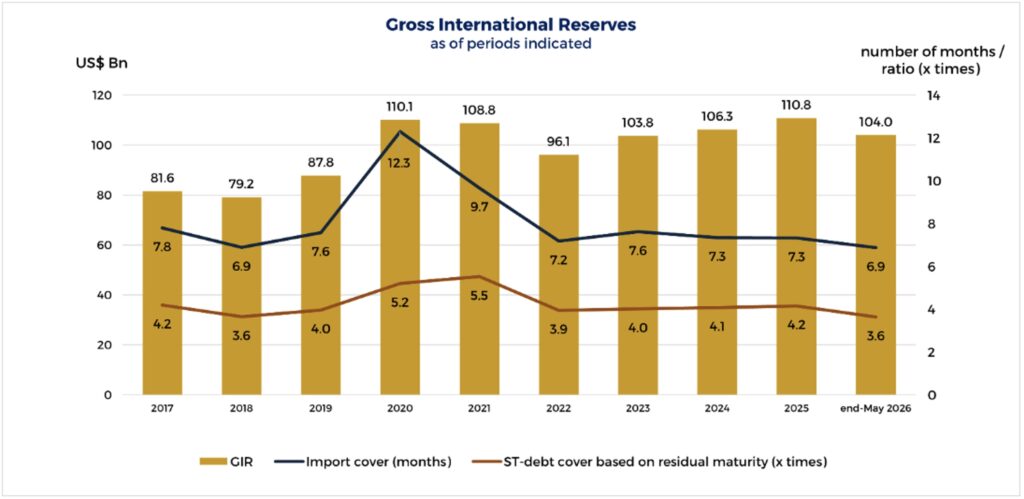
The Philippines’ gross international reserves (GIR) declined slightly to US$104.0 billion as of end-May 2026, reflecting government debt payments and valuation losses on gold holdings, according to preliminary data released by the Bangko Sentral ng Pilipinas (BSP).
The latest reserve level was lower than the previous month’s figure as the national government tapped its foreign currency deposits with the central bank to meet external debt service obligations.
The BSP also cited downward valuation adjustments on its gold holdings following a decline in global gold prices, as well as the impact of its net foreign exchange operations.
Despite the month-on-month decline,[1] the central bank said the country’s reserve position remains strong and continues to provide a substantial buffer against external risks.
At US$104.0 billion, the country’s foreign exchange reserves are sufficient to cover approximately 6.9 months’ worth of imports of goods and payments for services and primary income. This is more than double the international benchmark of at least three months of import cover commonly used to assess reserve adequacy.
The reserve level is also equivalent to about 3.6 times the country’s short-term external debt based on residual maturity, [2] [3] indicating ample capacity to meet debt obligations falling due within the next 12 months.
Reserves remain strong despite May’s modest decline
Gross international reserves represent the country’s stockpile of foreign assets, including foreign securities, deposits, and monetary gold that are readily available to the central bank. [4]
These reserves serve as a critical safeguard for the economy, helping ensure sufficient foreign currency liquidity during periods of financial stress or market volatility.
A healthy reserve position allows the country to pay for imports, service foreign debt, and cushion the economy against external shocks such as sudden capital outflows, global economic downturns, or sharp currency fluctuations.
The BSP has consistently emphasized the importance of maintaining adequate reserve buffers as uncertainties persist in the global economic environment. International reserves also strengthen investor confidence by signaling the country’s ability to meet its external obligations even during adverse conditions.
While the May decline reflects routine debt servicing and market-driven valuation adjustments, the latest GIR level remains among the strongest in the region and continues to indicate a resilient external position for the Philippine economy.
The BSP noted that eligible reserve assets are defined under the International Monetary Fund’s Balance of Payments Manual and form a key component of the country’s overall external liquidity and financial stability framework.
—
[1] By convention, GIR is considered adequate if it can finance at least three-months’ worth of the country’s imports of goods and payments of services and primary income. The latest GIR level ensures availability of foreign exchange to meet balance of payments financing needs, such as for payment of imports and debt service, in extreme conditions when there are no export earnings or foreign loans.
[2] Short-term debt based on residual maturity refers to outstanding external debt with original maturity of one year or less, plus principal payments on medium- and long-term loans of the public and private sectors falling due within the next 12 months.
[3] The GIR level is deemed adequate if, as of a given period, it is at least equal to 100 percent of a country’s total short‑term external debt—public and private—falling due within the next 12 months.
[4] Eligible foreign assets are defined in the IMF’s Balance of Payments Manual.