
Filipinos are using Google’s Gemini AI app not only to write and create content but also to support customer service, marketing, and career development, with the Philippines emerging as the only Southeast Asian market where female users outnumber male users on the platform.
The findings come from Google’s first “Gemini Report: Southeast Asia 2026,” [1] which showed that active Gemini users across Southeast Asia have more than doubled over the past year, making the region the fastest-growing market for the AI application.
Across Indonesia, Malaysia, the Philippines, Singapore, Thailand, and Vietnam, Google said Gemini now serves more than 900 million monthly active users globally, with Southeast Asia’s young, mobile-first population driving much of its recent growth.
Philippines stands out in AI adoption
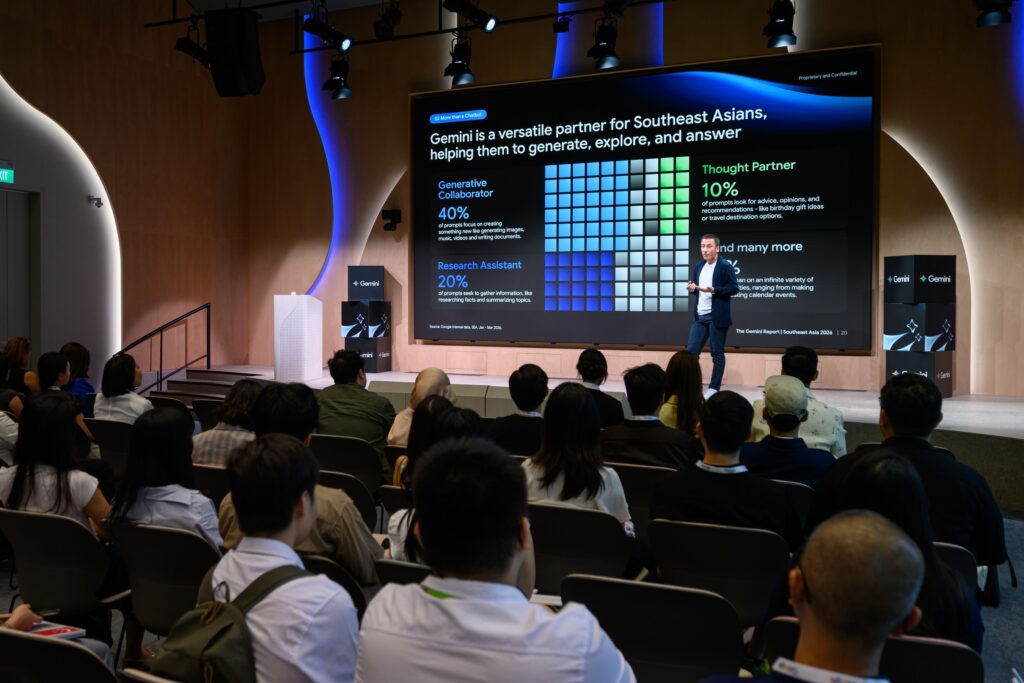
Samuele Saini, Director, Google Ads Solutions & Insights, Southeast Asia, explains how Gemini is more than a chatbot in SEA
Among the report’s key findings, the Philippines stood out for how users are integrating AI into both work and daily life.
Unlike other Southeast Asian markets, the Philippines is the only country in the region where female users account for the majority of Gemini prompts, highlighting a broader and more balanced adoption of generative AI across genders.
Filipinos are also among the region’s most active users of Gemini for professional tasks.
According to Google, 24 percent of prompts from the Philippines relate to creative work, making content creation the country’s most common use case. Another 17 percent focus specifically on writing assistance, while many users also rely on Gemini for career guidance, job applications, and workplace decisions.
The report also highlighted the Philippines’ strong business use cases.
Professionals in the country’s business process outsourcing (BPO) industry use Gemini for customer support and marketing-related tasks at three times the regional average, making the Philippines the leading Southeast Asian market for these applications.
Google also found that job-seeking and staffing-related prompts are more common among Filipino users than anywhere else in the region.
AI becomes part of everyday work
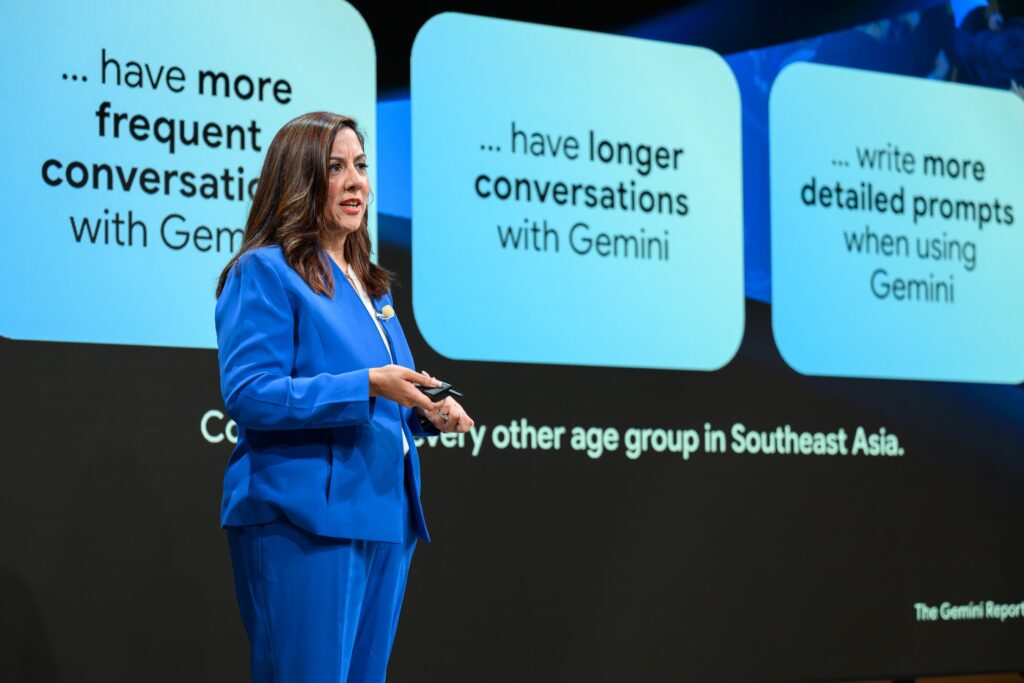
Sapna Chadha, Vice President for Southeast Asia and South Asia Frontier at Google
“We are proud to see that Gemini has become the AI of choice for many users across Southeast Asia,” said Sapna Chadha, Vice President for Southeast Asia and South Asia Frontier at Google.
“What makes this region remarkable is how naturally Gemini has been woven into daily life. People are using it in the languages they speak, through the modalities they prefer, and in ways that reflect their everyday needs.”
The report suggests that many users increasingly view AI as more than a productivity tool.
Beyond writing and research, Gemini is being used as a brainstorming partner, career adviser, research assistant, and creative collaborator for generating documents, presentations, images, music, and videos.
Local language support fuels regional growth
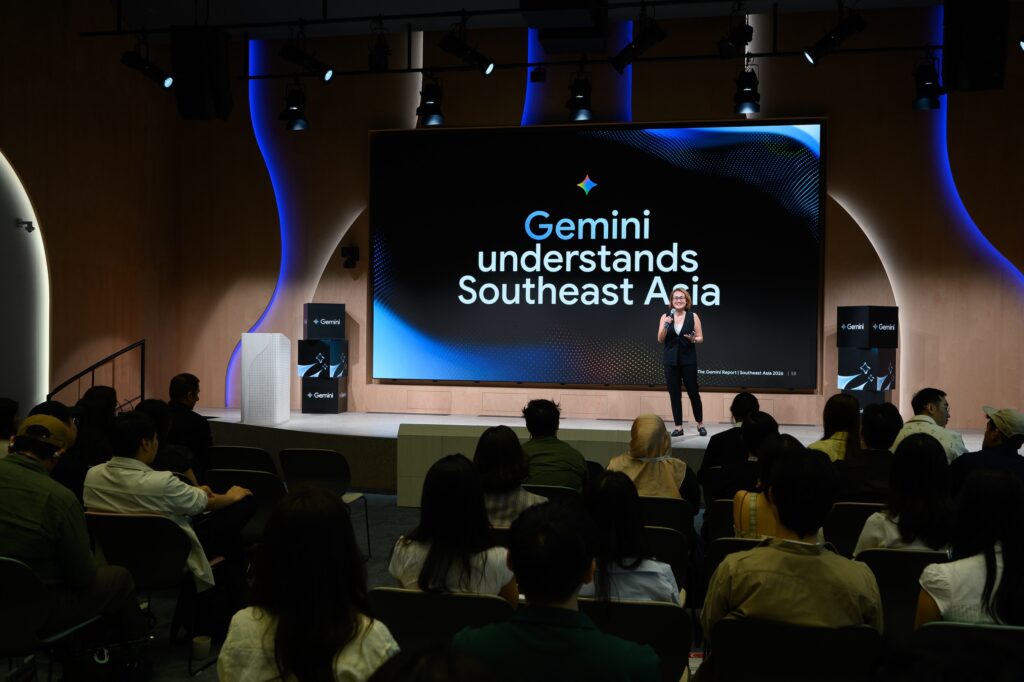
Christine Chia, Managing Director, Search and Gemini Partnerships APAC, on Gemini’s innovations for SEA
Google attributed Gemini’s rapid adoption partly to its ability to understand Southeast Asian languages.
Nearly 70 percent of prompts across the region are submitted in local languages, led by Vietnam, Thailand, and Indonesia.
The company also cited findings from AI Singapore’s Southeast Asia Holistic Evaluation of Language Models (SEA-HELM), which ranked Gemini as the best-performing large language model for Southeast Asian languages overall.
“AI adoption happens when technology feels native, not translated,” said Dr. Leslie Teo, Senior Director of AI Products at AI Singapore.
“In a region as linguistically rich as Southeast Asia, models must understand local context deeply to be used effectively.”
Mobile-first AI usage continues to grow
The report also found that nearly three out of four Gemini interactions in Southeast Asia now originate from mobile devices.
More than 40 percent of prompts already include voice, photos, or video uploads instead of text alone, while roughly one in ten users rely entirely on voice-based interactions through features such as Gemini Live.
Google said approximately 40 percent of all prompts involve generating new content, including images, documents, videos, and music.
Over the past year, users across Southeast Asia generated five billion images using Google’s Nano Banana image model and nearly one million songs through Lyria 3.
Expanding Gemini’s capabilities

Google said it is continuing to expand Gemini’s capabilities in Southeast Asia, including the rollout of Gemini Spark, an AI agent designed to perform tasks across Workspace applications such as Gmail, Docs, and Slides.
The company also recently introduced in-chat shopping features in the Philippines, Indonesia, Thailand, and Vietnam, allowing users to compare products, browse prices, and discover merchants without leaving the Gemini interface.
As AI adoption accelerates across Southeast Asia, Google’s latest findings suggest Filipino users are moving beyond experimentation, increasingly integrating generative AI into everyday work, business operations, and career development.
—
[1] The insights in this report come entirely from the Gemini web and mobile apps (the “Gemini App”) — the places where you can directly type and talk to our models. It doesn’t cover insights on adoption and usage of the Gemini family of models that powers other Google products like Search or Workspace.