

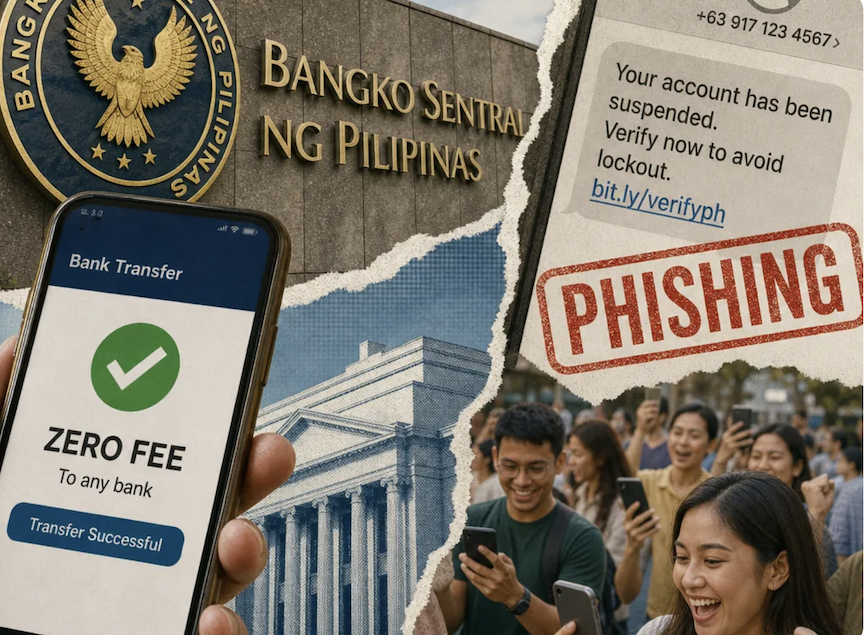
The Bangko Sentral ng Pilipinas (BSP)’s push to make digital fund transfers cheaper may shave off a small portion of banks’ fee income, but analysts say the long-term gains could outweigh the immediate cost.
Following the implementation of BSP Circular No. 1238, banks, e-wallets, and other payment service providers have moved quickly to waive or reduce fees for InstaPay and PESONet transactions.
While that means less income from transfer charges, it is also expected to encourage more people to use digital payments, strengthen customer loyalty, and intensify competition among financial institutions.
The circular, which took effect on July 4, requires payment service providers to adopt reasonable, fair, and market-based pricing for person-to-person fund transfers. For consumers, it means cheaper everyday transactions.
For banks, it marks a shift in how they compete in an increasingly digital financial landscape.
The new rules are part of the BSP’s broader push to make digital payments more accessible and bring more Filipinos into the formal financial system. By encouraging lower transaction costs, the central bank hopes to remove one of the barriers that has long discouraged consumers from making digital payments more frequently.
A domino effect across the industry
IMAGE CREDIT: BPI
The shift didn’t happen overnight.
State-run Land Bank of the Philippines was among the first to act, cutting its InstaPay fee from ₱15 to ₱8 in May before waiving fees for selected online government payments beginning June 1.
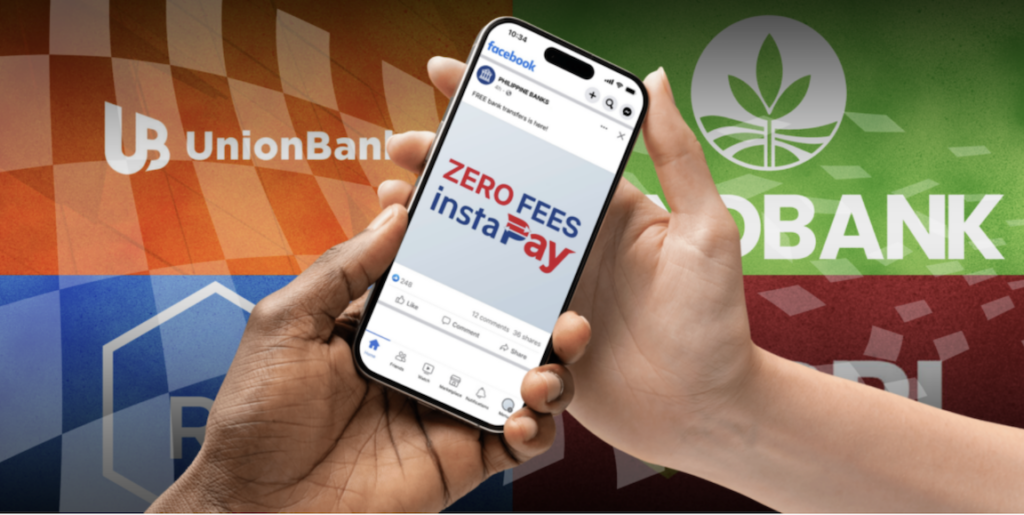
Momentum picked up when Bank of the Philippine Islands (BPI) announced that transfers to other banks and e-wallets via InstaPay and PESONet would become permanently free starting July 1. Within days, other major lenders — including RCBC, Security Bank, Metrobank, UnionBank, and EastWest — rolled out similar changes.
GCash also lowered its interbank transfer fee from ₱15 to ₱10, making lower-cost digital transfers the new norm rather than a promotional offering.
What started with a handful of announcements quickly turned into an industry-wide response to the BSP’s new pricing framework.
Giving up fees — but not necessarily profits
COMPOSITE IMAGE: FintechNewsPH
Waiving transfer fees may seem like an obvious hit to banks’ earnings. Analysts, however, believe the financial impact will likely be limited.
According to COL Financial Chief Equity Strategist April Lynn C. Lee-Tan, zero-fee retail transfers could trim around 1% of revenues for large banks, with profits declining by roughly 1% to 3%.
For most universal and commercial banks, however, transfer fees represent only a small portion of overall income. Lending, treasury operations, credit cards, wealth management, and other banking services continue to generate the bulk of their revenues.
First Metro Investment Corp. Head of Research Cristina S. Ulang believes the move could ultimately strengthen banks’ profitability by improving customer retention and reinforcing their relevance as everyday payment platforms.
She also noted that lower transaction costs come at an opportune time, helping ease the burden on consumers while supporting the BSP’s financial inclusion goals.
Jonathan L. Ravelas, senior adviser at Reyes Tacandong & Co., shares a similar view, saying lower transfer fees may create only a modest headwind for institutions that rely more heavily on transaction charges while encouraging greater digital adoption over the long term.
Brokerage F. Yap Securities likewise described the earnings impact as “negligible,” noting that resilient lending margins should continue to support banks’ profitability.
For UnionBank Chief Economist Ruben Carlo O. Asuncion, the bigger opportunity lies elsewhere. He said that if customers use their banking apps more often because transfers are now free, banks could strengthen client relationships and generate more business across savings, lending, investments, and other financial products — helping offset the loss of transfer fee income.
More Filipinos are already using digital payments
IMAGE CREDIT: SwiftPay
Early signs suggest the strategy is working.
According to BSP Deputy Governor Mamerto E. Tangonan, digital fund transfer volumes have increased by 10% to as much as 50% since banks and payment providers began lowering or eliminating transfer fees.
That supports the BSP’s long-term goal of making digital payments the preferred way Filipinos transact. Under the Philippine Development Plan, the central bank wants 60% to 70% of all retail payments to be made digitally by 2028.
The country is already moving in that direction. BSP data shows digital payments accounted for 57.4% of total monthly retail transaction volume in 2024, up from 52.8% the previous year. By value, digital payments represented 59% of all retail transactions, compared with 55.3% in 2023.
Lower transfer costs could help accelerate that trend even further.
Competition is entering a new phase
For years, free fund transfers were one of the biggest selling points of digital banks.
That advantage is becoming less distinct.
With traditional banks now offering the same convenience, competition is expected to shift toward other areas, including higher deposit rates, better mobile banking experiences, faster account opening, rewards programs, and easier access to loans and investment products.
Asuncion expects lower transfer costs to make it easier for customers to move money between financial institutions, increasing competition for deposits. Even so, he does not expect customers to abandon digital banks simply because traditional lenders have eliminated transfer fees.
Consumers still choose digital banks for several reasons, including convenience, competitive interest rates, intuitive apps, and quick access to financial services.
Lee-Tan likewise believes free transfers alone are unlikely to trigger a significant shift in deposits from digital banks back to traditional institutions.
Removing a long-standing barrier

IMAGE CREDIT: BSP
For many consumers, the fee reductions address a frustration that has existed for years.
The BSP’s Consumer Expectations Survey for the fourth quarter of 2025 found that one in three Filipinos cited high transaction fees as one of the biggest barriers to using digital payments more frequently.
The issue has also drawn international attention.
In a 2025 report, the International Monetary Fund (IMF) observed that Filipinos generally paid higher fees for small digital transfers than consumers in neighboring countries such as Singapore, Thailand, and Vietnam, where person-to-person transfers are often free.
The IMF also pointed to fragmented payment networks and standards as factors that increase processing costs — expenses that are ultimately passed on to consumers.
Reducing transfer fees addresses one part of the problem. Improving interoperability across payment systems will be equally important if digital payments are to become more seamless and affordable.
A bigger shift than free transfers
BSP Circular No. 1238 is about more than lowering the cost of sending money.
It reflects a broader shift in how financial institutions are approaching digital banking.
Instead of treating payments primarily as a source of fee income, banks are increasingly using them to build stronger, longer-term relationships with customers. Every digital transfer becomes another opportunity to keep users engaged within their ecosystem, whether through savings accounts, loans, investments, insurance, or other financial services.
In the end, the biggest impact of free transfers may not be the few pesos consumers save on each transaction.
It may be the way the BSP’s latest policy reshapes competition — encouraging banks to compete less on fees and more on delivering better digital experiences that keep customers coming back.