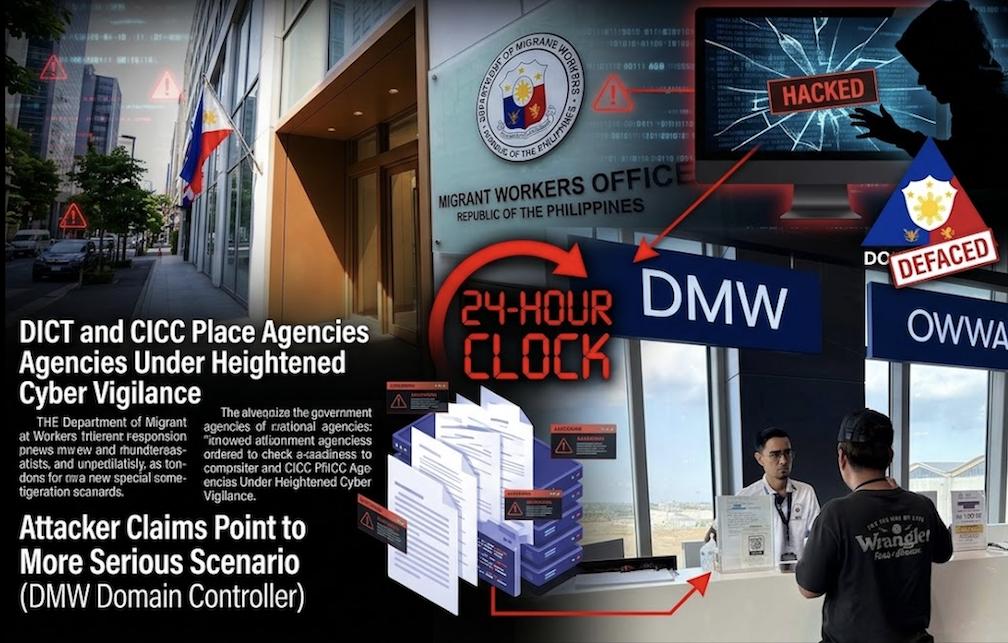
DMW and DOLE cyber incidents have triggered an urgent government-wide security response, with Philippine agencies and critical infrastructure operators ordered to assess their cyber risks and take immediate protective measures within 24 hours.
The move follows confirmed unauthorized access to the Department of Migrant Workers website and a web defacement incident involving the Department of Labor and Employment. The Department of Information and Communications Technology said investigations and mitigation measures were continuing, with affected systems isolated and access controls strengthened.
So far, authorities have not confirmed that sensitive databases or personally identifiable information were compromised.
However, claims from the group that allegedly breached DMW suggest the intrusion may have reached much deeper into the agency’s network, putting greater focus on how government identity and worker information is protected.
Government agencies ordered to check cyber readiness
The DICT and Cybercrime Investigation and Coordinating Center have placed national government agencies, government-owned and controlled corporations, local governments and critical information infrastructure operators under heightened cyber vigilance.
Under the joint cybersecurity directive reported on September 10, covered organizations were told to provide agency heads or chief executives with a one-page cyber-readiness assessment within 24 hours.
The review should identify their biggest cybersecurity risks, immediate actions already taken and any assistance they require. Priority measures include patching critical vulnerabilities, enforcing multi-factor authentication for privileged accounts, reducing unnecessary internet exposure, reviewing third-party access and checking whether backups can actually be restored.
The order goes beyond telling employees to be more careful online. It places responsibility on agencies themselves to determine whether their systems, access controls and response procedures can withstand an attack.
What actually happened to DMW and DOLE?
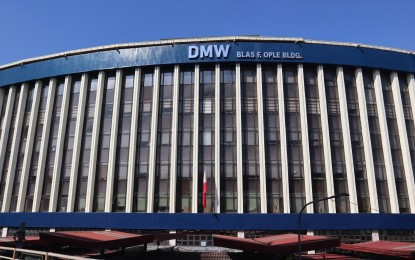
IMAGE CREDIT: DMW
DICT’s National Computer Emergency Response Team responded to the unauthorized access involving the DMW website and coordinated with the department’s information technology personnel in investigating the incident.
Affected services were temporarily taken offline while technical teams isolated systems, tightened access controls and conducted forensic and recovery work. DICT has not yet released a detailed public technical report establishing exactly how the unauthorized access occurred or how far the attacker may have moved within DMW’s infrastructure.
The DOLE incident was different. Authorities investigated an unauthorized modification or defacement involving a web host, while the affected system was isolated for digital forensics.
The DOLE-NCR clarified in an official advisory that its affected Clients Portal serves as a public landing page linking users to different online services. The regional office said the portal does not maintain a database or directly collect and store personal information.
That distinction is important. Being able to change what appears on a government website does not automatically mean an attacker gained access to the databases or information systems behind other government services.
DMW attacker claims point to a more serious scenario
The bigger unanswered question involves DMW.
Cybersecurity monitoring reports said hacktivist group HappyGoLuckyPH claimed it had maintained access to the agency’s Active Directory environment for more than a month before eventually compromising a domain controller.
The group further alleged that it reached internal systems, databases, security-management consoles and server directories. It also claimed repositories containing worker, recruitment, contract, financial, legal and administrative information were accessible, including identity-verification records and scanned identification documents.
Those allegations were detailed in a September 8 report on the claimed DMW network access, but they remain unverified.
DICT and DMW have not publicly confirmed that the group reached those systems or that any records were viewed, copied or extracted.
That means it would be premature to describe the incident as a confirmed leak of migrant worker records. The confirmed fact is unauthorized access. The alleged extent of that access remains part of the forensic investigation.
Why a domain controller claim raises the stakes
A domain controller is considerably more sensitive than an ordinary public webpage.
According to Microsoft’s documentation on Active Directory, domain controllers are used to store user accounts and credentials and provide authentication services across a network domain.
They help determine who can sign in and what resources authenticated users are allowed to access. Microsoft consequently considers domain controllers high-value systems that require strict security controls.
If the attacker’s claim of compromising a DMW domain controller is eventually verified, investigators would have to establish what privileges were obtained, which systems those privileges could reach and whether they allowed lateral movement into more sensitive environments.
But compromise of a domain controller would still not automatically prove that migrant worker records were stolen. Investigators would need evidence showing whether files or databases were accessed or exfiltrated.
No confirmed PII breach is not the end of an investigation
DICT’s initial assessment that no sensitive databases or personally identifiable information were compromised is significant, but it should be read as an initial technical finding rather than proof that every question surrounding the incidents has already been resolved.
Forensic investigations can involve reviewing authentication records, server activity, access logs, malware traces and indications that information may have been transferred outside an organization.
That is especially important for agencies handling identity and employment-related information. Migrant worker services can involve information used for recruitment, verification, contracts and deployment, making unauthorized access to systems surrounding those processes potentially more consequential than a typical website defacement.
The government’s cybersecurity rules are also becoming more explicit about accountability. Under the 2026 implementing rules of the E-Governance Act, government agencies are required to adopt minimum information security standards, monitor systems for security incidents and address vulnerabilities.
The rules also require major information security incidents affecting government critical information infrastructure to be reported within 24 hours of discovery.
The PPA case shows why verification still matters
The same wave of cybersecurity reports also included an alleged ransomware attack against the Philippine Ports Authority.
DICT later determined that case was a false positive. A joint review of PPA system logs found no ransomware activity and no compromise of the agency’s infrastructure.
The finding illustrates the problem authorities face during a fast-moving cyber incident. An alarming claim is not necessarily proof of a breach, but an initial absence of confirmed data loss also does not remove the need for a full investigation.
For DMW and DOLE, the line is clearer for now. Unauthorized access to DMW and a web defacement involving DOLE are confirmed, while the more serious allegations involving DMW’s internal network and worker information remain unverified.
The next technical findings will determine whether the DMW incident remained limited in scope or exposed a deeper weakness in how government agencies protect identities, credentials and sensitive information.