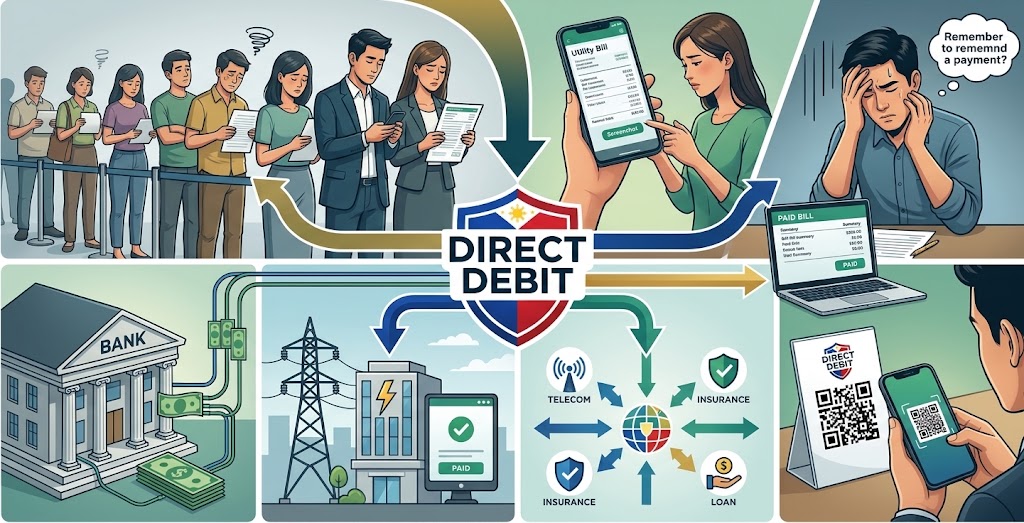
Filipinos are champion manual bill-payers.
We queue at Bayad Centers. We screenshot Meralco statements and forward them to relatives. We wake up on the fifth of the month remembering, with a jolt, that the internet is about to be cut.
It’s a national ritual — and it’s also, quietly, a huge waste of time.
Direct Debit PH is designed to end it.
The country’s first real autopay rail
Launched by the Bangko Sentral ng Pilipinas and Payments Policy and Management, Inc. (PPMI) on July 29, 2026, Direct Debit PH lets you authorize a biller — a utility, telco, lender, or insurer — to automatically collect payment from your account on scheduled due dates through a formal mandate.
It works across banks and e-wallets, which is the part that makes it new. Your BPI account can pay a Globe bill. Your GCash wallet can pay Maynilad.
Direct Debit PH doesn’t care where your money lives. It’s one of three new payment rails the BSP and PPMI launched together in July 2026 — a development worth reading side-by-side for the full picture.
How Direct Debit PH works

The mechanics are simple.
You enroll once, defining what the biller can charge and when. On the due date, the amount is pulled automatically. If the funds are there, the bill is paid.
If not, the payment fails — no overdraft surprises, no debt spiral.
Anyone deciding whether to borrow against their salary alongside setting up autopay may also want to review our guide on what to consider before taking a salary loan.
Real-world scenarios: Direct Debit PH in everyday life
To truly understand how Direct Debit PH changes the routine, it helps to look at a few concrete examples of how this plays out in real life compared to the old way of managing money.
Example 1: The monthly postpaid fiber bill
- The old way: You receive an email bill from your internet provider on the 10th with a due date on the 25th. You log into your banking app, manually search for the biller name, copy-paste your 10-digit account number, double-check the amount, key in an OTP, and take a screenshot of the confirmation screen “just in case.” If you are busy during payday, you forget, pay two days late, and get slapped with a late payment fee or an abrupt disconnection.
- The Direct Debit PH way: You establish an electronic mandate once via your provider’s app or your bank portal. You set a transaction limit—for instance, capping authorization at ₱2,500 for a ₱1,899 monthly plan. Every 23rd of the month, the exact billed amount is pulled seamlessly from your chosen e-wallet or deposit account. You receive an automated SMS or push notification confirming the successful payment, without ever opening a biller portal again.
Example 2: Managing variable utility expenses (water and electricity)
- The old way: Because electricity or water charges fluctuate every month depending on consumption, automated scheduling through basic online banking transfers often failed to solve the problem. Setting up a fixed recurring transfer either underpaid or overpaid the bill, forcing you back into manually reviewing and settling every statement each month.
- The Direct Debit PH way: When you sign a Direct Debit mandate with a utility like Maynilad or Meralco, the authorization dynamically matches the billed invoice up to a pre-agreed upper limit you define (e.g., “authorize up to ₱5,000”). If your summer cooling bill comes out to ₱3,400, the system pulls exactly ₱3,400. You retain full control over the ceiling price while eliminating the monthly manual execution.
The behavioral question
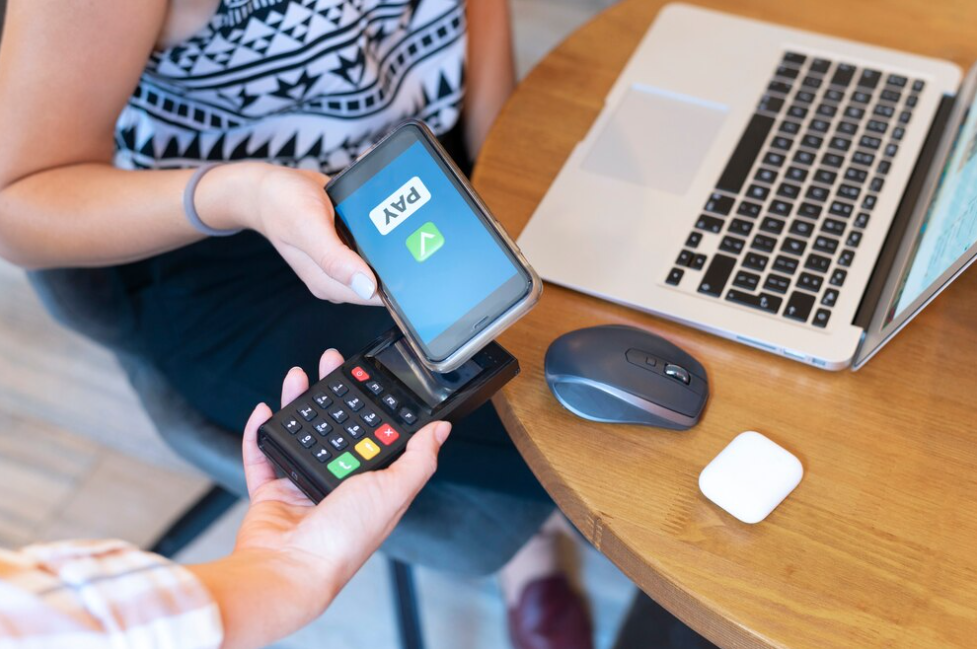
The interesting question isn’t technical. It’s behavioral.
Filipino consumers have historically been cautious about giving any institution standing permission to withdraw money. Manual payment feels like control.
Direct Debit PH asks you to trade that feeling for convenience—a trade many are already quietly making by juggling multiple digital wallets to control their payday cashflow.
A parallel shift is happening on the merchant side too, where phones are becoming full POS terminals through “U Accept.”
Three honest reasons to consider it
Missed-payment penalties usually cost more than the psychological safety of paying manually.
The mandate is bounded — the biller can’t pull arbitrary amounts, and you can revoke authorization anytime.
And the mental load of tracking six recurring bills isn’t free. It just doesn’t show up on a receipt.
Three reasons to be cautious
You need a buffer so a scheduled pull doesn’t overdraw you.
You need to actually review your statements — automation makes it easier to stop noticing what you’re paying for.
And with scammers now targeting digital wallet users users through seven common tactics, you also need to keep your bank and wallet credentials properly protected. Trust the rail; verify the biller.
Step-by-step: How to safely transition to Direct Debit PH
If you are ready to stop spending your payday evening manually keying in reference numbers, here is a practical roadmap to setting up your first automated mandate safely:
- Start with a predictable, fixed bill: Choose a fixed recurring expense first—such as your monthly broadband, streaming subscription, or insurance premium—rather than a highly variable bill. This lets you get comfortable with how the automated debit notices work.
- Set a conservative mandate limit: When filling out your digital authorization form, define a maximum threshold slightly above your average bill. If your phone bill is normally ₱1,500, set the mandate cap at ₱2,000. This guarantees the payment clears if taxes or minor usage charges vary, but prevents any runaway charges.
- Establish a dedicated “Bill Buffer”: Keep an extra balance equivalent to one month’s worth of recurring bills in your designated payment account. This prevents accidental payment failures if a due date falls a day before your salary hits.
- Audit your mandates quarterly: Treat your automated payments like an annual subscription review. Every three to six months, check your active mandates through your bank or e-wallet app to ensure you aren’t paying for services you no longer use, and revoke any mandates for ended contracts immediately.
For most Filipinos, Direct Debit PH won’t replace manual paying overnight. It’ll start with one bill — probably the one you keep forgetting. That’s the right way in.