For years, one of the simplest rules in digital banking security was also one of the most repeated: never share your password. That advice still matters, but it no longer describes the full threat.
Modern financial scams are increasingly designed to work around passwords rather than simply steal them.
Instead of breaking into a bank’s systems, fraudsters can manipulate customers into approving transactions, taking control of their devices, revealing one-time codes, installing malicious applications, or moving money themselves.
The attack is no longer necessarily aimed at the password. It is aimed at you, your device, your session, and the transaction. This is changing how banks, financial institutions, and cybersecurity partners approach fraud prevention in the Philippines.
The Bangko Sentral ng Pilipinas (BSP) has been pushing financial institutions toward stronger, more proactive controls, including real-time fraud monitoring, device fingerprinting, behavioral analysis, and phishing-resistant authentication — often integrated alongside security software from firms like Trend Micro or Kaspersky to detect malware and rogue applications.
Social engineering turns the customer into the attack surface

One reason passwords are becoming less central to fraud is that scammers do not always need to steal them.
They can simply persuade the account holder to do what the scammer wants.
A fraudster might pose as a bank representative, government employee, delivery company, employer, online seller, or even a family member. The conversation may begin with a seemingly harmless message and gradually escalate into a request to click a link, confirm an account, share a verification code, install an application, or transfer money.
This is social engineering, and it exploits something technology cannot completely eliminate: human trust.
The BSP identifies phishing, smishing, vishing, QR phishing, and identity theft among common forms of financial fraud. These schemes are specifically designed to manipulate people into revealing information or performing actions that can lead to unauthorized transactions.
The important distinction is that the scammer may never need to know the victim’s permanent password.
They just need the victim to help them get around the security process.
The OTP is not always the final line of defense
One-time passwords were introduced as an additional security layer because knowing a username and password alone should not be enough to access an account.
But OTPs delivered through SMS or email can themselves become targets.
A scammer can impersonate a trusted institution and convince someone to provide the code. They can use phishing pages to capture credentials and OTPs in real time. They can also exploit compromised devices or communications channels.
This is why the BSP’s updated technology risk-management rules specifically call for financial institutions to limit reliance on interceptable authentication mechanisms, including OTPs delivered through SMS and email, as social engineering attacks increasingly target these methods.
The direction is toward advanced authentication methods that are harder for another person to simply ask for and reuse. That includes biometrics, passkeys, hardware security keys (such as those manufactured by Yubico), and other phishing-resistant authentication technologies.
Your device is becoming part of your identity
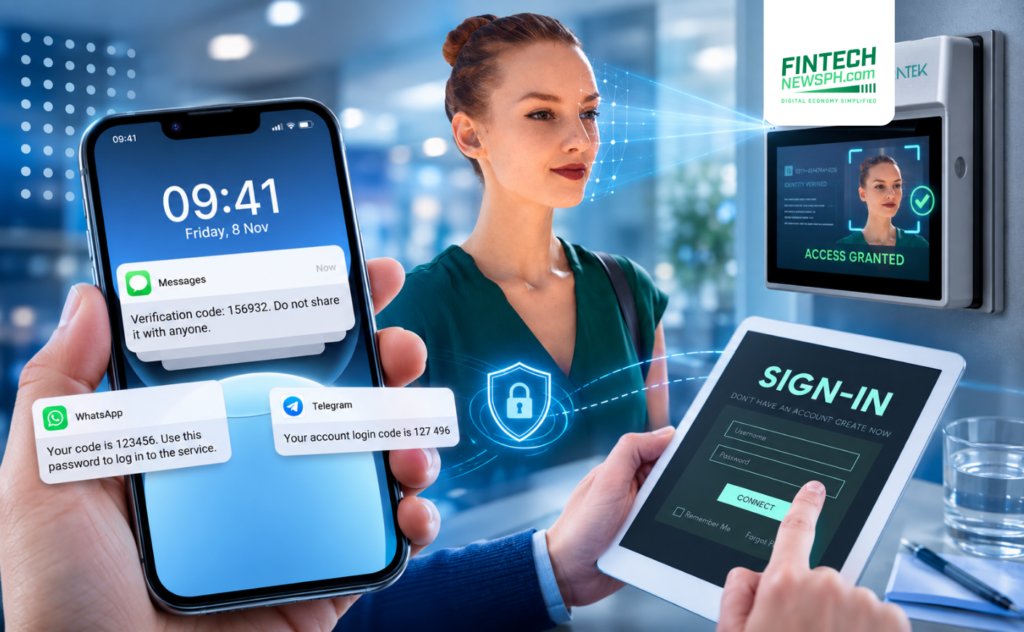
The next security layer is increasingly the device itself. Banks can analyze characteristics associated with the phone, computer, or other device being used to access an account.
Device fingerprinting tools, often backed by digital identity and fraud prevention platforms like LexisNexis Risk Solutions or Sift, can help determine whether a transaction is coming from a familiar device or an environment that looks unusual.
BSP rules require strong device fingerprinting and mechanisms designed to prevent attackers from spoofing device identities. Financial institutions are also expected to restrict applications from running on certain unsecured devices, such as rooted or jailbroken phones and outdated systems.
This creates another barrier for fraudsters.
Knowing someone’s login credentials is one thing. Successfully reproducing the customer’s normal device environment and behavior is considerably more difficult.
The security model therefore starts moving from “Do you know the password?” toward “Does this look like the real customer?“
Banks are watching behavior, not just credentials
The same principle applies to behavior.
A legitimate customer may normally log in from a familiar device, from a familiar location, at a particular time, and transfer amounts that fit their usual pattern. A sudden change can be a warning signal.
For example, an account that normally makes small domestic payments could suddenly attempt a large transfer to a new recipient from an unfamiliar device immediately after a phone number or email address has been changed.
None of these events necessarily proves fraud on its own. Together, however, they can create a suspicious pattern.
The BSP’s technology risk-management framework calls for financial institutions to use measures including transaction velocity checks, geolocation monitoring, blacklist screening, device fingerprinting, and behavioral anomaly detection as part of stronger fraud management systems, utilizing enterprise fraud engines from companies like FICO or Feedzai.
This represents a major change in the way digital fraud is detected. Instead of waiting for a customer to report that an account has been compromised, financial institutions are expected to identify suspicious behavior while a transaction is happening.
Fraud prevention is moving closer to the transaction
This is where modern fraud management becomes particularly important.
A password check happens when someone attempts to access an account. But fraud can occur later, after the customer has successfully authenticated.
A scammer could convince a legitimate customer to transfer money to a fraudulent account. From a traditional authentication perspective, the transaction may look valid because the real account holder initiated it.
The challenge is therefore no longer simply determining whether someone has logged in legitimately.
Banks increasingly need to determine whether the transaction itself makes sense.
Real-time fraud management systems can assess transaction patterns and other signals before allowing suspicious activity to proceed. BSP regulations require covered financial institutions to strengthen their systems so they can rapidly detect, prevent, and block disputed, suspicious, or fraudulent online transactions.
This creates multiple checkpoints around a transaction instead of relying on one password or OTP at the beginning of the process.
Scammers are also targeting the device
The device itself can become a weapon in a financial scam.
Fraudsters may attempt to persuade victims to install malicious applications or provide remote access (via tools like AnyDesk or TeamViewer).
Once installed, malicious software can potentially give attackers visibility into activity on the device or interfere with how users interact with legitimate financial services. This is one reason BSP rules include restrictions involving unsecured devices and unauthorized scripts or automation tools.
Financial institutions are also expected to work with mobile security providers to use behavioral analysis, session management, rate limiting, and bot detection to defend against automated or manipulated access.
For consumers, this means that downloading an application simply because someone sent a link or instructed them to do so can create a much bigger risk than giving away a password. The safest financial security practice is increasingly about protecting the entire device, not just the banking credentials stored in memory.
The newest threat can be convincing because it looks normal
Another problem is that today’s scams do not always look obviously suspicious. Messages can imitate the branding and language of legitimate companies. Fake websites can resemble actual banking pages. Calls can sound professional.
A scammer can create a sense of urgency that prevents the victim from stopping to verify the request. The BSP itself warns consumers about fake websites, phishing messages, vishing calls, and QR-based scams. Its consumer guidance advises people to verify sources, avoid suspicious links, and report unauthorized transactions to their financial institution.
The more convincing the interaction becomes, the less useful the old assumption that “I will know a scam when I see one” becomes.
Security increasingly depends on slowing down the interaction.
This is why banks are adding friction
Digital banking has spent years removing friction. Customers want faster logins, instant transfers, one-tap payments, and seamless account opening.
Fraud prevention sometimes requires the opposite. A bank may temporarily restrict transactions after important account changes. It may ask for additional authentication when a transaction looks unusual. It may impose limits or provide a kill switch that allows customers to freeze access to funds.
The BSP’s current rules include a 24-hour transaction pause period after certain key account changes, such as modifications to a customer’s mobile number, email address, or registered device, subject to the framework’s conditions.
Financial institutions are also required to provide consumer protection features such as transaction controls and other safeguards. These measures can make banking slightly less seamless.
But the trade-off is intentional: a little friction can give a customer or financial institution time to stop a fraudulent transaction.
The Philippines is moving toward a layered security model
The shift away from password-centric security is particularly important as digital financial adoption expands.
More Filipinos are using mobile banking, e-wallets, QR payments, and digital financial services. As the number and value of digital transactions increase, fraudsters have more opportunities to exploit weak points.
Authorities are responding with stronger coordination as well. In July 2026, the BSP and Department of Justice signed an information-sharing agreement intended to strengthen investigations and prosecution of financial account scams under the Anti-Financial Account Scamming Act.
The PNP Anti-Cybercrime Group, alongside private threat intelligence organizations, has also been targeting money mules and individuals involved in the misuse of online banking profiles, ATM cards, and e-wallets.
In the first two months of 2026, authorities arrested 67 individuals in 60 operations related to financial account scams.
This shows that the fight against digital fraud is expanding beyond authentication. It now involves banks, regulators, law enforcement agencies, telecommunications networks, cybersecurity technology providers, and consumers.
What consumers should protect now
The advice to use strong passwords has not become irrelevant. It has simply become one part of a much larger security strategy.
Consumers also need to protect the device used for financial transactions, avoid installing applications from unknown sources, verify unexpected messages independently, and never give another person remote access to their phone or computer.
They should also be cautious about what they approve.
A notification asking you to authenticate a transaction you did not initiate is not simply an inconvenience. It can be a warning that someone else is attempting to use your account.
The BSP recommends its C-P-R approach: Check, Protect, and Report. Consumers are advised to verify links and sources, protect personal and financial information, and immediately report suspicious transactions to their bank or e-money issuer.
Financial institutions regulated by the BSP are also expected to maintain channels for reporting unauthorized or fraudulent transactions and provide assistance to affected consumers.
The password is now only one piece of the puzzle
The biggest misconception about digital financial security may be that protecting an account is simply a matter of keeping the password secret: It is not.
A modern scam can succeed without cracking a password if a customer is manipulated into revealing an OTP, approving a transaction, installing malicious software, changing account details, or transferring money to a scammer.
That is why the future of financial security is becoming less about one secret credential and more about layers of protection.
Biometrics can verify the person. Device intelligence can verify the environment. Behavioral analytics can identify unusual activity. Transaction monitoring can flag suspicious payments.
Account controls can give customers a way to stop activity. And human awareness can prevent a scam before it reaches the banking system.
The scammer may not need your password anymore. But that does not mean the bank has stopped trying to protect it. It means the security battle has moved beyond the password to everything else surrounding the transaction.