
Slack is pushing software development out of private browser tabs and directly into group chats.
Salesforce’s workplace messaging platform announced Slack Code on Tuesday, introducing dedicated project spaces where engineers, product managers, and autonomous AI agents build software together in full view of the team.
The move attempts to fix a growing friction point in enterprise tech: isolated AI tool usage.
While standalone AI coding assistants like Anthropic’s Claude Code, Cognition’s Devin, GitHub Copilot, OpenAI’s ChatGPT, and Vercel agents have accelerated individual output, the work usually stays hidden inside single-user sessions. When developers copy code back and forth between terminal windows and team chats, key decisions get lost, reviews lag, and non-technical teammates lose line of sight.
Slack Code addresses this fragmentation by converting software development into a shared, transparent process.
“AI only creates value when it’s part of how a team actually works, not something people go do alone in another tab,” said Rob Seaman, EVP and GM of Slack at Salesforce. “Code channels bring that work into the open, where the rest of the team can see it, shape it, and build on it.”
How code channels work
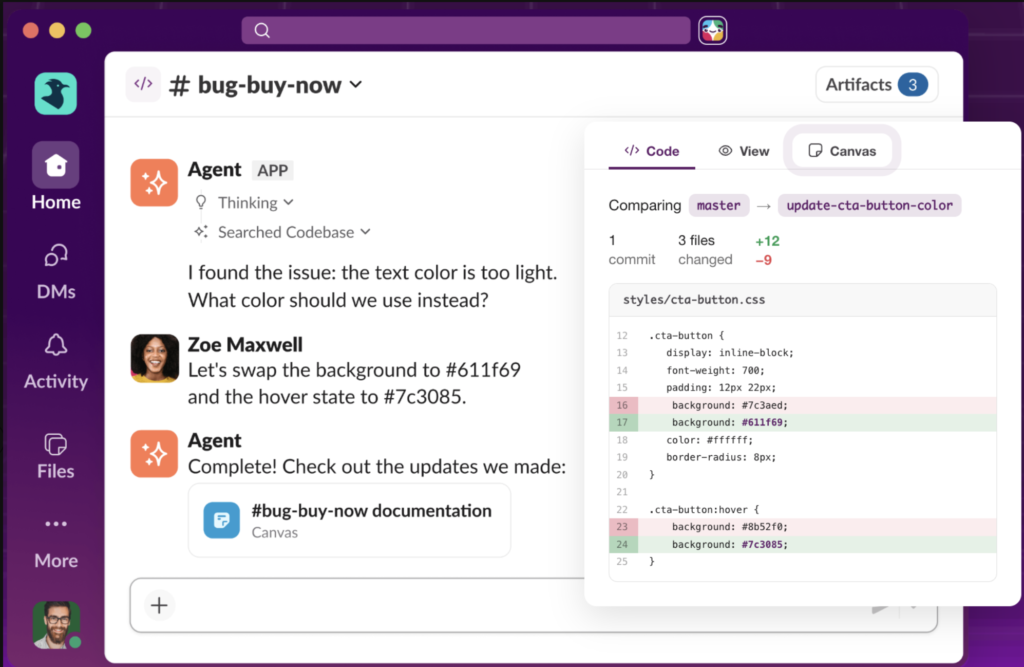
Central to the rollout are dedicated code channels. When a user tags a supported AI agent anywhere in Slack, the system automatically provisions a focused workspace tied specifically to that build or bug fix.
Instead of flooding regular message feeds with wall-of-text scripts, Slack Code provides structured workspace interfaces:
- Dedicated project tabs: Team members can monitor live progress, conversation logs, task roadmaps, code diffs, and visual previews without leaving the channel.
- Side-by-side diffs: Proposed code updates display clear, inline track-changes, making technical reviews readable for both engineers and non-technical project leads.
- Live HTML previews: Users can test front-end layouts and functional prototypes directly inside Slack to catch errors before code hits production repositories.
- Self-archiving logs: Once a job finishes, the channel automatically archives itself, keeping the active sidebar clean while retaining a searchable audit trail for future reference.
“So much engineering work already starts as a conversation in Slack with Claude: a bug report, a piece of feedback, a ‘what do you think about…'” explained Cat Wu, Head of Claude Product at Anthropic. “Slack Code gives teams a dedicated channel where the people, the context, and Claude work together from the start. Review the code diff and see a live HTML preview right in the channel, without anyone leaving the conversation.”
Democratizing the tech stack
By anchoring coding workflows inside an everyday collaboration tool, Slack aims to open up software creation to non-engineers. Product managers and designers can prompt an agent to draft a patch or build a minor feature, then bring in an engineer to review the diff and authorize deployment.
“A thread is great for a quick back-and-forth, but the work with an agent has gotten valuable and complex enough that it deserves its own space,” noted Malte Ubl, Chief Technology Officer at Vercel. “A whole team can gather in one Code Channel, watch the agent work, steer it together, and ship a preview, with all the context and history staying in one shared place. It turns building software from something that happens in one person’s local session into something the whole team does together.”
This operational shift reflects a broader industry movement toward embedded artificial intelligence.
“For companies to unlock the full value from AI, it has to move beyond individual productivity gains to operational transformation,” said Rebecca Wettemann, Principal Analyst at Valoir Research. “Slack Code enables AI to move beyond individual copilots to embedded, contextual AI orchestration to deliver real AI ROI at scale.”
Ecosystem integration and security control
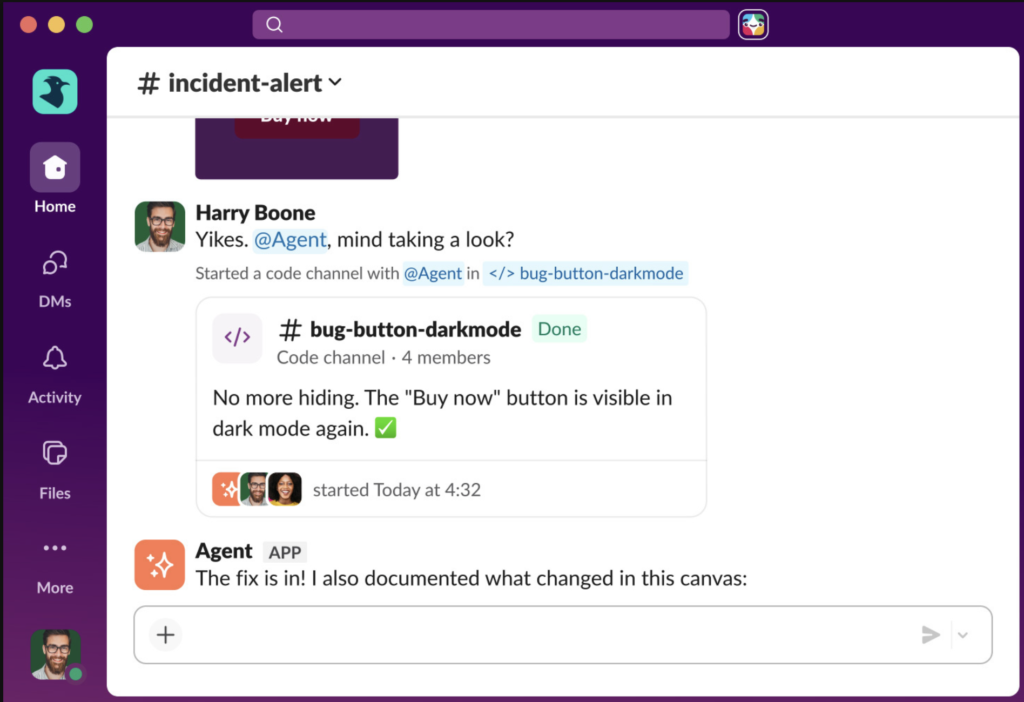
Slack Code launches with native integration support for Anthropic, Cognition, GitHub, OpenAI, and Vercel. Partner leaders point to the collaborative advantage of embedding autonomous agents into existing team workflows.
“Slack is a strategic part of a broader GitHub promise: humans set direction, agents close the loop,” said Mario Rodriguez, Chief Product Officer at GitHub. “That has to be true wherever developers are working, which is why we’re bringing Copilot into the flow of conversation in code channels to help teams turn shared intent into shippable software.”
Jeff Wang, President of New Enterprise at Cognition, echoed that stance: “Agents earn their place on a team the same way people do, by knowing when to contribute and when to stay out of the way. With code channels, Devin responds in Slack autonomously, verifies its work by running end-to-end in cloud agents, and brings the right people together without cluttering the conversation.”
Alongside the coding features, Slack updated its broader platform interface to treat AI tools more like colleagues. Updates include dedicated Direct Messages for agents, a centralized Agents Tab to track active runs, and a simplified setup process for custom bots built on tools like LangChain, n8n, and Lovable.
To satisfy enterprise compliance requirements, agents running in code channels operate within Slack’s standard security framework, user permissions, and administrative controls. High-risk actions—such as merging code into live production—still require explicit human sign-off inside the channel.
Slack Code is now live across all plan tiers, with access to specific AI agents dependent on a company’s existing third-party licenses.