
Savio, a newly launched Philippine fintech app, is entering the market with a model that departs from one of the most widely used approaches in personal finance, expense tracking.
The platform is built around behavioral finance, focusing on how users understand and act on their financial decisions rather than how they record transactions.

The shift reflects a broader issue in the local fintech landscape. While digital financial services such as e-wallets and neobanks have expnded rapidly in the Philippines, many of these platforms remain centered on payments and access.
Financial literacy, particularly in areas such as saving, debt management, and long-term planning, continues to lag behind.
Moving beyond traditional budgeting frameworks
Savio’s approach is based on the idea that financial outcomes are shaped more by behavior than by tools. Traditional budgeting apps rely on consistent expense tracking, requiring users to log purchases and categorize spending in detail over time.
For many users, maintaining this level of discipline proves difficult to sustain.
Theo Roque, Founder of Savio, said this gap informed the development of the app. “For the past 10 years, I didn’t have any savings even though I’m doing it,” he said, referring to his experience with manually tracking expenses.

This led him to question whether the issue was not the absence of tools, but the way individuals approach money. “Maybe the problem is how I deal with money itself,” he added, pointing to the role of behavior in financial decision-making.
Designing around awareness and decision-making
Instead of requiring detailed transaction logs, Savio encourages users to engage with their financial situation at a higher level. The platform includes a daily check-in feature that allows users to reflect on how they feel about their finances, which can influence how they make financial decisions.
Roque described the platform as a behavioral finance tool rather than a budgeting app. “It’s a behavioral finance app that actually helps people to create awareness about how they are really doing with their money,” he said.
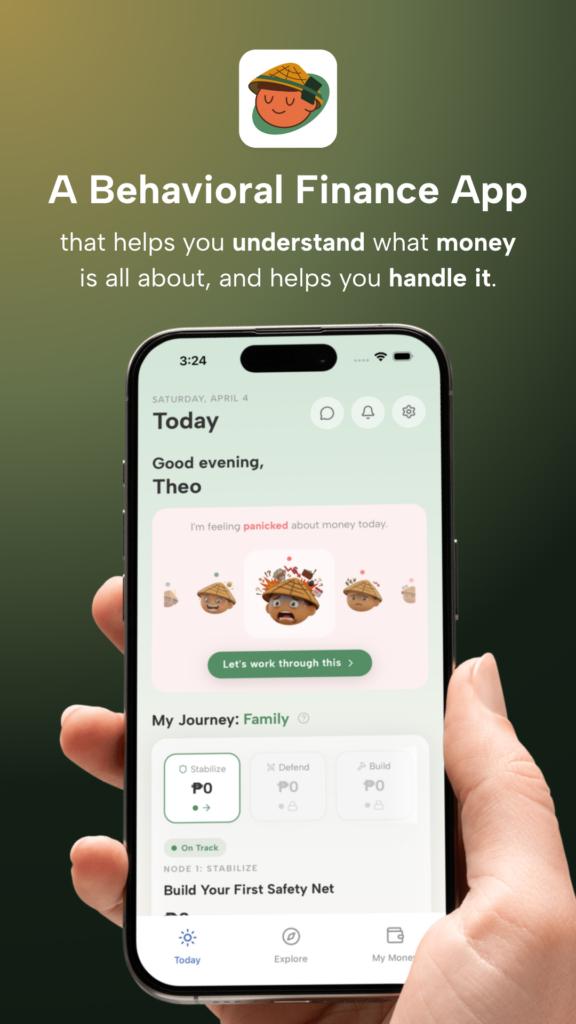


IMAGE CREDIT: Savio
The app also organizes finances into four broad categories: essentials, obligations, growth, and joy. Users update these categories periodically, allowing them to maintain a structured overview of their finances without tracking each individual transaction.
In addition, Savio incorporates short learning modules covering topics such as saving, debt management, and investing. These are designed to be completed quickly, making financial education more accessible while reducing the likelihood of overwhelming users.
Reflecting local financial behavior and constraints
The emphasis on behavior is particularly relevant in the Philippine context. Financial decisions are often shaped by social expectations, including the responsibility to support family members and extended households.
Practices such as utang na loob can influence how individuals allocate their income, sometimes creating financial pressure when boundaries are not clearly defined. Roque said this dynamic affected his own financial situation. “That became one of the reasons why I didn’t have any savings, because I didn’t have boundaries,” he said.
By incorporating these realities into its framework, Savio aims to provide a system that reflects how people actually manage money, rather than how they are expected to manage it in theory.
Early feedback highlights adjustment period for users
As a newly launched platform, Savio is still undergoing early user adoption. Initial feedback has pointed to some friction, particularly among users who are accustomed to traditional budgeting tools that rely on detailed tracking.
Roque acknowledged that the model may require adjustment. “It’s not something that people are used to… it’s a learning curve,” he said, referring to the app’s structure and approach.
At the same time, some users have responded positively to the platform’s design and overall experience. Feedback has highlighted a less rigid interface and a more reflective approach compared to conventional financial applications.
Focusing on outcomes rather than scale
Savio’s early focus is on measurable financial outcomes rather than rapid user growth. The platform aims to help users reduce debt, build savings, and develop more consistent financial habits over time.
Roque said even a small number of successful cases would be meaningful at this stage. “Even if it’s just one or ten people, we can change their lives,” he said.
This approach is tied to a broader goal of improving financial literacy in the Philippines. While access to financial services has expanded significantly, translating that access into sustained financial well-being remains an ongoing challenge.
Positioning within the evolving fintech landscape
Savio enters a fintech ecosystem largely defined by payments, lending, and digital banking services. These platforms have improved accessibility and convenience, but fewer products have focused directly on financial behavior and decision-making.
By centering its model on behavioral finance, Savio is positioning itself within a segment that remains relatively underdeveloped. The platform’s approach reflects an attempt to address the gap between financial access and financial outcomes.
Whether this model can scale will depend on user adoption and its ability to demonstrate consistent results over time. Its entry signals a shift in how financial tools may evolve, with greater emphasis on behavior alongside functionality.