


Amazon is preparing for a massive long-term expansion across Southeast Asia, with planned investments in cloud computing and artificial intelligence infrastructure expected to exceed US$33 billion by 2039.
The company said the investments, spread across Indonesia, Malaysia, Singapore, and Thailand, are projected to contribute more than US$64 billion to the combined gross domestic product (GDP) of the four countries while supporting over 56,300 full-time-equivalent jobs annually through local data center supply chains and related industries.
The announcement comes as Southeast Asia rapidly positions itself as one of the world’s fastest-growing digital economies, driven by rising AI adoption, expanding internet penetration, and increasing government support for technology infrastructure.
Amazon’s investment plans are centered largely around Amazon Web Services (AWS), its cloud computing arm, which has steadily expanded its footprint in the region over the past decade.
AWS currently operates cloud regions in Singapore, Indonesia, Malaysia, and Thailand, with Singapore serving as one of the company’s earliest infrastructure hubs in Asia after launching there in 2010.
Speaking at Asia Tech x Singapore, Amazon Chief Global Affairs and Legal Officer David Zapolsky said Southeast Asia is becoming increasingly important to the global AI economy.
“Governments across Southeast Asia deserve recognition for their bold leadership in shaping policies and economic conditions that are accelerating growth and attracting global investment in AI and technology at an unprecedented pace,” Zapolsky said.
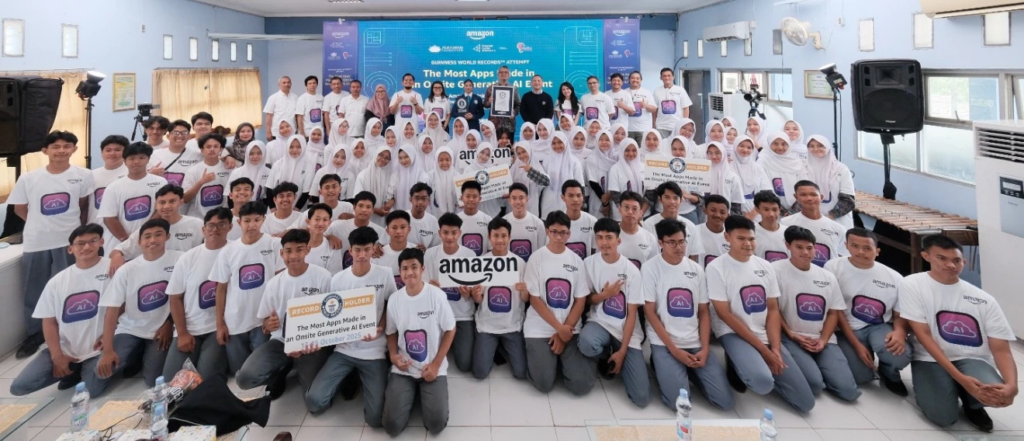
Just a fraction of over 2000 students who took part in the GUINNESS WORLD RECORDS attempt (IMAGE CREDIT: AWS)
Amazon’s expansion plans arrive at a time when competition among global technology companies in Southeast Asia is intensifying. Major firms including Microsoft, Google, Nvidia, and Alibaba have all announced large-scale AI and cloud-related investments across the region over the past year as countries compete to establish themselves as regional digital and AI hubs.
ASEAN’s digital economy is projected to reach US$560 billion by 2030, according to regional estimates, making Southeast Asia an increasingly strategic market for global cloud providers.
In 2025 alone, Amazon said it invested more than US$3 billion across Southeast Asia, including infrastructure spending and employee compensation tied to businesses such as AWS, Amazon Stores, Devices, Entertainment, and Global Selling operations.
The company currently employs more than 3,000 workers across the region, alongside an extended workforce of over 2,500 people.
AWS AI adoption grows across Southeast Asia
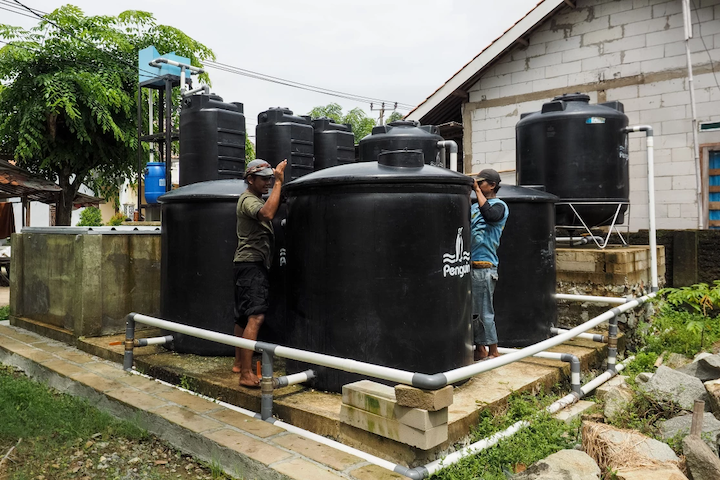
A clean water facility in West Java built by AWS (IMAGE CREDIT: Amazon)
Beyond infrastructure, Amazon is also positioning AI adoption as a central part of its regional strategy.
Several Southeast Asian companies and public sector agencies are already using AWS-powered AI tools to automate operations, improve analytics, and speed up customer services.
Malaysia-based stock image platform 123RF, for example, uses Amazon AI services to analyze millions of images, helping double search accuracy while reducing content discovery time by 90%.
In the Philippines, UnionBank has deployed generative AI-powered analytics tools for more than 200 business users, enabling teams to generate insights three to five times faster through AWS infrastructure.
Thailand property developer Sansiri has also built an AI assistant using AWS technology to speed up responses to homebuyers while automating invoice processing with reportedly 90% accuracy.
Meanwhile, Singapore’s GovTech agency developed an internal AI platform called MAESTRO on AWS, which helps public sector agencies build generative AI applications tailored to government use cases. Amazon said the platform was adopted by 20 public sector organizations and more than 300 data scientists and machine learning engineers within nine months of launch.
Amazon expands AI training and regional connectivity

IMAGE CREDIT: AWS
At the same time, Amazon is increasing its focus on workforce development as AI adoption accelerates.
The company said it has trained more than 2.7 million people across Southeast Asia in cloud-related skills since 2017 through various training initiatives and partnerships with governments, schools, and industry groups.
Zapolsky warned that workforce readiness remains one of the biggest challenges facing countries hoping to compete in the AI economy.
“AI and cloud training and upskilling are the most important enablers and where most countries are underinvesting,” he said.
Among Amazon’s regional initiatives is Singapore’s AI Spring program, which aligns with the country’s National AI Strategy 2.0 and aims to train 5,000 learners annually through partnerships with educational institutions including Temasek Polytechnic and the National Institute of Education.
In Indonesia, Amazon collaborated with schools across West Java in a generative AI training event involving more than 2,600 participants who collectively created over 10,000 AI applications in a single day, earning a GUINNESS WORLD RECORDS title.
Amazon is also participating in the Skills to Job Tech Alliance, a regional coalition active in Malaysia, Singapore, and Thailand that uses AI-driven systems to match workforce skills with employment opportunities in the technology sector.
The company’s broader Southeast Asia strategy extends beyond cloud infrastructure and AI services.
Amazon said it is also working to improve digital connectivity in underserved areas through low Earth orbit satellite technology under its Project Kuiper initiative, referred to in the release as Amazon Leo.
According to data cited by the company, more than 150 million people across Southeast Asia still lack reliable and affordable internet access, particularly in remote and rural communities where traditional broadband infrastructure remains difficult and expensive to deploy.
Closing this connectivity gap could generate nearly US$48 billion in annual economic benefits and support up to 3.8 million jobs across the region, according to estimates from consultancy Access Partnership.
Amazon is additionally using Southeast Asia as both a production and export hub for businesses selling globally through its marketplace ecosystem.
Amazon expands regional digital and sustainability footprint

Through Amazon Global Selling, thousands of Southeast Asian small and medium enterprises now export products to customers across more than 200 countries and territories. These include sellers from Vietnam’s furniture and apparel sectors as well as Singapore-based brands in beauty, baby products, and personal care.
The company is also expanding its entertainment footprint in the region through Prime Video, recently unveiling seven local original productions from the Philippines that will stream globally across 240 countries and territories.
Sustainability is another major component of Amazon’s regional expansion strategy.
To support AWS’s goal of becoming water positive by 2030, the company said all of its Singapore data centers now operate using recycled NEWater, Singapore’s reclaimed water supply. Amazon is also partnering with Malaysian utility provider Air Selangor on a reclaimed water initiative in Selangor.
In Indonesia, Amazon has worked with Habitat for Humanity to build clean water facilities and household water connections across villages in West Java. The company said the projects are expected to replenish around 200 million liters of water annually.
Amazon has also invested in renewable energy projects across Southeast Asia as part of its goal of achieving net-zero carbon emissions by 2040, including renewable energy developments in Singapore and a 210-megawatt green tariff agreement with Indonesian utility provider PT PLN.
As governments across Southeast Asia continue crafting AI regulations and digital economy policies, Amazon said it plans to work closely with policymakers on areas such as cybersecurity, trusted cloud adoption, responsible AI governance, and cross-border data flows.
“Sovereignty means different things in every country,” Zapolsky said during his remarks in Singapore. “You decide where your data sits, who can access it, and which models you use.”
For Amazon, Southeast Asia is no longer simply an emerging market. It is increasingly becoming one of the central battlegrounds shaping the future of AI infrastructure, cloud computing, and digital services globally.