
In an era where generative AI is increasingly being weaponized, the Philippine financial sector finds itself staring down an invisible enemy. We’ve moved far beyond simple phishing emails; today’s cybercriminals are deploying “deepfake” identities and hyper-sophisticated algorithms to try and crack even the most established institutions.
To stay ahead, the industry is leaning into RegTech (Regulatory Technology).
It’s a term the World Economic Forum defines as the use of tech to manage governance and risk, but for local players, it’s more than just a buzzword where AI-driven impersonation and financial fraud have become a common reality.
It has become the automated backbone of modern finance — built to slash compliance costs and minimize risks in a landscape where AI-driven fraud is a daily reality.
The early adopters: Setting the pace
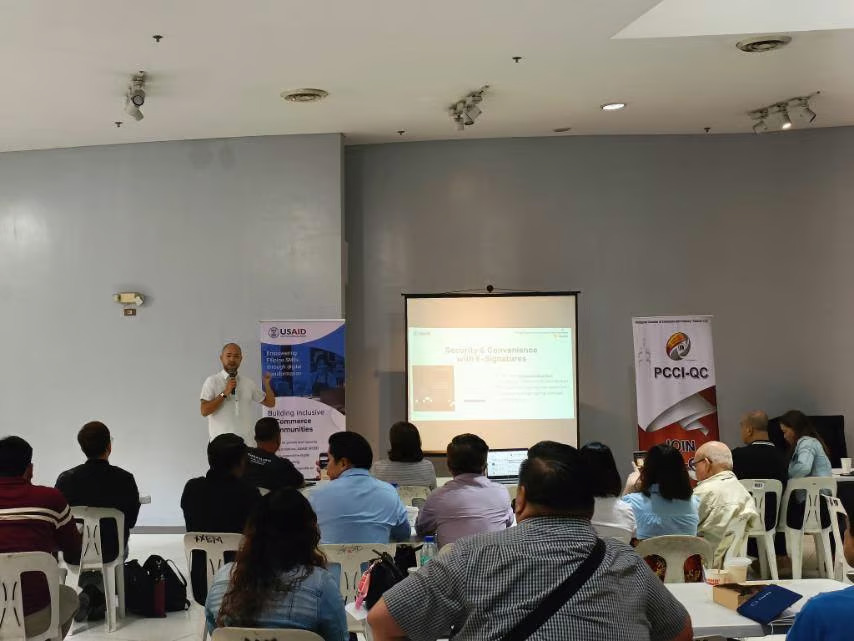
UNAWA COO Atty. Gino Jacinto addressing queries from the audience
The shift started as a quiet ripple.
In 2019, Unawa emerged as a local pioneer, digitizing the often-clunky world of audits, records, and document approvals. But as financial crimes grew more complex, the industry needed heavier reinforcements.
By 2022, Singaporean giant Tookitaki entered the fray.
Seeing the massive local demand for better anti-money laundering (AML) tools, the firm recently set up a satellite office in Manila. It’s a strategic move aimed at curbing the rising tide of financial crime across Southeast Asia.
“AI-driven solutions and a federated approach to fighting financial crime help firms detect complex fraud patterns and uncover hidden risks,” says Abhishek Chatterjee, founder and CEO of Tookitaki. His vision points to a massive industry pivot: moving away from slow, manual checks and toward a proactive, machine-led defense that can actually outrun modern hackers.
Beyond human speed: Why automation is non-negotiable
In the Philippines’ booming digital banking scene, the stakes couldn’t be higher. RegTech provides a multi-layered shield that old-school manual processes just can’t match.
Unlike backward-looking manual audits, RegTech offers real-time vigilance, flagging suspicious moves the second they happen.
It also provides compliance agility — as rules change, these frameworks update automatically, so local firms aren’t buried in legal red tape when launching new products.
Perhaps most importantly, there’s an efficiency dividend: by automating the “boring” stuff like data entry, banks can finally let their teams focus on growth instead of paperwork.
The toolkit: KYC, AML, and the “automation of everything”

IMAGE CREDIT: Freepik
RegTech covers everything from capital management to specialized crime-fighting. Anti-money laundering (AML) automation uses intelligent tech to monitor and manage compliance, while Know-your-customer (KYC) automation deploys “AI agents” to verify identities with surgical precision.
But there’s a warning: experts like iProov note that “static” verification —the kind that doesn’t move or adapt — is essentially dead. In a world of evolving identity fraud, the Philippine fintech sector has to embrace continuous, real-time detection. In this battle, standing still is a guaranteed way to fall behind.
The ripple effect on Philippine fintech
This isn’t just a technical patch; it’s a total shift in how the country does business:
1. Levelling the field: Small fintech startups can now automate compliance departments that used to require a “Big Bank” budget, allowing smaller e-wallets to compete.2. Reaching the unbanked: RegTech’s digital ID tools are a godsend for Filipinos who lack traditional paperwork. By using biometrics and alternative data, firms can finally bring more people into the financial fold.
3. Exiting the “Grey List”: The Philippines has had a rocky history with the FATF “Grey List.” Adopting global standards like Tookitaki’s signals to the world that our market is secure and transparent.
4. New jobs, new skills: We’re seeing the rise of the “Compliance Technologist” — a hybrid pro who knows both Philippine law and data science.
5. The “instant” factor: For the rest of us, this means no more waiting days for a loan or a new account. Automated KYC makes the experience fast, seamless, and competitive with the best in the world.