
Personal finance platform MoneyHero Group reported a 15% year-on-year increase in first-quarter revenue as higher-margin financial products and artificial intelligence-driven operational improvements helped narrow losses and move the company closer to profitability.
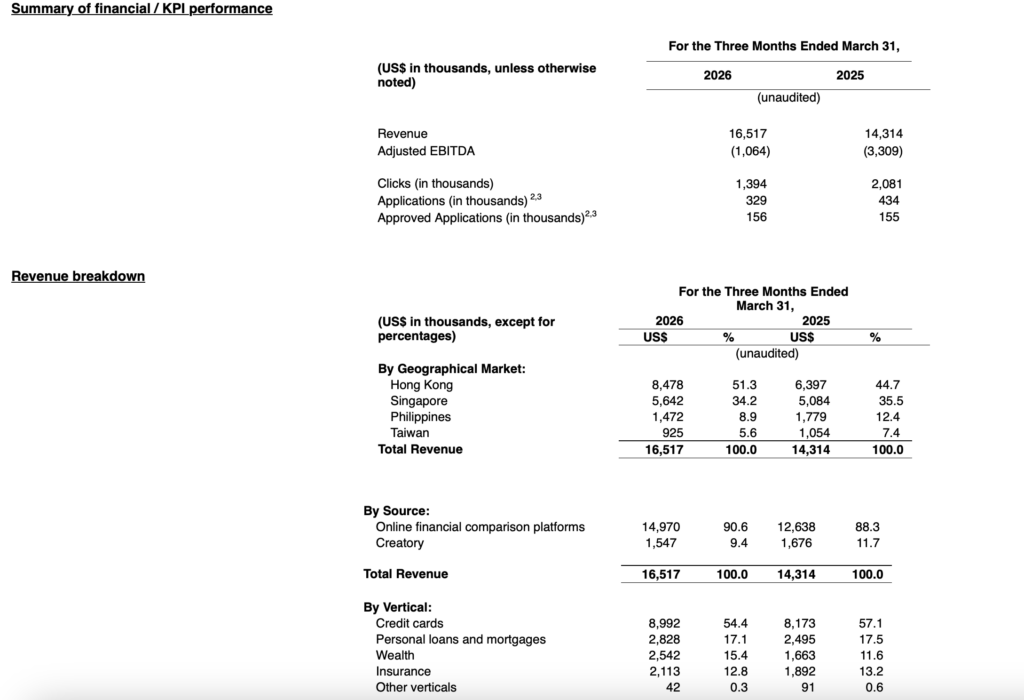
The Nasdaq-listed fintech, which operates comparison platforms and digital insurance brokerage services across Greater Southeast Asia, generated US$16.5 million in revenue for the quarter ended March 31, 2026, up from US$14.3 million a year earlier.
Growth was fueled by expanding demand for wealth management and insurance products, which together contributed US$4.7 million, or more than 28% of total revenue, compared with 25% in the same period last year. Revenue from the company’s wealth business alone climbed 53% year on year, while insurance revenue rose 12%.
The company’s adjusted EBITDA loss narrowed significantly to US$1.1 million, a 68% improvement from the previous year, reflecting lower operating costs and improved monetization across its core markets.
“Our first-quarter performance reflects continued progress toward sustainable, profitable scaling,” said Danny Leung, interim chief executive officer and chief financial officer of MoneyHero.
According to Leung, the company has focused on improving unit economics while expanding higher-margin businesses, allowing it to grow revenue without proportionately increasing operating expenses.
AI transformation drives cost savings

IMAGE CREDIT: Freepik
A key driver behind the improved financial performance was MoneyHero’s expanding use of artificial intelligence across product development and internal operations.
The company said AI now powers much of its software development process, allowing engineering teams to spend more time refining AI-generated outputs instead of writing code manually. It is also extending AI adoption into business operations to automate workflows, improve collaboration, and identify additional cost-saving opportunities.
These initiatives helped reduce combined technology, employee, and advertising expenses by 13% year on year to US$8.5 million.
MoneyHero said its approval rate also improved from 36% to 48%, even as marketing spending became more targeted, resulting in year-on-year growth in approved applications.
Leung said the company’s AI strategy is beginning to support not only operational efficiency but also revenue generation.
“AI remains a core pillar of margin expansion and our path toward sustainable profitability,” he said.
Core markets continue to lead growth

Hong Kong and Singapore remained MoneyHero’s largest contributors, accounting for more than 85% of total revenue during the quarter.
Revenue from Hong Kong increased 33% to US$8.5 million, while Singapore posted 11% growth to US$5.6 million, supported by continued expansion across the company’s financial product offerings.
Performance in Taiwan and the Philippines, however, reflected a more deliberate strategy.
Revenue from Taiwan declined 17%, while revenue in the Philippines fell 12% year on year as the company prioritized profitability over transaction volume.
According to MoneyHero, the Philippines generated US$1.47 million in revenue during the quarter after reducing lower-margin business to improve overall returns.
Despite the decline, the Philippines remained the group’s largest membership market, accounting for 6.9 million of its 9.8 million registered members, which grew 24% year on year.
Net loss widens despite operational gains
While operational performance improved, MoneyHero reported a net loss of US$6.7 million, compared with US$2.4 million a year earlier.
The company attributed the wider loss primarily to non-cash accounting adjustments, including changes in the fair value of warrant liabilities and unrealized foreign exchange losses resulting from regional currency movements against the US dollar.
Excluding those items, management said underlying operating performance continued to improve.
MoneyHero ended the quarter with US$28 million in cash and cash equivalents and no outstanding debt, providing financial flexibility to support product development, AI initiatives, and regional expansion.
Among its planned investments is the continued rollout of Credit Hero Club, its TransUnion-backed credit education and monitoring platform in Hong Kong.
Looking ahead, the company said it remains focused on disciplined execution, operational efficiency, and expanding higher-margin products as it works toward achieving sustainable profitability.