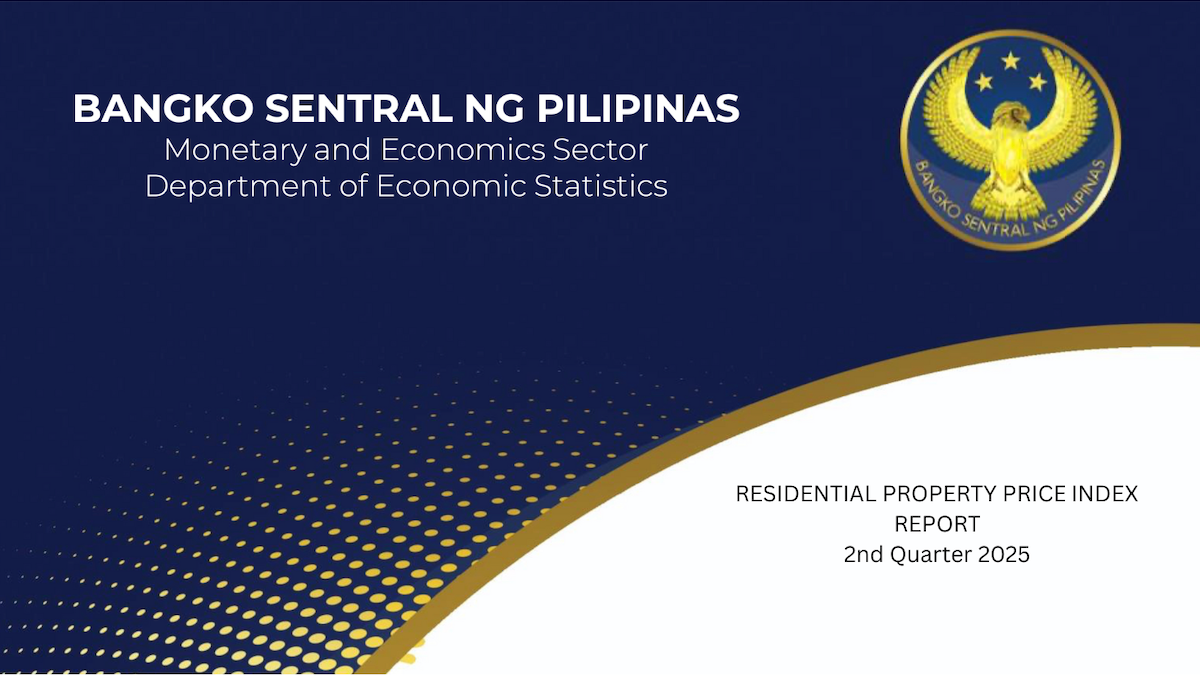
Housing prices in the Philippines continued their upward trajectory in the second quarter of 2025, with residential property values rising 7.5 percent year-on-year (y-o-y), according to the latest Residential Property Price Index (RPPI) released by the Bangko Sentral ng Pilipinas (BSP).
While the increase was slightly slower than the 7.6 percent growth recorded in the first quarter, analysts note that the sustained momentum reflects both resilient housing demand and structural shifts in the property market.
Outside Metro Manila leads the charge

A closer look at the data reveals a striking divergence between Metro Manila and the rest of the country.
Property prices in Areas Outside the National Capital Region (AONCR) surged by 11.5 percent y-o-y, significantly outpacing the modest 2.4 percent growth in the National Capital Region (NCR).
This trend suggests that housing markets in secondary and emerging cities are becoming key drivers of growth. Industry experts attribute this to several factors:
- Urban decentralization has been accelerated by hybrid work arrangements, prompting families to consider more affordable housing outside the metro.
- Infrastructure projects such as new highways, airports, and rail lines, are improving connectivity between provinces and business hubs.
- Lower land costs in regional areas are allowing developers to offer larger units at competitive prices.
“More Filipinos are recognizing the value of owning homes in provincial centers where space is larger, prices are relatively more affordable, and new infrastructure makes commuting more manageable,” said a property analyst familiar with the BSP data.
BSP sees mixed movements across housing types

The RPPI further breaks down price trends by type of housing, highlighting a split between landed homes and vertical developments.
- Single-attached and detached houses, apartments, townhouses, and duplexes all registered strong gains, with overall house prices rising 13.1 percent y-o-y.
- In contrast, condominium prices slipped by 0.2 percent, reflecting softer demand for high-density living, particularly in urban centers like Metro Manila.
Industry observers say the cooling of condo prices may be linked to changing consumer preferences after the pandemic. Many homebuyers now prioritize larger living spaces and outdoor access, features typically offered by landed homes outside crowded city cores.
Read the full report here: https://www.bsp.gov.ph/Media_And_Research/RPPI/RPPI-Report-2025-Q2.pdf
Residential Property Price Index: Why it matters
The Residential Property Price Index (RPPI) tracks the average change in the cost of housing over time, drawing data from actual housing loan transactions across banks.
For the BSP, the RPPI is a critical tool in monitoring both the real estate sector and the credit market.
Rapid increases in housing prices can signal potential overheating in the property sector, while sharp declines may point to weakening demand or risks to bank loan portfolios.
“Monitoring real estate prices is essential not only for the stability of the banking system but also for ensuring sustainable growth in the housing market,” the BSP said in a press statement.
Implications for buyers and developers

For prospective homeowners, the data underscores the importance of location and timing.
Buying property outside Metro Manila is becoming more expensive, but it still offers relative value compared to urban condominium units.
For developers, the sustained demand in regional areas may encourage more investments in housing projects outside NCR, particularly master-planned communities and affordable housing schemes.
The continued weakness in condominium prices, however, could push builders to rethink strategies for vertical developments, focusing on differentiated offerings such as co-living spaces or mixed-use projects.
A market in transition
Overall, the second-quarter data reflects a housing market in transition — moving away from a Metro Manila-centric model toward a more geographically diverse and resilient property landscape.
With infrastructure spending reshaping regional accessibility and hybrid work changing lifestyle choices, experts believe that property demand outside NCR will remain robust.
At the same time, the BSP’s close monitoring of the RPPI signals the central bank’s vigilance in preventing imbalances that could affect financial stability.
For now, the message is clear: Philippine housing remains on an upward climb, and the next phase of growth is increasingly being written beyond the borders of Metro Manila.