As Filipinos demand faster connectivity and more responsive digital services, PLDT is turning to agentic AI not simply as a technology experiment, but as a way to redesign how work gets done across the company.
The telecommunications giant is scaling AI-powered automation across customer service, internal knowledge management, enterprise workflows, and risk management as demand for 5G, broadband, and satellite connectivity continues to expand.

The shift is significant because agentic AI goes beyond generating answers. Instead of waiting for employees to complete every step of a process, AI agents can retrieve information, coordinate tasks, analyze data, and support decisions within defined workflows.
For a company handling millions of customers and complex network and enterprise operations, that difference can translate into substantial time savings.
From AI assistants to AI that gets work moving
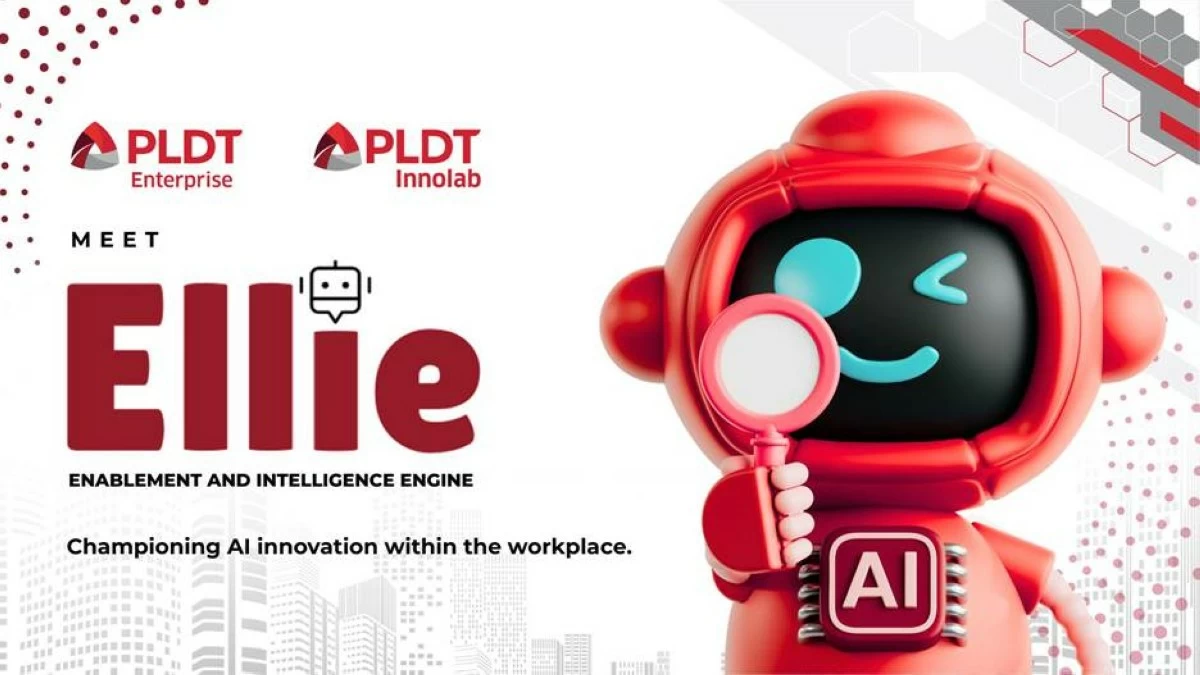
PLDT’s current deployments include KAI, its internal knowledge assistant; Ellie, which supports enterprise teams; and ERICA, an agent designed for enterprise risk management. The systems are being used for different workflows rather than as a single general-purpose chatbot.
KAI helps employees retrieve approved information for activities such as proposal development and customer support. PLDT estimates that it can reduce a research process that previously took days to responses delivered within seconds.
Ellie focuses on connecting employees with internal knowledge and workflows, with PLDT reporting customer response times that are up to 80% faster and annual time savings estimated at 18,000 to 25,000 hours. The company also estimates a 25% to 35% reduction in manual effort.
Meanwhile, ERICA supports risk reviews by synthesizing information, scoring risks, and recommending treatments. PLDT said reviews that previously took two to 10 days can now take between five minutes and one day, while manual effort has fallen by an estimated 97% to 99%.
These numbers show where agentic AI can become more valuable than simple automation: in workflows involving multiple sources of information and several steps before a decision can be made.
The customer experience is becoming an AI battleground
For consumers, the most important outcome may not be the number of hours PLDT saves internally. It is what happens to those savings when they reach the customer.
Telecommunications is a high-volume business where delays can quickly become frustrating. A customer asking about an order, payment, activation, or service issue may interact with several systems before a representative can provide an answer.
PLDT has already been deploying agentic AI on its customer-facing operations. Its Store Genie system, for example, connects specialized AI agents handling billing, provisioning, network, and payment workflows. At PLDT Home, certain processes that previously took hours were reduced to minutes.
This suggests that the competitive value of AI for telcos is moving beyond having a chatbot on a website.
The bigger advantage is the ability to connect intelligence with the systems employees already use, allowing customer requests to move through the organization faster.
Why the timing matters for Philippine telcos
Digital demand is becoming more complex. Customers now expect connectivity to support everything from mobile payments and remote work to streaming, cloud applications, smart devices, and increasingly AI-powered services.
That means telcos have to scale their operations without simply scaling headcount and manual processes at the same rate.
PLDT’s approach illustrates how automation can become part of that equation. The company estimates KAI alone eliminates around 25,000 to 30,000 hours of manual work annually, while Ellie is estimated to save another 18,000 to 25,000 hours.
The potential is not just lower operating effort. Employees can spend less time searching for information, moving data between systems, or completing repetitive reviews and more time handling work that requires judgment, customer interaction, and specialized expertise.
Agentic AI still needs guardrails
The faster AI systems become capable of acting across workflows, the more important governance becomes.
PLDT said KAI is grounded in approved information sources, which is one way to reduce the risk of employees receiving unsupported answers. But the company’s reported productivity figures are its own estimates and have not been independently verified.
That distinction matters as businesses measure AI success. Faster processing is useful, but accuracy, security, accountability, and appropriate human oversight remain just as important, particularly when AI is involved in customer interactions or risk-related decisions.
For PLDT, the next stage of digital transformation therefore may not be about adding more AI tools. It is about connecting those tools more deeply to the company’s actual operations.
If that strategy works, customers may not even notice the technology behind it. They will simply notice that getting an answer takes seconds instead of hours, that a request moves faster, and that fewer processes feel unnecessarily complicated.
That may ultimately be the strongest measure of whether agentic AI is working: not how intelligent the system sounds, but how much friction it removes from everyday digital life.