
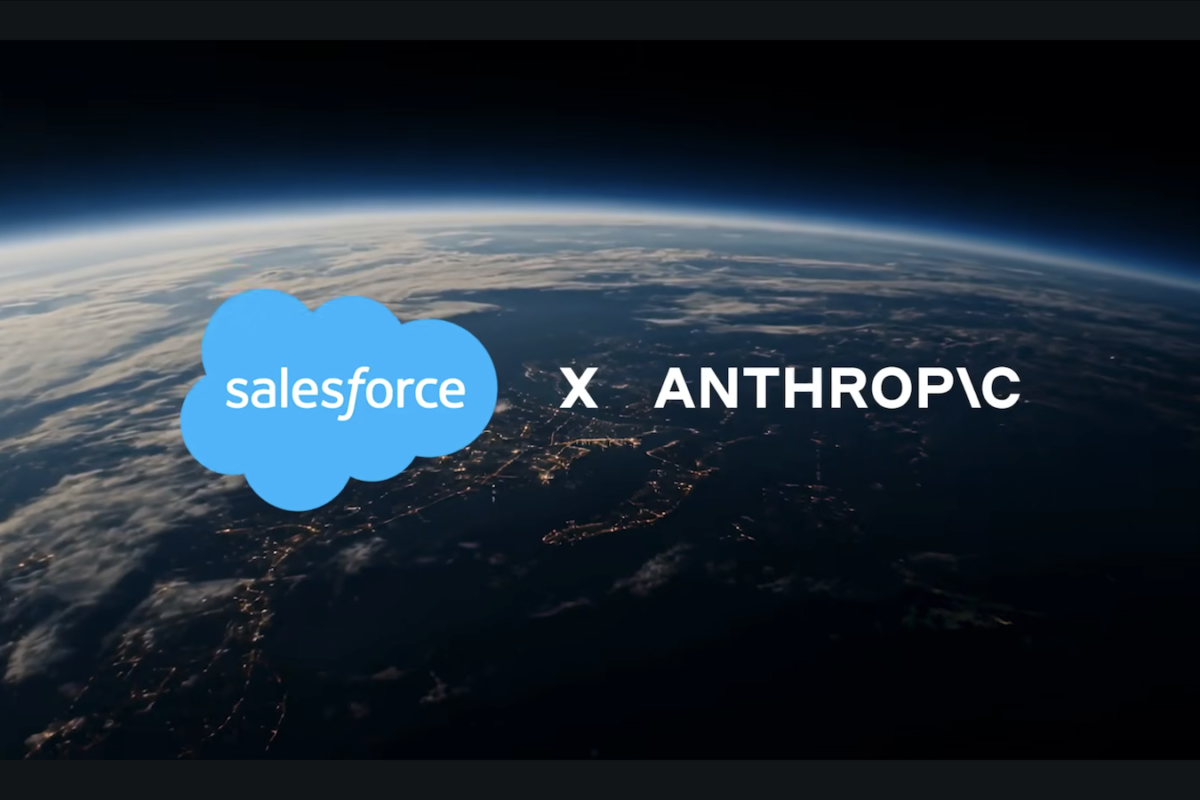
Claudeforce combines Claude’s reasoning capabilities with Salesforce data, workflows and governance to enable AI-powered enterprise actions.
Salesforce and Anthropic are expanding their partnership to bring Claude’s artificial intelligence capabilities deeper into enterprise workflows, allowing businesses to combine AI reasoning with customer data, business rules and governed actions within Salesforce.
The companies are calling the expanded partnership Claudeforce, which will initially introduce Salesforce in Claude, a plugin designed to give sellers access to live Salesforce revenue data and enable them to perform certain CRM tasks directly within Claude.
The companies said the partnership is aimed at moving enterprise AI beyond generating answers toward systems that can reason over business data and take actions within established workflows and governance frameworks.

Salesforce in Claude will launch with 37 prebuilt sales skills, including meeting preparation, deal-health reviews and pipeline analysis. The companies said the tool can also automate pipeline updates and perform governed actions through Salesforce.
The integration is powered by AIforce, Salesforce’s enterprise AI framework, which connects business data and workflows to AI agents through MCP servers, APIs and command-line tools.
For sales teams, the integration means Claude can work with information already stored across Salesforce and other connected systems rather than relying solely on generic prompts or isolated AI interactions.
“By fusing Claude’s extraordinary reasoning with the trusted data, workflows, and governance every enterprise runs on, we’re delivering a dynamic interface that thinks, reasons, and acts,” said Marc Benioff, chair and CEO of Salesforce.
Anthropic CEO and co-founder Dario Amodei said the partnership would allow businesses to apply Claude’s AI capabilities to customer and operational information accumulated in Salesforce.
“Salesforce in Claude brings this same frontier intelligence into the systems where much of the world’s commercial activity happens,” Amodei said.
Four areas of expanded integration

The Claudeforce partnership spans four areas, covering Salesforce’s CRM platform, Claude, Slack and the companies’ own adoption of each other’s technology.
1. Salesforce inside Claude
The first rollout, Salesforce in Claude, is designed around the sales lifecycle and gives users access to 37 prebuilt skills covering activities such as meeting preparation, deal-health assessment and pipeline reviews.
The integration can draw on a seller’s Salesforce and Slack context, as well as other connected services in Claude, to generate tailored dashboards containing accounts, pipeline information and other live business data.
Salesforce said actions initiated through Claude are routed through Salesforce so that existing business rules and permissions remain in place.
Administrators can connect Salesforce in Claude once, with authentication and permissions managed centrally. The companies said this eliminates the need for individual sellers to complete separate setup processes.
2. Claude inside Salesforce
The partnership also brings Claude into Salesforce products.
Claude is available in Agentforce, where it serves as a reasoning model for the Atlas Reasoning Engine and powers Agentforce Vibes and Agentforce Coworker by default. It is also available through Agent Builder.
Through Amazon Bedrock, Claude is available within the Salesforce Trust Boundary, allowing customers, including organizations in regulated industries, to deploy domain-specific AI while maintaining security controls around their data and AI workloads.
3. Claude and Salesforce in Slack
The expanded partnership also places Claude at the center of Slack’s AI capabilities.
Salesforce said Claude is the default model for Slack and will power Slackbot, support team decision-making through Claude Tag, and contribute to Slack Code.
The integration is intended to allow teams to move from conversations and decisions in Slack to governed actions in Salesforce without switching between multiple systems.
4. Mutual adoption
Salesforce and Anthropic are also customers of each other, with the companies using their respective technologies internally as part of the broader partnership.
Salesforce uses Anthropic’s Claude across several products and internal operations, including Slackbot, Salesforce in Claude, Headless 360, Agentforce Coworker and Claude Code.
According to Salesforce, Slackbot has generated 8.1 million hours of annualized productivity gains for its employees, more than doubling quarter over quarter.
Salesforce also plans to make Claude Code and Claude Enterprise available to its developers and knowledge workers as preferred AI assistants and productivity tools.
The companies said Claude is the first large language model provider to be fully integrated within the Salesforce Trust Boundary.
Enterprise AI moves closer to taking action

The partnership reflects a broader shift in enterprise AI, where companies are increasingly looking beyond standalone chatbots toward AI agents capable of working with business data, following established rules and completing tasks.
Salesforce said its AIforce framework is designed to give agents access to enterprise data and workflows without requiring organizations to build separate integrations for every AI application.
For businesses, the distinction is significant: AI systems can provide reasoning and recommendations, while enterprise platforms provide the structured data, permissions, workflows and governance needed to turn those recommendations into actions.
The approach could allow employees to interact with enterprise software through AI interfaces rather than manually navigating multiple applications for routine tasks.
Availability
Salesforce in Claude is currently available to select pilot customers, with an open beta expected in September 2026.
Additional prebuilt skills are expected to begin rolling out in the third quarter of 2026.