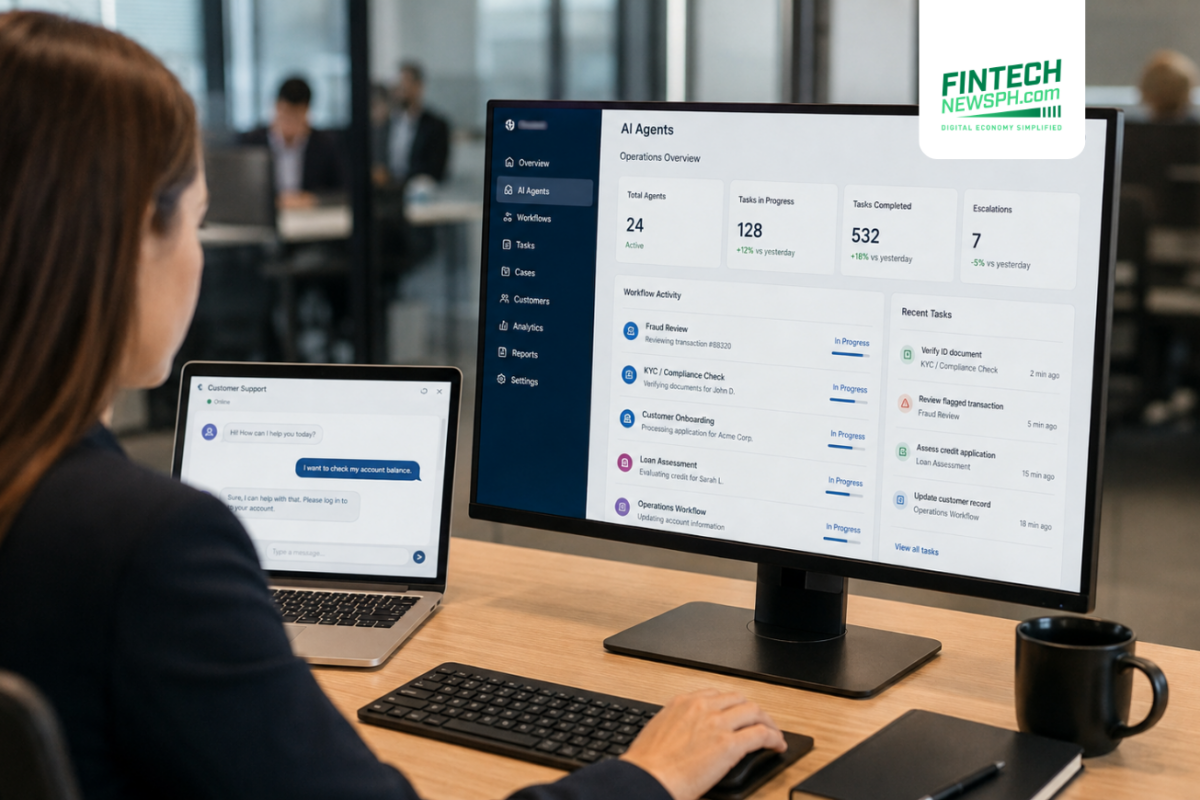
Banking AI is entering a new phase. Instead of simply answering customer questions, artificial intelligence is beginning to perform work once handled by bank employees — from onboarding customers and detecting fraud to supporting compliance and credit assessments.
The shift is being driven by AI agents, software designed to complete defined tasks rather than just hold conversations.
Chatbots remain the most visible form of banking AI. They answer common questions, locate transactions, explain products, and direct customers to the appropriate service. However, banks are increasingly directing their most significant AI investments toward less visible applications that can perform multistep tasks instead of merely responding to customer prompts.
A Covasant analysis of AI in banking describes this transition as a move from conventional virtual assistants toward agentic AI systems. These systems can access approved tools, evaluate available information, and carry out defined workflows involving customer onboarding, loan processing, fraud detection, compliance, and banking operations.
What separates an AI agent from a chatbot?
A traditional banking chatbot is mainly designed for conversation. It may answer frequently asked questions, retrieve account information, or guide a customer through a predefined process.
An AI agent is designed to accomplish a defined objective. With permission to access specific banking systems, an agent could collect documents, check whether information is complete, compare the data against internal policies, prepare a risk assessment, and send exceptional cases to a human reviewer.
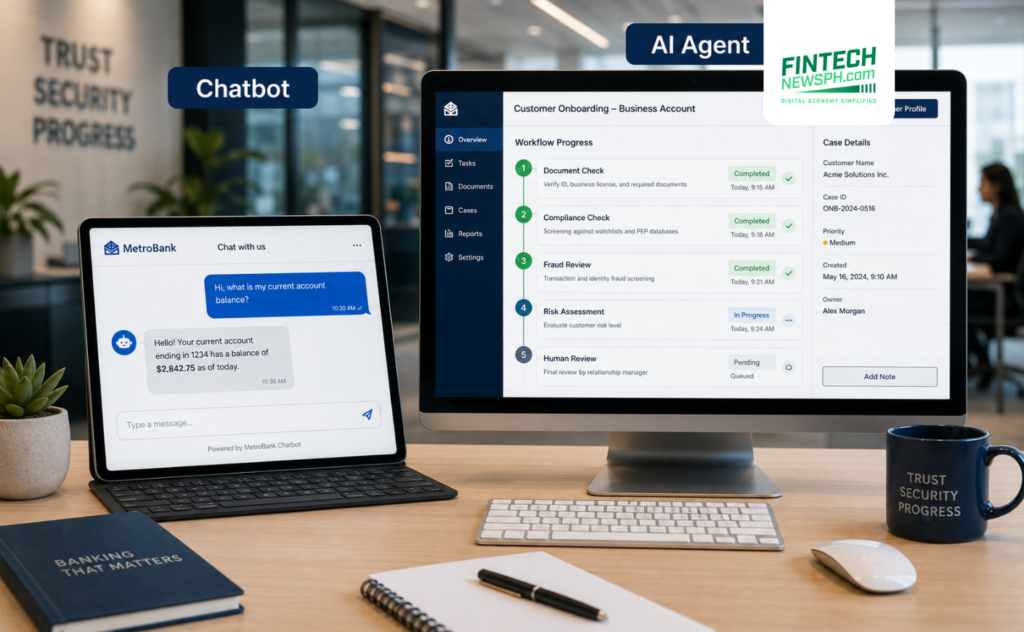
This does not mean that the agent independently approves a loan, rejects a customer, or freezes an account. In regulated financial services, real-world deployments are generally expected to operate within defined limits, maintain activity records, and require human approval for sensitive or higher-risk decisions.
The customer may still interact with what appears to be a chatbot. Behind that interface, however, several specialized agents could be working together. One could retrieve account information, another could check fraud indicators, while a third could prepare the case for a bank employee.
Fraud detection offers a clearer business case
Fraud and anti-money laundering systems are among the strongest reasons for banks to invest beyond conversational AI.
The Bangko Sentral ng Pilipinas’ thematic review of AI and machine learning found that pattern and anomaly detection were the leading AI use cases among the Philippine financial institutions it surveyed. These systems are commonly used for suspicious transaction monitoring, fraud detection, network security, and anti-money laundering activities.
Conversational tools were also widely used, particularly for customer service and sentiment analysis. However, the review found that AI initiatives primarily supported internal functions, followed by core banking processes and enterprise-wide applications. This suggests that banks are already looking beyond customer-facing assistants when deciding where AI can create measurable value.
In its 2025 Annual and Sustainability Report, UnionBank identified customer onboarding, credit underwriting, and fraud detection as three of the areas where AI has had the greatest impact.

IMAGE CREDIT: UnionBank
The bank said AI now processes some customer applications almost in real time, while AI-driven credit models help strengthen risk assessments and identify borrowers who may be overlooked by older systems. For fraud detection, the bank uses AI to establish normal transaction behavior and flag unusual amounts, locations, or timing before customers notice something is wrong.
RCBC has also introduced a unified AI-powered fraud and AML platform that analyzes behavioral signals, device fingerprints, and location data. According to the bank, the platform can identify unusual activity, including possible user coercion or automated bot behavior, and flag suspicious transactions before losses occur.
These systems may never receive as much public attention as mobile banking assistants, but they can directly affect fraud losses, investigation time, false alerts, and compliance costs.
Banks want AI to handle entire workflows
Customer onboarding illustrates why agentic systems are gaining attention.
Opening a bank account can involve document collection, identity verification, sanctions screening, customer risk classification, and manual approval. A chatbot can explain which documents are required. An AI agent could potentially coordinate the steps, identify missing information, perform preliminary checks, and prepare the application for a human decision.
Bank of Singapore, the private banking arm of OCBC, has begun using an agentic AI platform called HELIOS for customer due diligence and onboarding. According to OCBC’s announcement, the platform can help reduce private banking account-opening times to 15 business days, compared with an industry median of around six weeks.
HELIOS performs much of the customer due diligence process before a relationship manager meets the prospective client. The rollout covers Singapore, Hong Kong, and Dubai, while the bank said risk management and compliance requirements remain part of the process.
UnionBank is also preparing its infrastructure for what it calls agentic AI commerce. Under this model, customers could state what they want to accomplish, while an authorized AI system completes the transaction within security, compliance, and spending rules established by the bank and customer.
Why these investments are happening quietly
Banks have several reasons to prioritize internal AI deployments before promoting autonomous financial assistants directly to the public.
Internal workflows offer benefits that are easier to measure, including faster processing, fewer manual reviews, lower operating costs, and shorter fraud-investigation times. Banks can also limit agents to specific data, tools, and decisions while employees supervise the final results.

Customer-facing autonomy carries greater reputational and regulatory risk. A chatbot giving an incomplete answer may inconvenience a customer. An AI agent incorrectly rejecting a borrower, blocking a legitimate payment, exposing confidential information, or producing an inaccurate compliance report could have serious financial and legal consequences.
The BSP review found that many Philippine financial institutions had already invested in AI-related data, talent, and tools, but governance remained less developed. It also found that several institutions were intentionally cautious about customer-facing or fully automated AI to keep potential risks manageable.
McKinsey’s analysis of agentic AI in Asian banking estimates that end-to-end operations represent around 60 to 70 percent of a bank’s cost base. This makes operational processes a potentially larger source of AI-related savings than standalone customer-service tools.
However, banks must move beyond isolated experiments. Connecting agents to entire workflows requires changes to data access, employee responsibilities, approval processes, cybersecurity controls, and accountability structures.
Governance will determine how far agents can go
As AI systems gain the ability to perform actions, banks must determine exactly what each agent can access, what decisions it can make, and when human approval is required.
Institutions will also need records showing which information an agent used, which actions it took, and how an employee can review or reverse the outcome. Vendor oversight becomes equally important when third-party AI providers process sensitive customer information or connect with core banking systems.
Chatbots are therefore unlikely to disappear. Instead, they may become the visible front end of a larger AI infrastructure operating across fraud detection, compliance, lending, onboarding, payments, and banking operations.
The real transition isn’t simply from chatbots to autonomous AI. It’s from AI that only provides information to AI that can perform controlled, measurable tasks.