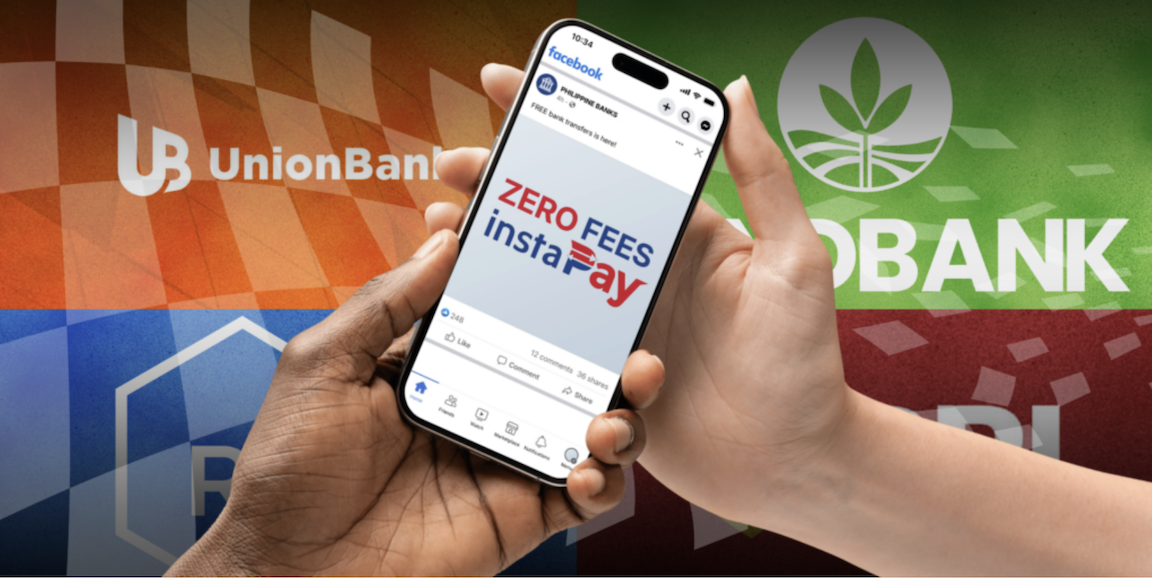
For years, InstaPay fees were simply accepted as the cost of moving money digitally. Today, those transfer fees are quickly disappearing. If you’ve checked your phone over the past few weeks, you’ve probably noticed a common message from banks across the Philippines: InstaPay transfer fees are now free.
It almost feels like a race, with banks announcing waived or reduced InstaPay fees one after another as they compete to attract and retain customers.
The shift is largely driven by Bangko Sentral ng Pilipinas (BSP) Circular No. 1238, Series of 2026, which seeks to make interbank fund transfers more affordable and accessible.
So far, the list of major local banks that have already waived their InstaPay fees includes BPI, RCBC, LANDBANK, UnionBank, and several thrift, rural, and digital-first banks.
As of this writing, more banks are expected to follow suit. Consumers are also beginning to view free transfers as an expected feature rather than a premium benefit.
A win-win for everyone’s wallet

Those ₱10 to ₱25 fees may seem insignificant on a single receipt, but for the average Filipino who transfers money frequently, the costs can quickly add up.
This is one of the many reasons why, despite the rapid growth of digital finance, many businesses in the Philippines continue to rely on physical cash for day-to-day transactions.
So removing these charges is a double win. It reduces transaction friction, helps consumers save money, and encourages wider adoption of digital payments.
During a recent forum hosted by Citi Philippines entitled “Driving Momentum in Digital Payments Transformation,” Citi Philippines CEO Paul Favila discussed the efforts to accelerate digital payments in the country and how businesses in particular stand to benefit from adopting digital payments.
“Digital payments are inherently safer, with transactions that are more secure, transparent, and traceable,” Favila said.
“They drive efficiency by automating processes, reducing manual effort, and minimizing risk, while providing clear visibility into cash flow and helping businesses lower costs while strengthening governance and control.”
Sustainability of the zero-fee

IMAGE CREDIT: Shutterstock
The move to waive transfer fees is not just for compliance; it is a broader competitive strategy in the industry. Banks are embracing this shift not because they are willing to lose revenue, but because they are focused on winning in the long run.
Transfer fees can influence where customers choose to keep and move their money. They can influence customer loyalty and engagement. One reason is that consumers naturally compare costs, and this can influence where they choose to store and spend their money.
Although banks may lose fee income in the short term, stronger customer loyalty and higher deposit balances can offset those losses over time. With this retention of active users over the long term, many banks view waived transfer fees as a long-term customer acquisition and retention strategy rather than simply a short-term cost.
Essentially, what allows banks to absorb these fee cuts is their ability to generate income from other sources.
According to a financial and industry analysis, traditional banks have diversified revenue streams, with around 87% of their revenues coming from loans and deposits, while approximately 13% only comes from fees.
Meanwhile, the case is different for e-wallets, as their revenue model relies more heavily on fees and commissions, which account for around 90% of their revenues. This helps explain why many e-wallet providers have opted to reduce, rather than completely eliminate, transfer fees.
A look at the finish line
Close collaboration between business leaders, regulators, and corporate executives are gradually paving the way for the cash-lite society. Their shared agenda recognizes that cashless payments are no longer just a matter of technological convenience, but an economic imperative.
Now that transfer fees are disappearing, the digital finance ecosystem in the Philippines is entering its maturity phase. Consumer payment behavior is evolving rapidly. More Filipinos are using digital payments to buy groceries, pay bills, and send money to loved ones. At the same time, businesses — from sari-sari stores to large corporations — are increasingly integrating digital payments into their day-to-day operations.
As more banks eliminate transfer fees, consumers stand to benefit the most. Lower transaction costs make digital payments more affordable and accessible, encourage wider adoption, and support the country’s broader shift toward a more inclusive digital financial ecosystem.