


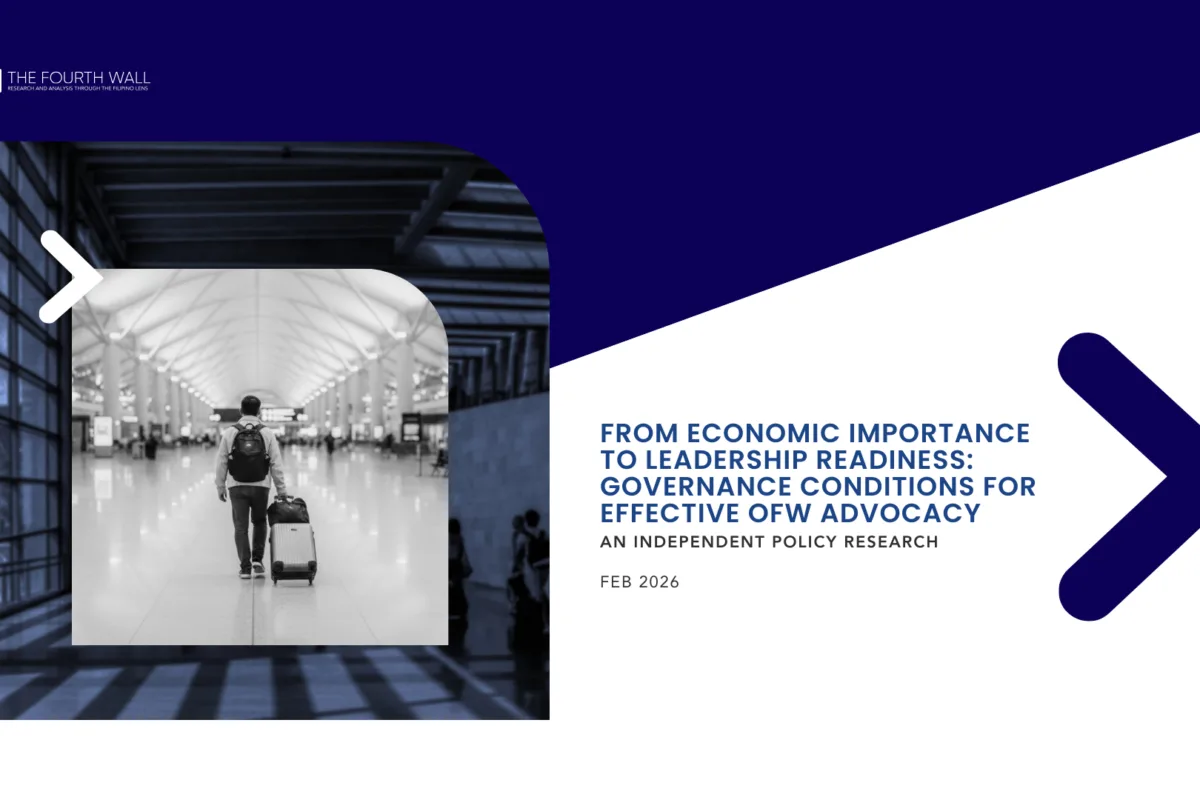
For decades, the Philippines has been hailed as a global gold standard for migration governance. But for the millions of Filipinos powering the economy from abroad, a “comprehensive framework” matters far less than a leader who shows up when the sirens go off.
A new study by sociocultural research firm The Fourth Wall reveals a critical disconnect in the country’s migration system: Overseas Filipino Workers (OFWs) do not measure government effectiveness by bureaucratic mandates, but by the visibility and decisive action of leaders during times of crisis.
The US$35 billion disconnect
The economic stakes could not be higher. Data from the Bangko Sentral ng Pilipinas (BSP) shows that OFW remittances hit a staggering USD 35.63 billion in 2025, accounting for 7.3% of the nation’s GDP.
Yet, the study, titled “From Economic Importance to Leadership Readiness,” argues that this massive financial contribution demands a level of governance that goes beyond mere administration.
While agencies like the Department of Migrant Workers (DMW) handle the technicalities of recruitment and reintegration, the research suggests that OFWs experience “service,” not “policy.”
“When documentation is slow, when hotlines are unresponsive, or when agencies fail to coordinate during an emergency, migrants don’t turn to ‘administrative complexity’ — they look to national leadership,” says John Brylle L. Bae, Research Director at The Fourth Wall.
Digital nudges vs. human presence

In an era where fintech apps are simplifying how OFWs send money, the government’s challenge is simplifying how they receive protection. The study identifies that because the institutional infrastructure is already in place, the “primary variable for success” has shifted from policy design to execution discipline.
Key findings from the report highlight that OFWs look for “credible champions”—leaders who can serve as a coordinating force across a fragmented network of agencies. These workers prioritize:
- Visible responsiveness: On-the-ground presence during distress cases.
- Representational legitimacy: Leaders who demonstrate a “lived understanding” of the migrant experience.
- Process discipline: Reliable service delivery that matches the speed of the digital age.
The shift from bureaucracy to reliability
The Fourth Wall concludes that the Philippine government does not need a larger bureaucracy or expanded mandates. Instead, it needs to optimize the reliability of existing structures.
The report outlines several urgent policy considerations to bridge the trust gap:
- Streamlined coordination: Harmonizing the efforts of all migration-related agencies.
- Accessible support: Improving the responsiveness of digital and physical assistance channels.
- Simplified documentation: Reducing the friction in cross-agency service processes.
- Stronger reintegration: Creating clearer, more stable pathways for those returning home.
“Leadership readiness is not an abstract quality,” Bae adds. “It is a governance function that serves as the deciding factor in whether migration policy translates into timely protection for Filipino workers abroad.”
To access the full report, visit fourthwallglobal.com or follow The Fourth Wall on Facebook and LinkedIn.