
As generative artificial intelligence (AI) becomes increasingly accessible, the competitive advantage for businesses may no longer lie in the technology itself but in their ability to deploy it effectively.
That was the key message from TP in the Philippines during the GenAI Summit Philippines 2026, where the company argued that organizations are now entering a new phase of AI adoption—one where execution, operational expertise, and measurable outcomes matter more than access to large language models and AI platforms.
Speaking at the event, Vishnu Raj, Vice President for AI at TP in the Philippines, said many companies today have access to the same AI technologies but struggle to generate meaningful business value because they lack the operational maturity required to integrate AI into real-world workflows.
“Everyone has access to the same technologies today, but not everyone has the same processes and expertise,” Raj said. “The real differentiator is orchestration intelligence. At TP, we have decades of domain expertise, and rich and deep experience in AI, both in deployment and optimization, to maximize value in every customer interaction.”
Orchestrating AI systems to deliver business value
IMAGE CREDIT: The Value of AI
According to Raj, successful AI implementation requires more than deploying chatbots or automation tools. Organizations must understand where AI can create the most value across customer journeys and how to balance automation with human intervention.
The discussion comes as enterprises across the Philippines and Southeast Asia accelerate investments in generative AI, seeking efficiencies in customer service, operations, sales, and back-office functions. However, many projects remain stuck in pilot stages as businesses grapple with integration challenges, governance concerns, and difficulties demonstrating return on investment.
TP believes its experience managing customer experience operations at scale provides a distinct advantage in identifying practical AI use cases that can deliver measurable results.
During the summit, the company demonstrated an AI-powered customer service agent capable of handling a range of functions, including identifying customer concerns, conducting authentication processes, troubleshooting issues, recognizing cross-selling and upselling opportunities, and escalating complex cases to human representatives when necessary.
The demonstration showcased how TP combines autonomous AI agents, large language models, machine learning technologies, and customer relationship management (CRM) systems to create end-to-end support experiences.
The solution is powered by TP’s proprietary Foundational AI Backbone (FAB), which serves as the orchestration layer connecting AI systems with human agents.
Operational knowledge drives effective AI implementation
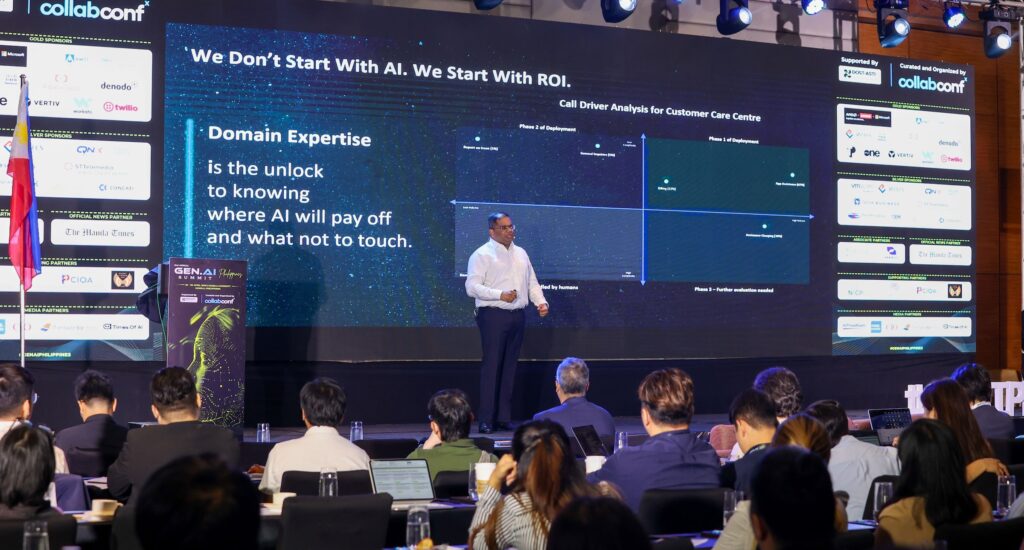
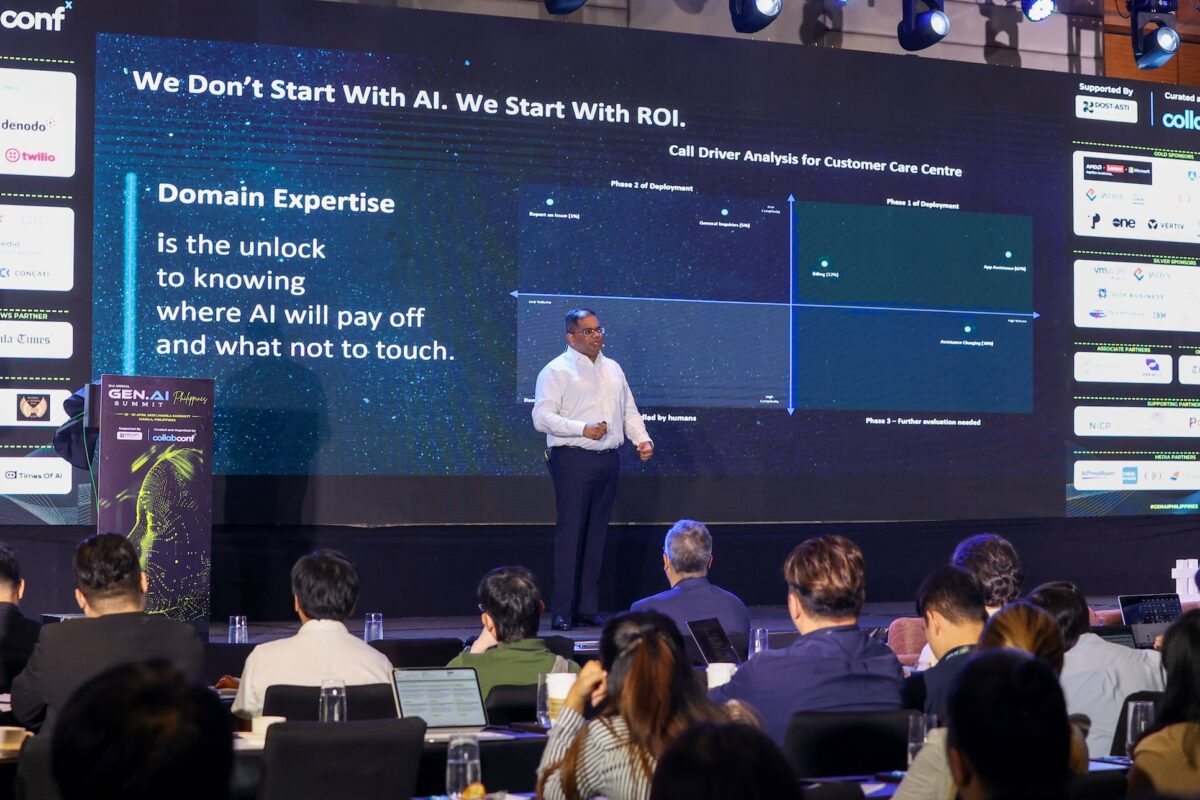
Vishnu Raj, Vice President for AI at TP in the Philippines, delivering a speech at GenAI Summit Philippines 2026
In a speech delivered during the event, Raj noted that one of the biggest advantages of large-scale customer operations is the depth of institutional knowledge available from frontline teams.
“We work closely with the people on the production floor, the agents, quality analysts, and subject matter experts who understand customer concerns deeply,” he said. “That operational knowledge is critical in identifying where AI can deliver the greatest value, including the objective of reducing the total cost of operations.”
Rather than pursuing large-scale automation immediately, TP advocates a phased deployment strategy that focuses first on high-volume, lower-complexity interactions. Raj said this approach enables organizations to demonstrate business value and ROI more quickly before expanding AI into more sophisticated workflows.
The company also emphasized that human oversight remains essential, particularly for complex, sensitive, or high-stakes customer interactions where empathy, judgment, and contextual understanding are required.
As AI adoption continues to mature, industry conversations are increasingly shifting away from the capabilities of individual models toward the systems, processes, and governance frameworks needed to operationalize them at scale.
For TP, that shift reinforces the importance of combining technological innovation with decades of operational expertise.
The annual GenAI Summit Philippines brings together technology leaders, enterprises, startups, and policymakers to discuss emerging developments in generative AI, as well as the opportunities and challenges shaping the future of AI adoption across industries.