


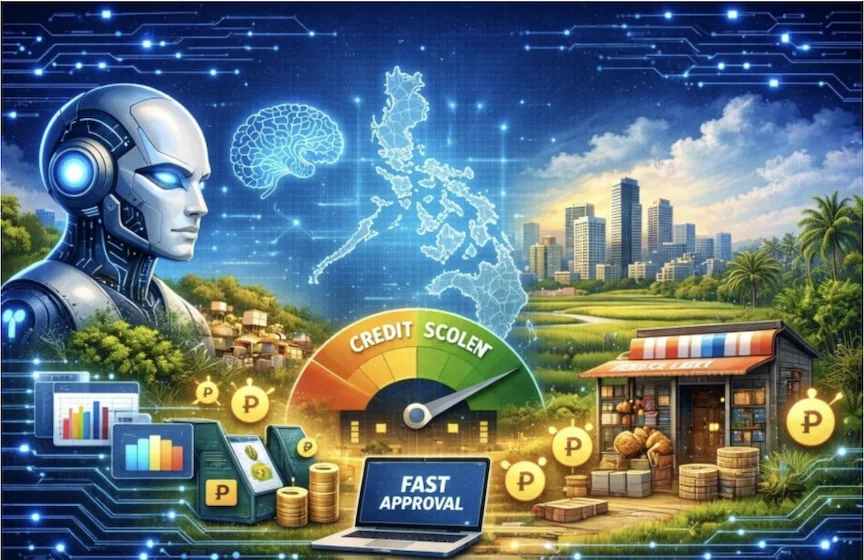
As the Philippines continues its push toward financial inclusion, a new wave of fintech companies is harnessing artificial intelligence (AI) to help millions of Filipinos gain access to credit — especially those left out of the traditional banking system.
From villages far from Metro Manila to gig workers with irregular incomes, AI-driven credit scoring and lending platforms are redefining how financial institutions assess creditworthiness and extend loans.
This trend marks a significant departure from conventional credit scoring, which has historically relied on formal banking histories, stable employment records, and lengthy documentation.
For many Filipinos, particularly the underbanked and unbanked, such requirements have been insurmountable barriers to securing even modest loans.
Now, fintech innovators are using AI to analyze alternative data — from mobile phone usage and telecom records to e-commerce activity and digital transactions — opening the door to formal loan access for millions.
Bridging the credit gap with AI

In 2025, Trusting Social, a Vietnam-based fintech specialist, expanded its AI credit scoring services in the Philippines. Its platform analyzes masked and aggregated telecom data to determine creditworthiness for Filipinos lacking formal financial histories.
The company reports enabling access to roughly USD 500 million in unsecured loans monthly and partnering with more than 50 financial institutions in the country to expand lending reach.
Another key player is JuanHand, the local arm of fintech group FinVolution, which has disbursed over PHP 55 billion in nano-loans through its AI-powered lending system. The platform approves loans in minutes using proprietary machine-learning models to evaluate risk and automate credit decisions.
The company says its system helps borrowers build a credit profile that can eventually qualify them for larger and more conventional loans.
At the same time, Island Credit Solution, a newly accredited credit bureau under the state-owned Credit Information Corporation (CIC), is introducing “PhilScore,” an AI-powered analytics system that combines traditional financial records with alternative data to generate deeper insights for lenders.
The technology aims to benefit not only individual borrowers but also micro, small, and medium enterprises (MSMEs), which frequently struggle to obtain financing.
Emerging startups such as LenderLink are also building real-time credit bureaus in the Philippines, enabling lenders to access up-to-date credit risk data instantly and reduce non-performing loans. This infrastructure could further support responsible lending and more inclusive financial systems.
Mainstream banks join the AI rush
It is not only fintech startups adopting AI. Traditional lenders are also experimenting with the technology to speed up decision-making and improve loan processing.
For example, the Bank of the Philippine Islands (BPI) has announced plans to integrate AI into its lending platforms to enhance workflow efficiency and automate loan approvals.
Digital banks such as Tonik are likewise tapping AI and alternative scoring methods, underscored by the institution’s rapid growth and recent funding aimed at scaling its services regionally.
Financial inclusion at scale
Proponents of AI-driven lending argue that the technology can help include segments of the population long excluded from formal finance.
In the Philippines, only about half of adults had a financial account as of 2024, according to World Bank data, highlighting persistent gaps in financial inclusion.
For MSMEs — widely considered as critical drivers of the Philippine economy but often constrained by limited access to credit — AI-powered fintech solutions could prove transformative.
Global development research consistently identifies financing as a top barrier to small business growth in emerging markets, a gap these technologies may help narrow.
Balancing innovation and consumer protection
Despite its promise, experts caution that rapid innovation must be matched with strong safeguards.
AI models trained on alternative data raise concerns about privacy, fairness, and potential bias, particularly when users may not fully understand how their data is collected or used.
As fintechs, banks, and regulators navigate this evolving landscape, the growing use of AI in Philippine lending reflects a broader shift in financial services — not just a technological upgrade, but a meaningful step toward more inclusive finance.