


As AI agents become capable of writing code, running applications, and completing multi-step tasks, AMD believes the humble CPU is poised to take on a much bigger role in AI computing.
For years, GPUs have dominated conversations around AI infrastructure, powering the large language models behind today’s most popular chatbots. But according to the chipmaker, the next wave of AI could place renewed importance on processors that execute the work after an AI model decides what to do.
The shift could have implications for banks, fintech firms, and other enterprises increasingly exploring AI agents to automate software development, fraud detection, regulatory compliance, customer support, and back-office operations. As AI moves beyond answering questions to completing real-world tasks, the hardware running those workloads becomes a bigger part of the equation.
The chipmaker believes the rise of AI agents—software capable of writing code, opening files, running applications, and completing multi-step workflows—is changing where computing work happens.
Instead of simply generating text in the cloud, these systems increasingly rely on the user’s device to execute actions, making processor performance a bigger part of the overall AI experience.
The shift also aligns with AMD’s broader strategy around agentic AI, including OpenClaw, its open-source framework that helps developers build AI agents capable of interacting with local files, applications, and development tools. As more AI workloads move beyond simple text generation, AMD sees faster local execution becoming an increasingly important part of the user experience.
AI is learning to do more than answer questions
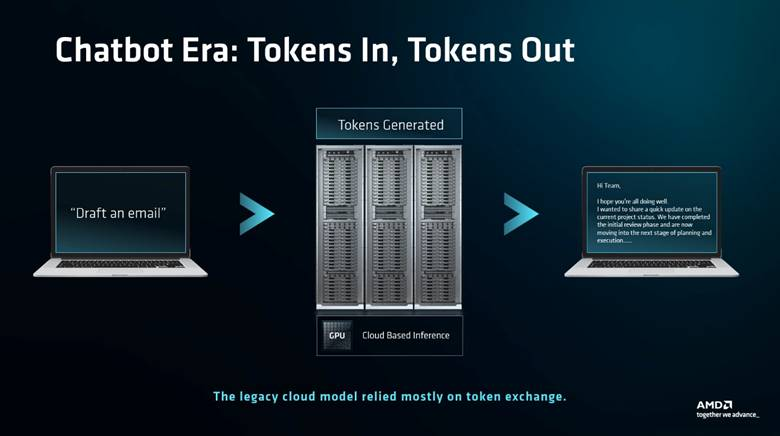
The first generation of generative AI was largely built around conversations. Users entered prompts, models generated responses, and most of the processing took place during inference, often on cloud-based GPUs.
AI agents are beginning to change that model. Rather than simply responding to questions, they can read local files, execute code, interact with software, call external tools, and complete complex, multi-step tasks. Generating text is still part of the process, but it is no longer the end goal.
For financial institutions, that could mean AI systems capable of reviewing compliance documents, analyzing suspicious transactions, preparing regulatory reports, reconciling data across multiple systems, or assisting customer service teams — all with minimal human intervention.
A developer, for example, can ask an AI agent not just to explain a piece of code but to inspect an entire project, edit files, compile the application, run tests, fix errors, and repeat the process until everything works.
That workflow involves much more than AI inference.
Each time the model decides on an action, the computer still has to execute it—whether that’s launching Python, searching project directories, opening documents, querying a database, or interacting with other software.
The CPU becomes part of the AI workflow
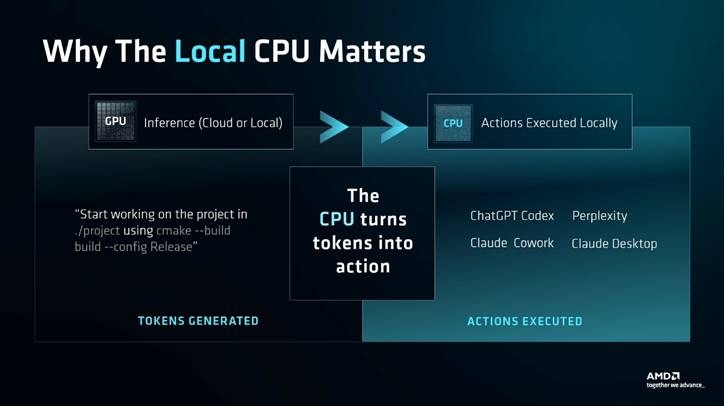
Much of that work falls to the CPU.
Even when AI inference is accelerated by cloud GPUs or on-device NPUs, CPUs continue managing operating system processes, scheduling workloads, moving data, and executing many of the applications AI agents depend on.
As agents become more capable, those responsibilities only increase.
Rather than performing a single action, an AI agent may execute dozens of operations before returning a finished result. Some systems can even run multiple agents simultaneously, with each handling a different part of the task.
The same principle applies in financial services. An AI agent investigating potential fraud may need to retrieve transaction records, cross-reference customer profiles, search internal knowledge bases, generate risk assessments, and prepare reports before recommending the next step. While AI models determine what should happen next, the CPU helps carry out much of the underlying work.
In those situations, processor performance affects more than benchmark scores. It can influence how quickly code compiles, how fast files are processed, how responsive applications remain, and ultimately how long users wait for a task to finish.
Benchmark reflects changing workloads
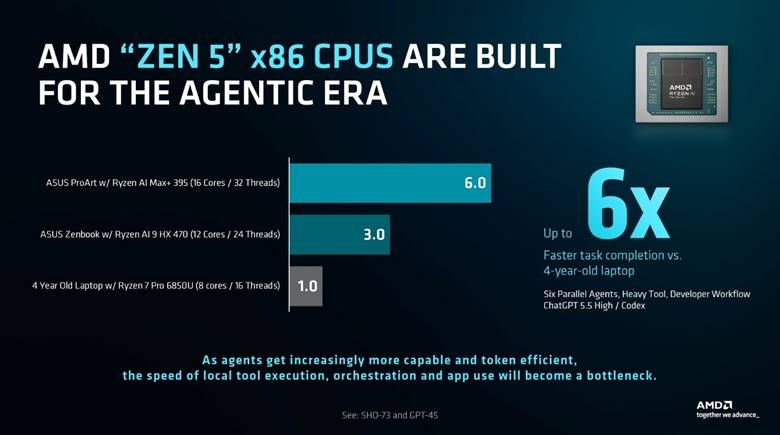
To demonstrate that shift, AMD tested a software development workflow using six concurrent ChatGPT 5.5 High agents running through OpenAI Codex.
The workload is similar to the type of agentic AI applications developers can build with OpenClaw, where AI agents interact with local files, execute code, run software, and coordinate multiple tools to complete complex tasks instead of simply generating responses.
During the test, the agents carried out a mix of programming tasks, including source code analysis, software compilation, Python execution, database queries, file serialization, compression, hashing, package management, and other operations that rely heavily on local system resources.
AMD said an ASUS ProArt system powered by its Ryzen AI Max+ processor delivered up to six times the CPU throughput of a four-year-old laptop during the multi-agent workload.
Although AMD’s benchmark focused on software development, the underlying principle extends well beyond coding. Financial institutions deploying AI agents for document processing, Know Your Customer (KYC) checks, anti-money laundering (AML) reviews, compliance monitoring, and internal knowledge management also rely on systems that continuously interact with enterprise applications and local data.
While the benchmark was conducted by AMD, it highlights a broader shift taking place across the AI industry. As AI models become faster and more efficient, more of the overall workload moves to the device running the applications rather than the model itself.
Measuring AI by completed work

For enterprises adopting AI — from software development and cybersecurity to financial services and customer support — the way AI performance is measured may also be changing.
Until recently, discussions largely centered on model size and token generation speed. But as AI agents become capable of completing real-world tasks, a more practical question emerges: How long does it take to finish the job?
Cloud GPUs will continue powering many of the largest AI models, while local GPUs and NPUs accelerate AI inference on devices. But every file an AI agent opens, every application it launches, every script it executes, and every workflow it coordinates still depends on the processor underneath.
For banks and fintech companies investing in agentic AI, that could make CPU performance a more strategic consideration than it has been in previous generations of AI deployments. Faster execution can help reduce the time it takes AI agents to complete workflows, whether processing compliance documents, assisting software engineers, supporting fraud investigations, or responding to customer inquiries.
Rather than replacing GPUs, AMD argues that CPUs are becoming an equally important part of the AI stack — providing the execution environment that turns AI-generated decisions into completed work.