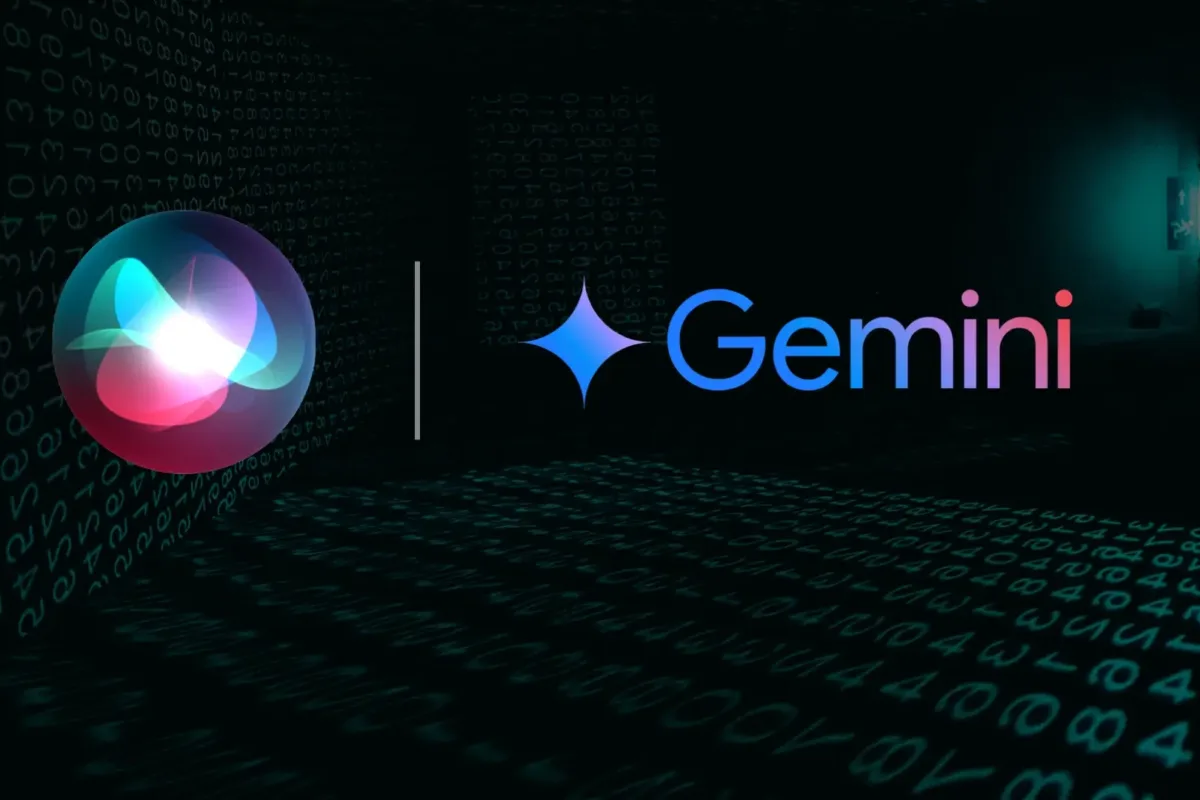
Apple has chosen Google’s Gemini artificial intelligence technology to power its next-generation AI features, including the Siri digital assistant, marking a rare and consequential partnership between two long-time smartphone rivals.
The multi-year deal signals a strategic recalibration for Apple, which has historically insisted on developing core technologies in-house.
In a joint statement, the companies said Apple selected Google’s AI stack after a “careful evaluation,” concluding that Gemini offered “the most capable foundation” for its near-term AI ambitions.
The announcement underscores how the rapid rise of generative AI is reshaping alliances in Big Tech, even among competitors that dominate adjacent ecosystems. Apple’s iOS and Google’s Android together control the vast majority of the global smartphone market, yet the two companies are now aligning on one of the most strategically sensitive layers of modern computing: artificial intelligence.
A rare alliance between rivals
Apple and Google’s relationship has long been complex. While they compete fiercely on mobile operating systems, hardware, and services, they also maintain one of the most lucrative commercial agreements in the technology sector. Google pays Apple billions of dollars annually to remain the default search engine on iPhones, iPads, and Macs.
That arrangement has come under sustained regulatory pressure in the United States. The US Department of Justice has argued in an ongoing antitrust case that the deal helps Google preserve its dominance in search. A federal judge, however, has allowed the agreement to continue while the case proceeds.
The Gemini partnership extends that uneasy coexistence deeper into product strategy. Under the deal, Google’s large language models will underpin Apple’s next wave of AI features, most visibly through Siri, which has lagged competitors in recent years.
For Apple, the move reflects urgency. Rivals including Microsoft, Google, and a growing ecosystem of AI-native companies have rolled out increasingly capable assistants and developer tools at a rapid pace. Apple, by contrast, has been criticized for moving cautiously and, at times, falling behind.
Why Apple turned to Gemini
Apple reportedly evaluated AI offerings from multiple providers, including OpenAI, Anthropic, and Perplexity, before settling on Google’s Gemini.
While financial terms were not disclosed, the choice suggests Apple prioritized model maturity, scalability, and integration readiness over exclusivity. Gemini has been deployed across Google’s own products, from Search to Workspace, giving it a track record at consumer scale that few rivals can match.
Dan Ives, an analyst at Wedbush Securities, described the partnership as “a major validation moment for Google” and a “stepping stone” for Apple as it works to stabilize and accelerate its AI roadmap through 2026 and beyond.
Apple’s AI leadership has been in flux. In December, the company announced that the head of its artificial intelligence team would step down. It has also delayed the rollout of a significantly upgraded Siri, first teased last year and now promised for release later this year.
Privacy and on-device AI remain central
Despite relying on Google’s models, Apple was quick to stress that it is not abandoning its long-standing emphasis on privacy and on-device processing. The company said its in-house system, branded Apple Intelligence, will continue to handle device-level AI tasks on iPhones and iPads.
According to Apple, sensitive requests and personal data will still be processed locally where possible, with cloud-based AI used selectively. The company framed this hybrid approach as consistent with its “industry-leading privacy standards,” a core differentiator in its marketing and regulatory positioning.
This architecture could help Apple manage reputational risk, particularly in markets such as the European Union and Asia-Pacific, where data protection rules are stringent and consumer trust around AI remains fragile.
Market reaction and competitive backlash
News of the partnership pushed shares of Google-parent Alphabet past a US$4 trillion market capitalization threshold for the first time, reflecting investor confidence in Gemini’s growing commercial relevance.
Not everyone welcomed the deal. Tesla chief executive Elon Musk, whose xAI venture competes in the generative AI space, criticized the partnership as anti-competitive. Musk argued that giving Google another distribution channel — on top of Android and Chrome — represents an “unreasonable concentration of power.”
Such criticism echoes broader concerns among regulators and smaller AI developers that a handful of tech giants could end up controlling both the infrastructure and interfaces through which AI reaches consumers.
What it means for fintech and the Philippines

For the fintech sector, the Apple-Google tie-up has implications that extend beyond consumer convenience. AI-powered assistants embedded at the operating-system level could become key gateways for financial services, from payments and budgeting to customer support and fraud detection.
In the Philippines, where mobile-first banking and e-wallet adoption continue to grow, deeper AI integration into smartphones could influence how users interact with financial apps.
Smarter voice assistants and contextual AI features may lower barriers to entry for first-time digital finance users, while also raising questions about data sharing, model bias, and platform dependence.
Local fintech players may need to adapt quickly, optimizing their apps and services for AI-mediated discovery and interaction on iOS devices. At the same time, regulators may face renewed pressure to clarify how AI models embedded in consumer devices intersect with existing rules on data privacy, consumer protection, and competition.
A pragmatic turn for Apple
Ultimately, Apple’s decision to rely on Google’s Gemini reflects a pragmatic shift rather than a philosophical one. Building frontier-scale AI models is capital-intensive and fast-moving, and even Apple’s vast resources have limits.
Partnering allows the company to close perceived gaps more quickly while continuing to develop its own AI capabilities behind the scenes.
For Google, the deal cements Gemini’s status as a leading AI platform not just for its own ecosystem, but for competitors’ products as well. For the industry, it is another sign that the AI race is blurring traditional lines between rivals — and that strategic necessity is increasingly trumping old rivalries.
As Apple prepares to roll out its next wave of AI-powered features later this year, the success of the partnership will be judged less by headlines and more by execution: whether Siri finally becomes meaningfully smarter, and whether users trust the intelligence now partly powered by a longtime competitor.