




Thanks to an SEC Memorandum Circular, MSME registration just got more affordable.
The Securities and Exchange Commission (SEC) has moved to deepen support for micro, small, and medium enterprises (MSMEs) by extending registration and filing fee discounts into 2026 — a strategic effort to ease compliance burdens and invigorate business formalization and capital market participation.
Extended discounts for MSME registration fees

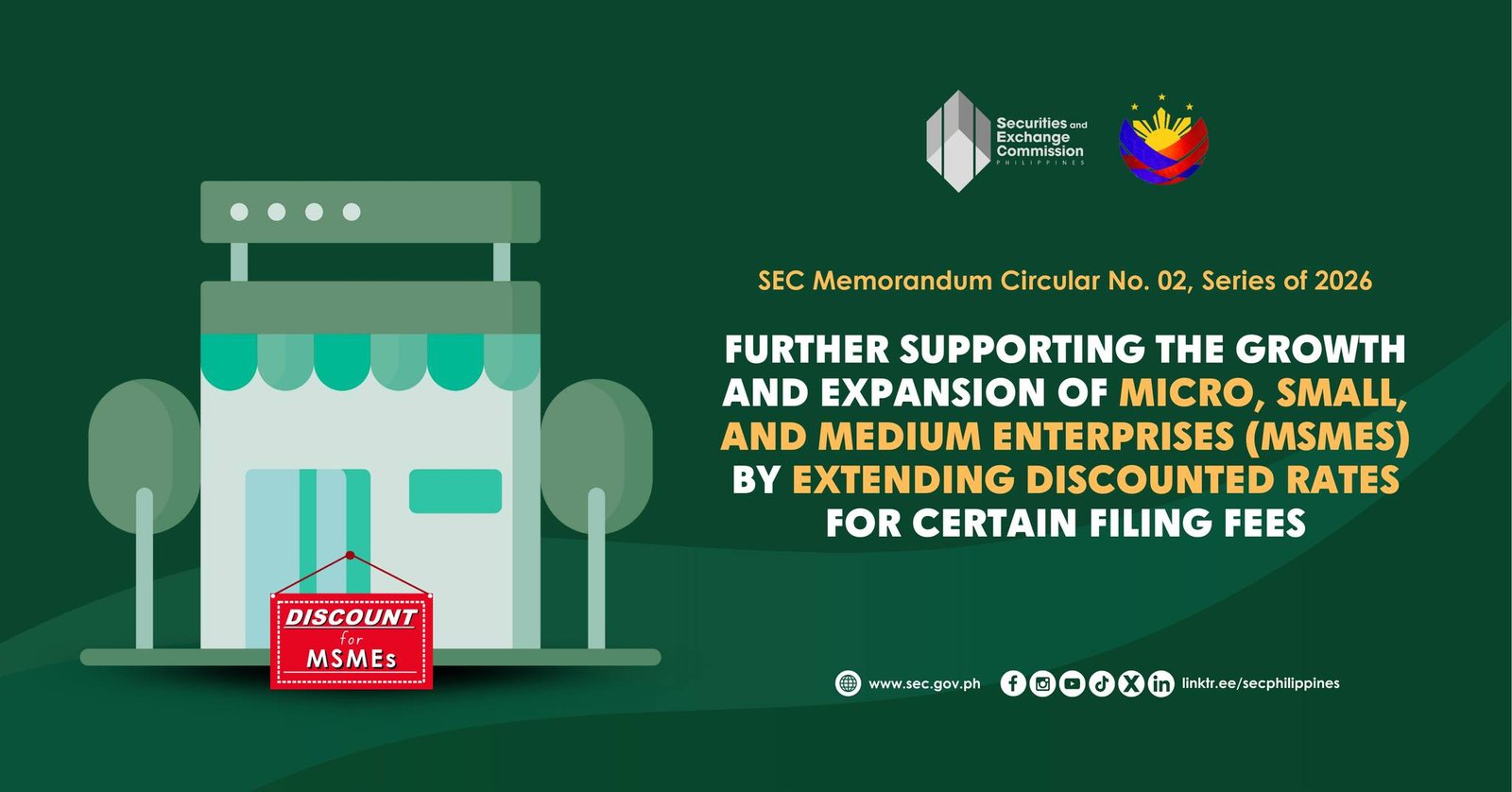
In a bid to lower barriers to formal business operations, the SEC issued Memorandum Circular No. 2, Series of 2026, prolonging discounts originally introduced in 2025. Under the new circular, MSMEs can avail of a 20% discount on corporate registration fees until March 31, 2026, giving small businesses more runway to incorporate at reduced costs.
The extended incentive also includes a 50% discount on securities registration fees, valid until 30 June 2026. This reduction aims to encourage MSMEs not only to formalize but also to explore capital market opportunities with lower financial friction.
This move extends beyond traditional entities and also applies to companies using streamlined registration processes across sectors such as power generation, real estate, agribusiness and even hospital operations, broadening the scope of beneficiary MSMEs.
Regulatory focus on formalization and growth
SEC Chairperson Francis Lim highlighted the regulator’s intention to foster a more inclusive environment for Philippine MSMEs, acknowledging their critical role in the national economy. Easing registration and filing costs, Lim noted, can help bring more informal ventures into the formal economy.
Since the introduction of the discounted fees in July 2025, the SEC has reportedly granted roughly ₱34.5 million in discounts to over 15,000 MSMEs as of December 2025, illustrating early traction in uptake.
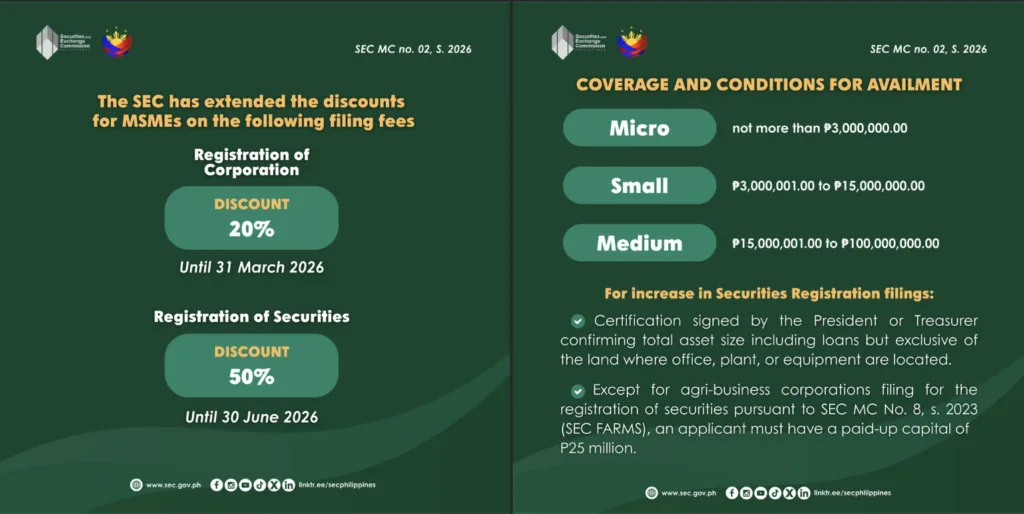
To qualify for the incentives, enterprises must meet the Magna Carta for MSMEs’ asset criteria — assets of up to ₱3 million for micro, up to ₱15 million for small, and up to ₱100 million for medium enterprises. Companies seeking the securities discount must also provide appropriate certification and typically hold a paid‑up capital of up to ₱25 million, with some exceptions for agribusinesses.
Implications for MSMEs and the Philippine economy
The extension of fee reductions can lower entry costs for budding entrepreneurs, boosting formal registrations and potentially improving access to financing and growth channels. Savings on compliance fees may enable MSMEs to allocate resources toward expansion, talent, and innovation, aligning with broader economic inclusion objectives.
Moreover, the substantial discount for securities registration may attract MSMEs looking to scale via capital markets, signalling regulatory intent to nurture a pipeline of future publicly listed firms. This could strengthen the ecosystem for MSME growth across sectors.
As implementation continues, the SEC’s fee incentives underscore an ongoing policy commitment to integrate small businesses into formal economic structures while reducing cost‑related entry barriers.