




The Philippine government’s updated Konektadong Pinoy regulations are poised to raise internet speed, transparency, and reliability nationwide — changes expected to impact millions of Filipino users.
While often described in technical language, the reforms serve a straightforward purpose: to ensure better, faster, and more dependable connectivity across the country.
The revised rules introduce stricter performance metrics for internet service providers (ISPs), clearer requirements for outage reporting, and faster approval processes for building telecom infrastructure. Together, these measures address common frustrations long felt by consumers, from sluggish peak-hour speeds to vague service advisories and delayed fiber installation.
Here’s a closer look at how the updated regulations can reshape the Philippines’ digital landscape:
Higher performance standards: Clear expectations for speed and reliability

One of the most significant changes under the Konektadong Pinoy regulations is the establishment of strict, measurable performance benchmarks. ISPs must now comply with defined standards covering:
- Minimum upload and download speeds
- Limits on latency and jitter
- Service availability and uptime requirements
- Maximum acceptable packet loss
Why this matters
Previously, providers had wider leeway to justify inconsistent service quality. With the new standards, regulators can rely on concrete numerical thresholds to verify compliance and impose penalties when necessary.
Example:
If a 200 Mbps plan regularly drops to 30 Mbps during peak hours, the National Telecommunications Commission (NTC) can now compel the provider to take corrective action.
Mandatory outage reporting: Greater transparency during disruptions

Under the updated Konektadong Pinoy regulations, ISPs must now follow a standard process for reporting network outages.
The rules require providers to:
- Notify authorities within a specified timeframe
- Disclose causes, affected areas, and estimated restoration periods
- Submit post-incident reports
- Coordinate public advisories for major disruptions
What this means for consumers
These guidelines aim to eliminate vague notifications such as “We’re experiencing network issues.” Under the revised framework, users can expect clearer, more timely updates.
Sample advisory:
“An outage affecting Cebu City and Mandaue has been reported due to roadworks along SRP. Estimated restoration: 4–6 hours.”
“Green lane” approvals: Faster permits for infrastructure rollout
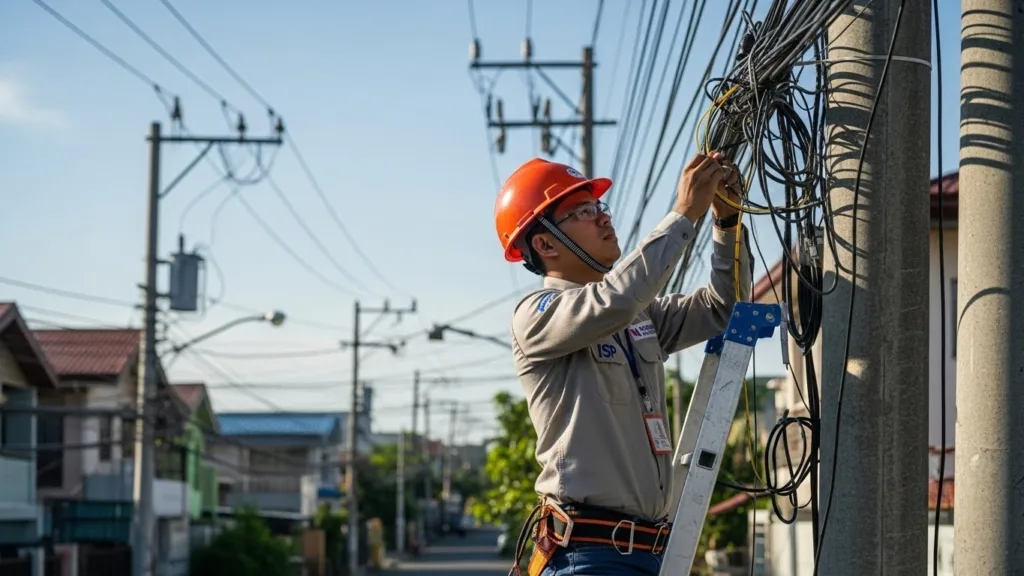
Another key improvement under the Konektadong Pinoy regulations is the introduction of a “green lane” for telecom permit applications. This expedited process applies to:
- Fiber rollout
- Cell site construction
- Small-cell deployment
- Emergency repairs
The streamlined system reduces permit processing times from months to weeks — and, in some cases, just a few days.
Benefits to consumers
- Faster installation of new broadband lines
- Quicker post-typhoon restoration
- Expanded fiber access in underserved areas
- Reduced downtime after infrastructure damage
This is particularly crucial for a country that now depends heavily on digital platforms for work, education, and commerce.
Fairer competition rules: More players, better service
A core objective of the Konektadong Pinoy Act is to promote open access across different layers of the network:
- Backbone
- Middle mile
- Last mile
By encouraging qualified providers to enter the market, the policy aims to reduce reliance on a few dominant players and to foster competition and innovation.
What consumers stand to gain
- More competition → potentially lower prices
- More choices → improved service quality
- Better redundancy → fewer large-scale outages
It’s akin to adding more lanes to a once-congested highway: traffic eases when more participants share the load.
Industry concerns: Questions on long-term investment and fairness
Some industry leaders—among them PLDT Chairman Manuel V. Pangilinan—have raised concerns about the reforms, including:
- The possibility of new entrants “free-riding” on infrastructure they did not build
- Regulatory imbalances that may discourage investment
- Risks of declining service quality if oversight is inconsistent
These concerns underscore a central challenge: the success of the regulations depends on strict, fair, and sustained enforcement.
What consumers should watch out for
Over the next several months, the public can expect early signs of the reforms taking effect, such as:
- Public performance dashboards from regulators
- Shorter installation timelines for new fiber connections
- More specific and timely outage notifications
- New or smaller ISPs entering more local markets
If these developments begin to materialize, they may indicate that the updated rules are working as intended.
Bottom line: A stronger, faster, and fairer internet for all
If properly implemented, the Konektadong Pinoy regulations could lead to:
- More dependable internet speeds
- Faster network expansion
- Clear and timely outage information
- A more competitive ISP landscape
- Overall improvements in service quality
The vision is straightforward:
A truly connected Philippines where reliable internet becomes a national strength—not a daily frustration.
External links
- NTC Performance Standards
https://ntc.gov.ph - DICT Konektadong Pinoy Program
https://dict.gov.ph - Open Access in Data Transmission Act Overview
https://legacy.senate.gov.ph/lisdocs/2604424339.pdf