


The Philippines’ external position is showing signs of resilience, even as global headwinds are expected to weigh on the country’s balance of payments (BOP) over the next two years, according to the Bangko Sentral ng Pilipinas (BSP).
In its latest assessment, the central bank said the country’s external sector is likely to undergo an “orderly but gradual adjustment” through 2026 and 2027, as moderating global trade, geopolitical tensions, and higher energy costs shape the outlook.
At the same time, separate data from the BSP’s Balance Sheet Approach (BSA) report showed that the Philippines’ net external liabilities declined in the third quarter of 2025 — pointing to a stronger financial position with the rest of the world.
External pressures persist
The BSP expects the balance of payments to remain under pressure in the near term, driven largely by external factors rather than domestic imbalances.
Global growth continues to lag pre-pandemic levels, while trade momentum is slowing as earlier tariff-driven demand normalizes. Heightened geopolitical tensions, particularly in the Middle East, are also adding uncertainty, primarily through rising oil prices and shifts in investor sentiment.
“These external conditions shape the overall outlook through cost and confidence channels,” the central bank said, noting that risks are less about sharp declines in trade volumes and more about sustained price pressures and volatility.
Export growth moderates
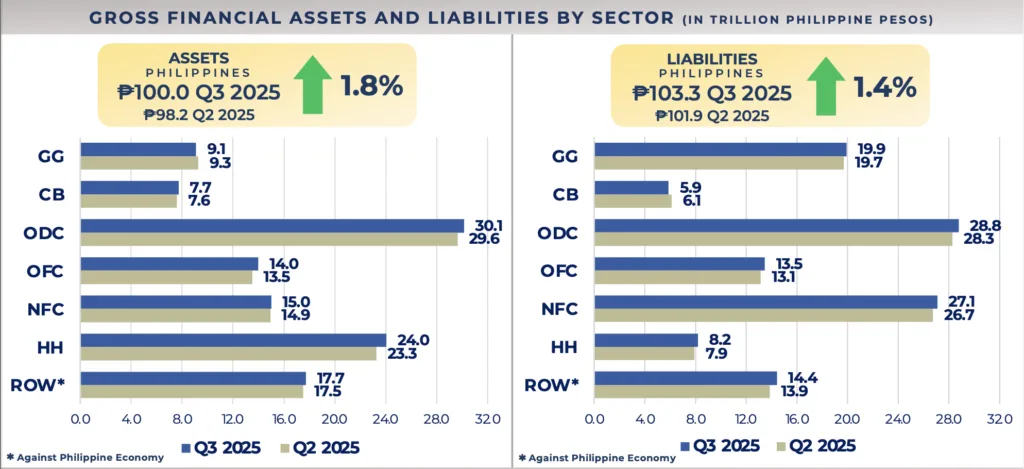
The Philippines’ gross financial assets by sector (IMAGE CREDIT: BSP)
After a strong 15% expansion in 2025, Philippine goods exports are expected to grow at a more measured pace — around 3% in 2026 and 4% in 2027.
The slowdown reflects easing global demand, normalization of inventories, and higher trade-related costs. However, some sectors are expected to provide support.
Electronics exports, a key driver of the country’s outbound trade, are projected to benefit from continued demand tied to artificial intelligence, electric vehicles, and data center infrastructure. Meanwhile, agri-food exports — particularly coconut products — are seen sustaining steady demand.
Still, structural challenges such as high electricity costs, regulatory frictions, and logistics bottlenecks continue to limit the sector’s ability to scale.
Imports driven by higher costs
On the import side, growth is expected to remain elevated at around 5% to 6%, largely due to higher oil prices.
Capital goods imports will continue to be supported by private sector investment, although softer government infrastructure spending may temper overall growth.
At the same time, services imports — particularly outbound travel — are projected to outpace services exports, adding further pressure to the external balance.
Financial position improves
Despite these pressures, the country’s financial position with the rest of the world showed improvement in late 2025.
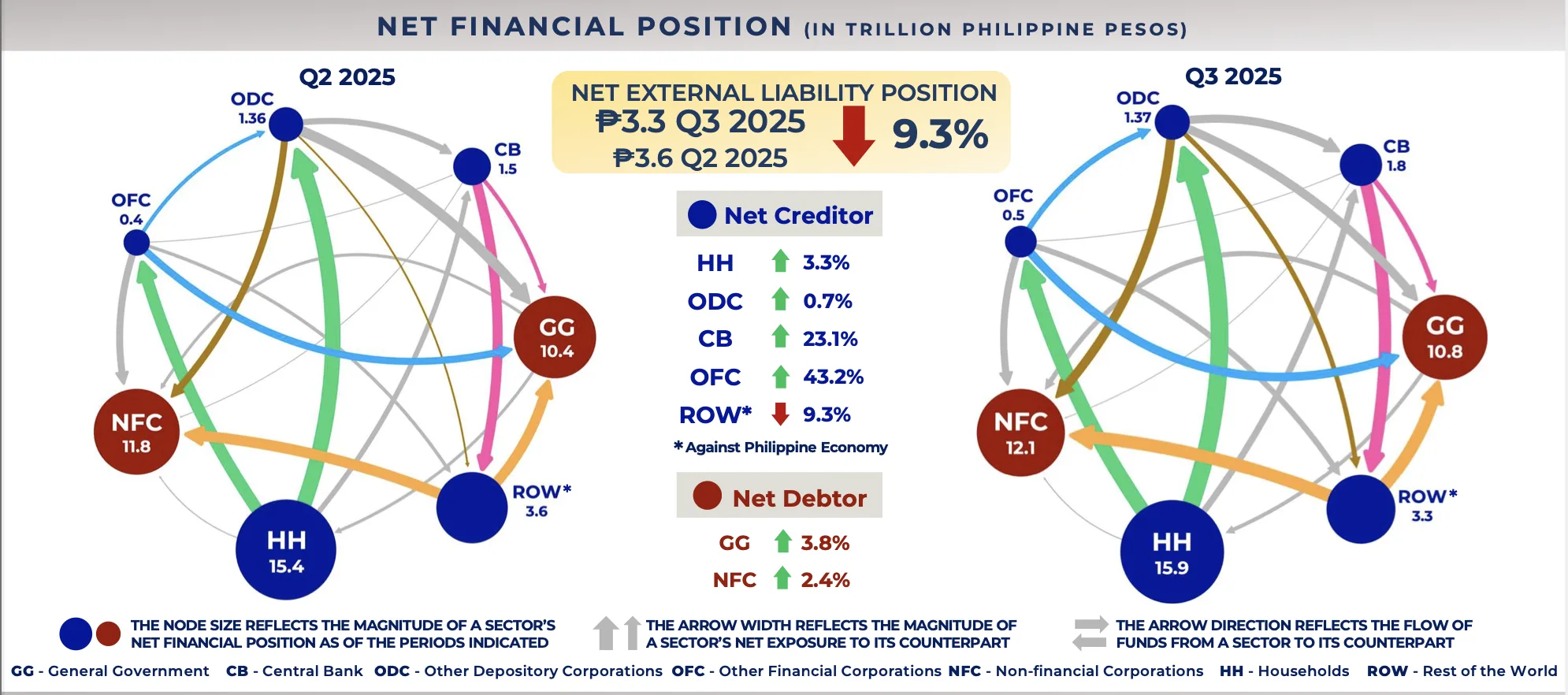
The Philippines’ net financial position (IMAGE CREDIT: BSP)
Preliminary BSP data indicate that net external liabilities fell by 9.3% quarter-on-quarter to ₱3.3 trillion in the third quarter of 2025, from ₱3.6 trillion in the previous quarter.
The decline was largely driven by increased investments of the central bank and other depository corporations in foreign debt instruments, strengthening their net creditor positions.
The BSP’s own balance sheet improved due to higher holdings of nonresident-issued securities and reduced deposit liabilities to the government. Similarly, banks benefited from increased external asset holdings and improved lending positions.
Government liabilities remain manageable
In contrast, the general government’s net debtor position widened, reflecting higher borrowing from nonresidents and increased holdings of government securities by foreign investors.
However, risks remain contained. Nearly 69% of government obligations are denominated in domestic currency, helping shield public finances from exchange rate volatility.
The BSP noted that government securities continue to serve as the primary funding instrument, underscoring sustained investor appetite for Philippine debt.
Balancing risks and resilience
The BSA framework, developed by the International Monetary Fund, provides a snapshot of the country’s financial linkages and vulnerabilities by examining outstanding assets and liabilities across sectors.
Taken together, the data suggest a nuanced picture: while external pressures are building due to global developments, the Philippines is entering this period from a relatively stronger financial footing.
Looking ahead, the BSP said maintaining stability will depend on managing external risks while addressing long-standing structural constraints that limit export competitiveness.
As global uncertainty persists, the country’s ability to balance resilience with reform will be key to sustaining external stability in the years ahead.